
Capillary and venous samples
- Collection
- Capillary: finger or heel prick
- What to know
- Small samples can be useful for initial testing, particularly in children.
- Follow-up distinction
- Lead on the skin can contaminate the sample and raise the apparent result.See reference 1
- Collection
- Venous: sample from a vein
- What to know
- Laboratory measurement of a properly collected blood sample.
- Follow-up distinction
- CDC uses venous testing to confirm elevated capillary findings in children.See reference 1
- Collection
- Other markers or specimens
- What to know
- A different blood marker, hair analysis or a urine result is not this measurement.
- Follow-up distinction
- Do not substitute another test’s interval for a whole-blood lead result.See reference 1,See reference 3,See reference 5
A reference value is not a line between safe and poisoned
CDC’s blood lead reference value for children is 3.5 µg/dL. It identifies children with a blood concentration higher than most children in the reference population, helping prioritise exposure reduction and follow-up. It is not a level below which lead is harmless; no safe blood lead level in children has been identified.See reference 1,See reference 2
Adult workplace surveillance values, professional recommendations and legal removal-from-exposure rules answer different questions. NIOSH presents several U.S. frameworks together. An occupational legal limit must not be presented as a universal health target, and local requirements can differ.See reference 3
Keep the unit attached
Reports commonly use micrograms per decilitre (µg/dL); some use micrograms per litre (µg/L). For the same analyte, 1 µg/dL equals 10 µg/L. Thus a fictional 2 µg/dL result is the same concentration as 20 µg/L, not a tenfold increase in exposure.See reference 1,See reference 3
A less-than sign or a laboratory reporting limit is also part of the result. Do not remove it when saving a report, or treat a value below the measuring limit as proof that no lead is present. Ask the laboratory how to compare reports with different limits or methods.See reference 5
The source history is part of interpreting the test
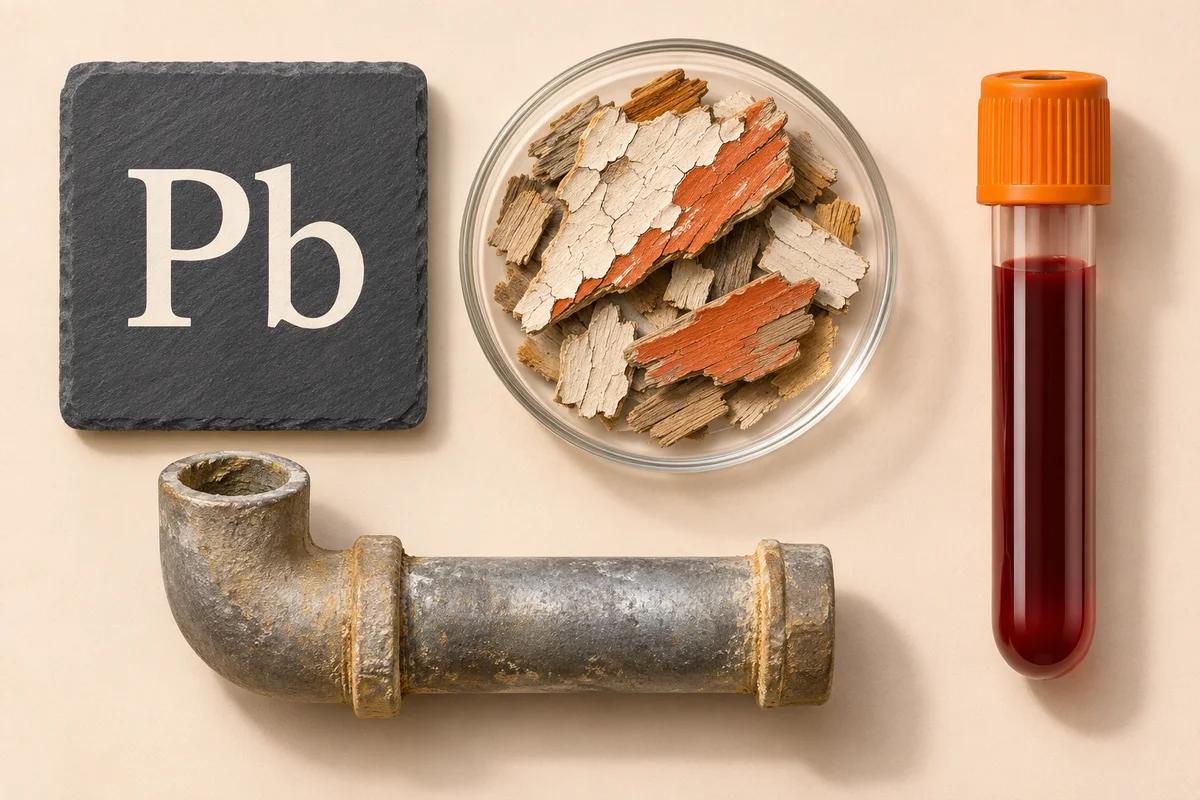
WHO identifies exposure through contaminated dust, soil, water and food, and through occupational processes such as battery recycling or work disturbing lead-containing materials. Children and pregnancy need particular attention. The artwork shows possible source contexts; it cannot identify whether a particular pipe or paint sample contains lead.See reference 4
Lead can accumulate in bone over time, and a blood measurement is not a complete inventory of all lead stored in the body. Bring work and hobby details, recent renovation or exposure events, previous blood results and pregnancy context to the professional responsible for follow-up.See reference 3,See reference 4
Confirmation and care depend on the full circumstances
If an initial capillary result is raised, ask whether confirmatory venous testing is needed and when. CDC’s child guidance links confirmation timing to the initial result; a clinician or public-health team should apply the relevant local plan. Do not choose a follow-up interval from another person’s result.See reference 1,See reference 2
Testing should lead to an appropriate exposure investigation and professional care where needed. This page does not recommend chelation, detox products or a supplement programme. Treatment decisions cannot be made from a reference flag alone.See reference 2,See reference 3,See reference 4
Common questions
Does being below 3.5 µg/dL mean there is no risk?
No. The CDC value is a population-based reference for children, not a safe exposure level. Ongoing exposure concerns still deserve discussion with a health or public-health professional.See reference 1,See reference 2
Can a finger-prick sample be falsely high?
Yes. Contamination during collection can raise a capillary result. That is one reason CDC calls for venous confirmation of elevated capillary findings in children.See reference 1
What should I save with the result?
Keep the date, exact unit and any less-than sign, sample type, laboratory, exposure history and previous results. Ask which local follow-up guidance applies to the person tested.See reference 1,See reference 3,See reference 5
Get the weekly longevity brief
The week's best longevity research in plain English. Free, every Tuesday.
See your blood results in context
If you already have blood test results, the paid LongevityMate app can help you view related markers together. It provides educational context, not a diagnosis or a replacement for your clinician.
Explore blood test analysisReferences
- 1. Testing for Lead Poisoning in Children
U.S. Centers for Disease Control and PreventionOfficial guidance
- 2. CDC Updates Blood Lead Reference Value
U.S. Centers for Disease Control and PreventionOfficial guidance
- 3. Blood Lead Level Guidance
CDC National Institute for Occupational Safety and HealthOfficial guidance
- 4. Lead poisoning
World Health OrganizationOfficial guidance
- 5. How to Understand Your Lab Results
MedlinePlus, U.S. National Library of MedicineOfficial guidance
Editorial transparency
- Published by
- LongevityMate Editorial
- Reviewed by
- Editorial evidence review (AI-assisted)
- Published
- Updated
Medical disclaimer
General education only. This guide does not diagnose a condition, interpret your personal result, choose treatment or recommend a medicine or supplement dose. A qualified health professional can interpret the full report in context.