
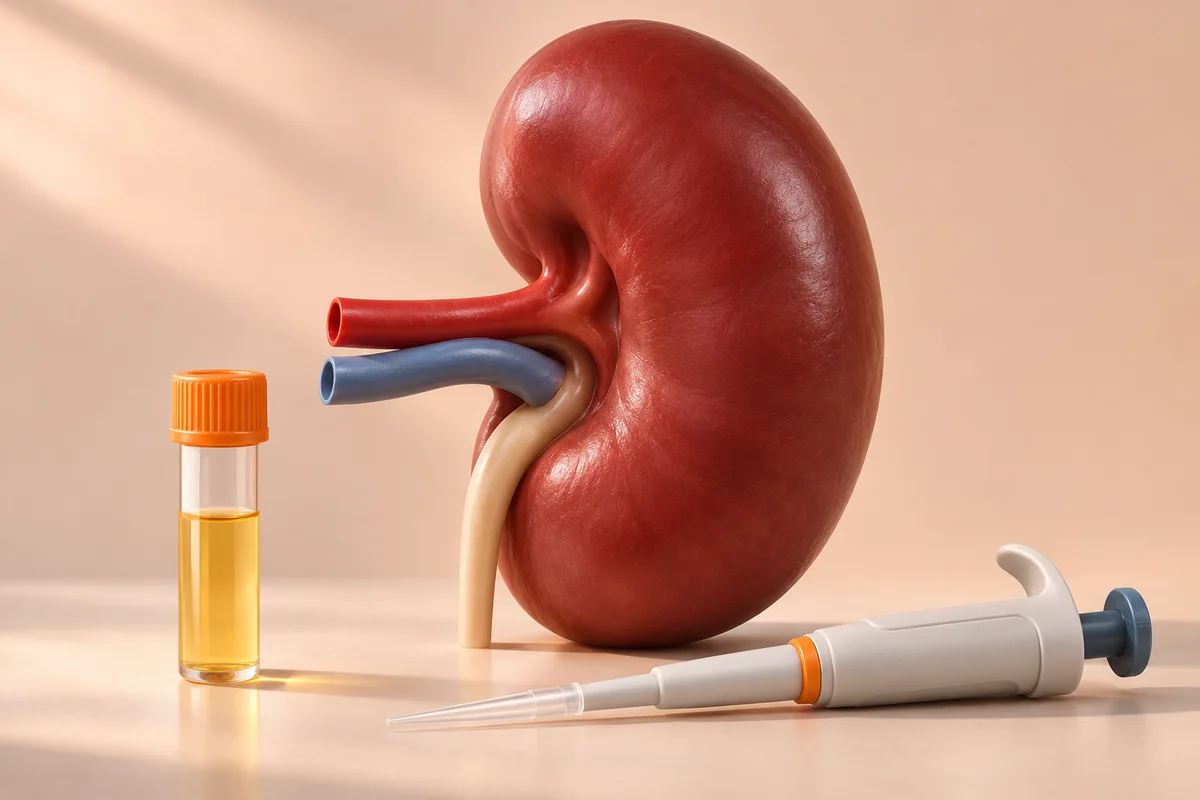
Two measurements with different units
- Test label
- Plasma renin activity, PRA
- What the result describes
- Activity assessed through the production of angiotensin I under assay conditions.
- Typical reporting distinction
- Often ng/mL/h: the hour is part of the measurement.See reference 2,See reference 5
- Test label
- Direct renin concentration, DRC
- What the result describes
- An assay of renin concentration.
- Typical reporting distinction
- May use mU/L or another method-specific concentration unit.See reference 2,See reference 3
- Test label
- Aldosterone-renin ratio, ARR
- What the result describes
- Aldosterone divided by the particular renin measurement used.
- Typical reporting distinction
- The denominator method and both units determine the numerical scale.See reference 2,See reference 3,See reference 4
Why a unit conversion cannot solve every difference
Changing litres to millilitres is ordinary unit arithmetic. Changing activity into direct concentration is different: the assays measure different properties. There is no universal conversion that makes any PRA result equivalent to any DRC result. Use the performing laboratory’s own method and interpretive guidance.See reference 2,See reference 3,See reference 5
A ratio from one method must not be compared with a cutoff developed for the other. ARUP publishes separate interpretive information for activity-based and direct-renin ratios. This guide explains the distinction; it does not supply a diagnostic ratio calculator.See reference 3
The conditions of collection are part of the result
Posture, time of day, recent diet, potassium and medicines can affect the renin-aldosterone assessment. Keep the collection position and any rest instructions with the report. A seated result and an older sample collected under different conditions may need a qualified comparison.See reference 1,See reference 2,See reference 3
The current Endocrine Society guideline describes interpreting aldosterone, renin and potassium together. It also recognises practical approaches when interfering medicines cannot safely be stopped. Do not invent a salt-loading plan, medicine washout or potassium correction yourself; the clinical team must set the preparation.See reference 4
What high or suppressed renin can tell you
A high or low renin value is a pattern clue, not a diagnosis. Medicines, fluid balance and diseases involving hormone or circulatory regulation can affect it. Clinicians generally consider the paired aldosterone, blood pressure, potassium, kidney function and testing circumstances.See reference 1,See reference 2
For example, primary aldosteronism involves aldosterone production that is relatively independent of its normal renin-related regulation, often with suppressed renin. That description does not mean every low renin result proves primary aldosteronism, or that a single ratio settles the diagnosis.See reference 4
Follow the performing laboratory’s instructions
Renin assays may have strict collection and transport requirements. Mayo’s plasma renin activity catalogue specifies a particular plasma specimen and rapid controlled handling. Those are instructions for trained collection staff, not a universal home sample procedure or proof that every DRC method uses identical handling.See reference 5
For follow-up, retain the method name, exact unit, interval, collection time and posture, paired aldosterone and potassium, and the medicine list. Ask whether the specimen and preparation were suitable before attributing a change to disease.See reference 2,See reference 3,See reference 5
Common questions
Can low renin alone explain my high blood pressure?
No. It must be read with aldosterone, potassium, medicines and the clinical assessment. Different conditions can produce overlapping patterns.See reference 1,See reference 2,See reference 4
Should I stop blood pressure tablets for the test?
Only the responsible clinician should decide. Medicines can affect interpretation, but stopping them can also be unsafe. Ask for instructions for your exact test and circumstances.See reference 1,See reference 4
Why did two laboratories give different-looking ratios?
Check whether one used activity and the other direct concentration, and compare both units. The laboratory’s assay-specific guidance is essential.See reference 2,See reference 3
Get the weekly longevity brief
The week's best longevity research in plain English. Free, every Tuesday.
See your blood results in context
If you already have blood test results, the paid LongevityMate app can help you view related markers together. It provides educational context, not a diagnosis or a replacement for your clinician.
Explore blood test analysisReferences
- 1. Renin Test
MedlinePlus, U.S. National Library of MedicineOfficial guidance
- 2. Primary Aldosteronism
ARUP ConsultOfficial guidance
- 3. Aldosterone-Renin Ratio
ARUP ConsultOfficial guidance
- 4. Primary Aldosteronism Clinical Practice Guideline
Endocrine SocietyGuideline
- 5. Renin Activity, Plasma
Mayo Clinic LaboratoriesOfficial guidance
Editorial transparency
- Published by
- LongevityMate Editorial
- Reviewed by
- Editorial evidence review (AI-assisted)
- Published
- Updated
Medical disclaimer
General education only. This guide does not diagnose a condition, interpret your personal result, choose treatment or recommend a medicine or supplement dose. A qualified health professional can interpret the full report in context.