
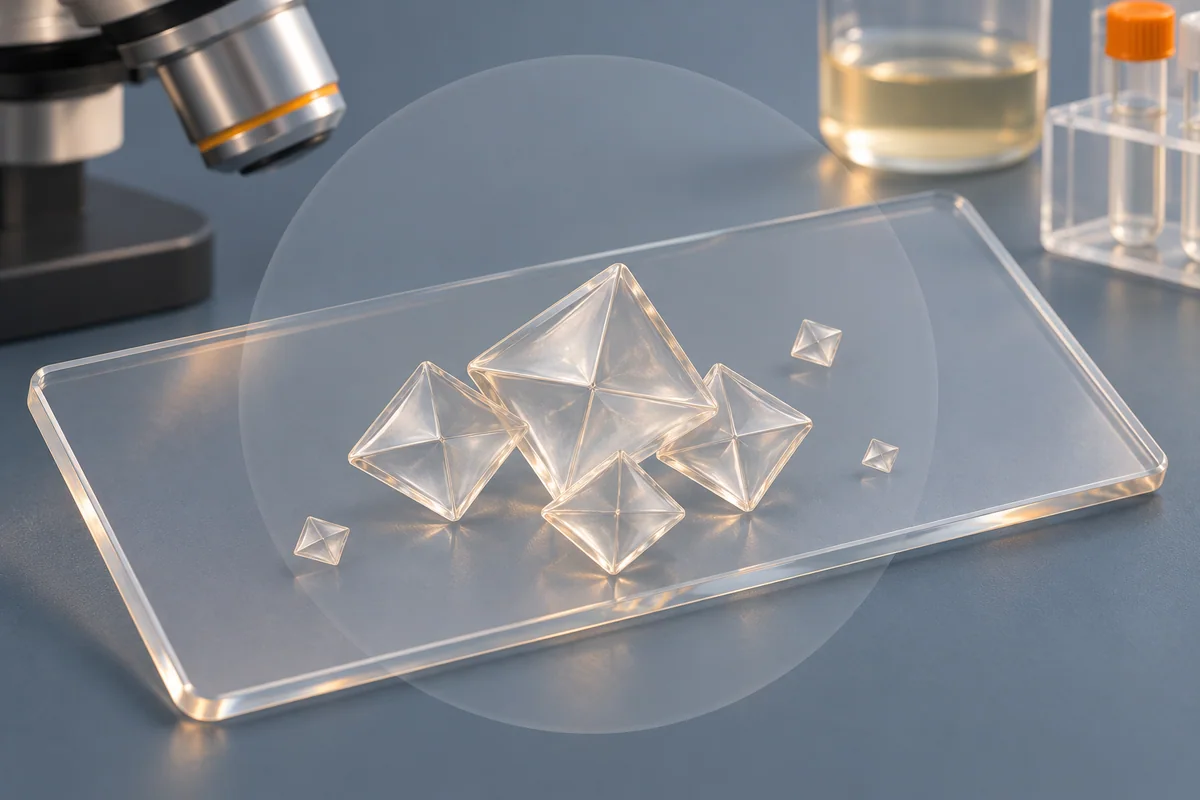
Microscopy looks for particles, not just a chemical-strip reaction
A urinalysis can include a visual inspection, chemical dipstick tests and examination of the sediment. Crystals belong to the particle examination. A pH or blood result on a strip is a different finding; it cannot identify a crystal species on its own.See reference 1,See reference 2
A laboratory may report a named crystal type, an amount or a descriptive category. Keep the exact wording and the laboratory comments. A category such as few or many is not a stone size, and a picture in this guide is not a way to classify a personal specimen.See reference 1,See reference 2
Read four parts of the report together
- Detail
- Crystal type
- Why it matters
- Different chemical substances can form different particles.
- Limit
- The word crystals alone leaves out the most useful distinction.See reference 1
- Detail
- Amount and reporting method
- Why it matters
- The laboratory describes what it detected in that specimen.
- Limit
- A category does not measure the size or number of stones in the body.See reference 1,See reference 3
- Detail
- Urine pH and other findings
- Why it matters
- Acidity and the rest of the urinalysis provide context.
- Limit
- pH alone does not identify a stone or choose a diet.See reference 2,See reference 4
- Detail
- Collection and handling
- Why it matters
- Cooling or delay can change what appears in the sample.
- Limit
- A changed specimen cannot be treated as a perfect record of the original urine.See reference 2
A named type is more informative than a blanket positive
Calcium oxalate, calcium phosphate, uric acid or urates, and struvite are examples discussed in patient guidance. Some crystal types can be associated with stone formation or other conditions, but their significance is not identical. The laboratory identification and the clinical question matter.See reference 1
Specialist stone evaluation may also consider less common crystals, medicines, family history and a previous stone analysis. The 2026 AUA guideline places urinalysis within a broader assessment rather than treating a single particle finding as the whole answer.See reference 4
Sample handling can create a misleading impression
The AAFP review notes that crystals can form when otherwise normal urine cools. Follow the performing laboratory’s collection, transport and storage instructions; do not improvise a home warming or preservation method. Tell the collection team about a long delay or uncertain storage.See reference 2
This does not mean every crystal report is an artefact. It means that the timing and condition of the specimen are relevant evidence. Ask whether those factors affect confidence in this particular result.See reference 2
A crystal report and a kidney-stone diagnosis are different
NIDDK describes stone diagnosis as a combination of medical history, examination, laboratory tests and, when appropriate, imaging. Urine testing can provide information about minerals and other abnormalities; imaging can show a stone and problems such as obstruction.See reference 3
That distinction works in both directions: seeing crystals does not tell you where a stone is or whether urine flow is blocked, and a specimen without reported crystals is not an imaging test that proves no stone exists.See reference 3
Useful questions for the clinician or laboratory
Bring the complete report and ask which crystal was identified, how it was reported, and whether sample handling could have affected it. Mention medicines and supplements rather than stopping them or changing an entire food group because of this result.See reference 2,See reference 4
For someone with an established stone history, a clinician may consider stone composition and a more detailed urine assessment. Those are individualized decisions. This guide does not choose fluid targets, a low-oxalate diet, a urine-pH target or a medicine from a crystal report.See reference 4
Common questions
Does finding crystals mean I definitely have a kidney stone?
No. Some small crystals occur without disease, and stone diagnosis can require other laboratory and imaging information.See reference 1,See reference 3
Can a stored sample look different from fresh urine?
Yes. Cooling can cause crystals to precipitate. The laboratory’s collection and handling instructions are therefore part of getting a meaningful result.See reference 2
Get the weekly longevity brief
The week's best longevity research in plain English. Free, every Tuesday.
See your blood results in context
If you already have blood test results, the paid LongevityMate app can help you view related markers together. It provides educational context, not a diagnosis or a replacement for your clinician.
Explore blood test analysisReferences
- 1. Crystals in Urine
MedlinePlus, U.S. National Library of MedicineOfficial guidance
- 2. Office-Based Urinalysis: A Comprehensive Review
Hitzeman, Greer and Carpio, American Family PhysicianEvidence review
- 3. Diagnosis of Kidney Stones
National Institute of Diabetes and Digestive and Kidney DiseasesOfficial guidance
- 4. Medical Management of Kidney Stones: AUA Guideline (2026), Part I
American Urological Association, Journal of UrologyGuideline
Editorial transparency
- Published by
- LongevityMate Editorial
- Reviewed by
- Editorial evidence review (AI-assisted)
- Published
- Updated
Medical disclaimer
General education only. AI-assisted editorial evidence review is not a qualified clinical assessment. This guide does not diagnose a condition, interpret a personal result, choose treatment or recommend a supplement dose. Discuss results, symptoms, medicines and supplements with a qualified health professional.