
Why a little urobilinogen can be expected
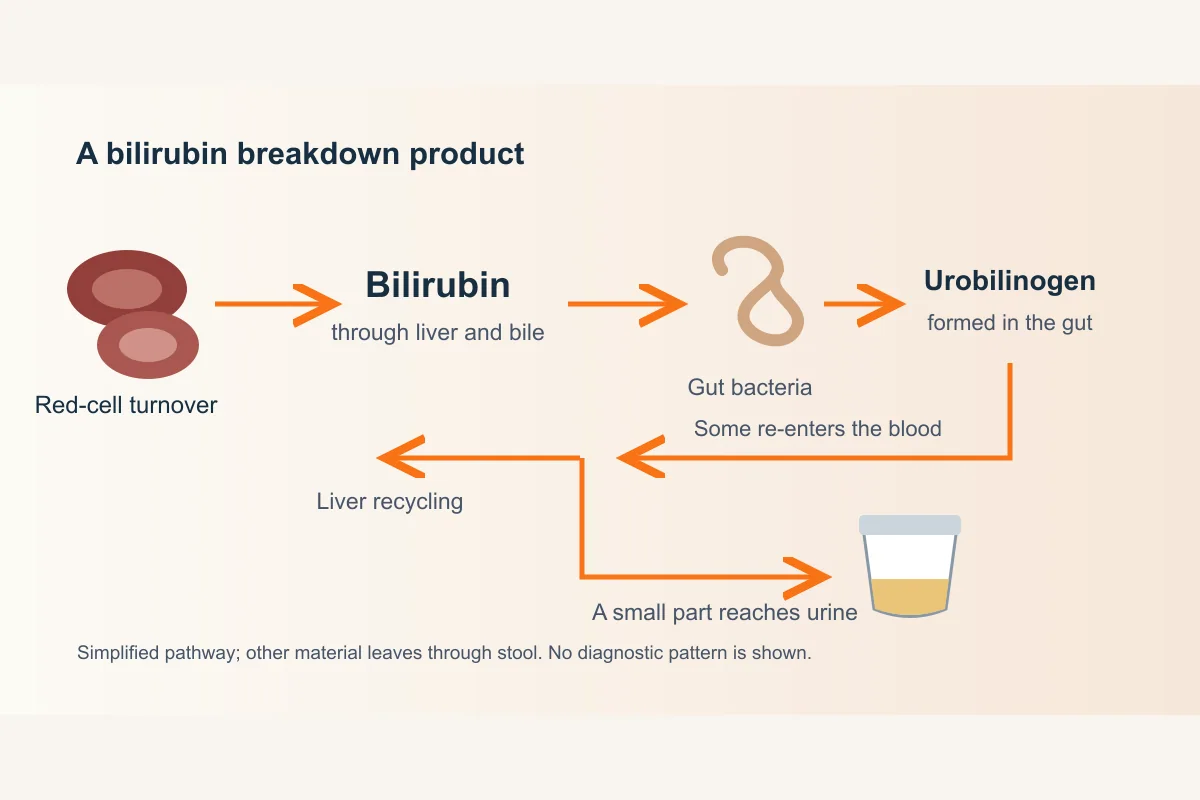
Bilirubin comes from normal red-cell turnover and reaches the intestine in bile. Gut bacteria produce urobilinogen; some leaves through stool and some is reabsorbed and recycled through the liver. A small amount reaches urine. The illustration simplifies this pathway and does not show a diagnostic pattern.See reference 1
Bilirubin and urobilinogen are different findings
- Finding
- Urine bilirubin
- What to keep separate
- A different reagent pad and chemical signal.
- Practical limit
- Its result cannot be substituted for urobilinogen.See reference 2
- Finding
- Urine urobilinogen
- What to keep separate
- A bilirubin-breakdown product that can be present in normal urine.
- Practical limit
- The amount alone does not identify a condition.See reference 1,See reference 2
- Finding
- The lowest strip category
- What to keep separate
- A method’s lower reporting band.
- Practical limit
- It may not establish complete absence.See reference 2
Why there is no single universal number to use
A strip may report a category or a nominal concentration; some reports use Ehrlich units per decilitre and others use micromoles per litre. Each colour band represents a range. Use the units and reference interval printed on your own report rather than comparing a bare number from a different method.See reference 2
An important limitation is easy to miss: the cited Siemens strip instructions state that this method cannot determine complete absence of urobilinogen. The lowest band therefore should not be converted into a claim of “none present.” That analytical limit matters before considering a possible cause of a low result.See reference 2
High and low results remain nonspecific
Higher results can occur with increased red-cell breakdown or liver problems. Little or no detected urobilinogen can be associated with impaired bile flow, but the clinical context and the method’s ability to detect low amounts matter. These are possibilities for assessment, not a chart that lets one urine value diagnose a blockage or anemia.See reference 1,See reference 2
The RCPA describes urine urobilinogen as unreliable as a guide to liver disease. Neither an unflagged result nor a paired bilirubin/urobilinogen pattern can replace a broader clinical assessment.See reference 3
Collection, light and interference matter
Follow the laboratory’s collection and return instructions. The manufacturer notes instability with room temperature and light exposure, as well as reagent-specific chemical interference. A delayed sample or an unusual colour reaction can change confidence in the reading.See reference 2
A clean-catch sample may be requested. Tell the collection team about medicines, supplements or problems collecting the specimen. Do not stop a medicine just to change a strip result.See reference 1
A useful way to discuss the report
Ask which method was used, whether the lowest band can distinguish absence, and whether the sample was suitable. Then ask how the rest of the urine report, blood tests and symptoms affect interpretation. This keeps an uncertain screening signal in its proper context.See reference 1,See reference 2,See reference 3
Common questions
Does “normal” urobilinogen prove that the liver is healthy?
No. This urine finding alone is not a reliable exclusion test for liver disease.See reference 3
Can I diagnose a bile-duct blockage from a low result?
No. A low signal has to be assessed with the test’s detection limits and other findings; the cited strip cannot determine complete absence.See reference 1,See reference 2
Get the weekly longevity brief
The week's best longevity research in plain English. Free, every Tuesday.
See your blood results in context
If you already have blood test results, the paid LongevityMate app can help you view related markers together. It provides educational context, not a diagnosis or a replacement for your clinician.
Explore blood test analysisReferences
- 1. Urobilinogen in Urine
MedlinePlus, U.S. National Library of MedicineOfficial guidance
- 2. Reagent strips for urinalysis: urobilinogen performance and limitations
Siemens Healthcare DiagnosticsOfficial guidance
- 3. Urine dipstick
Royal College of Pathologists of AustralasiaOfficial guidance
Editorial transparency
- Published by
- LongevityMate Editorial
- Review
- Editorial evidence review (AI-assisted)
- Published
- Updated
Medical disclaimer
General education only. AI-assisted editorial evidence review is not a qualified clinical assessment. This guide does not diagnose a condition, interpret a personal result, choose treatment or recommend a supplement dose. Discuss results, symptoms, medicines and supplements with a qualified health professional.