
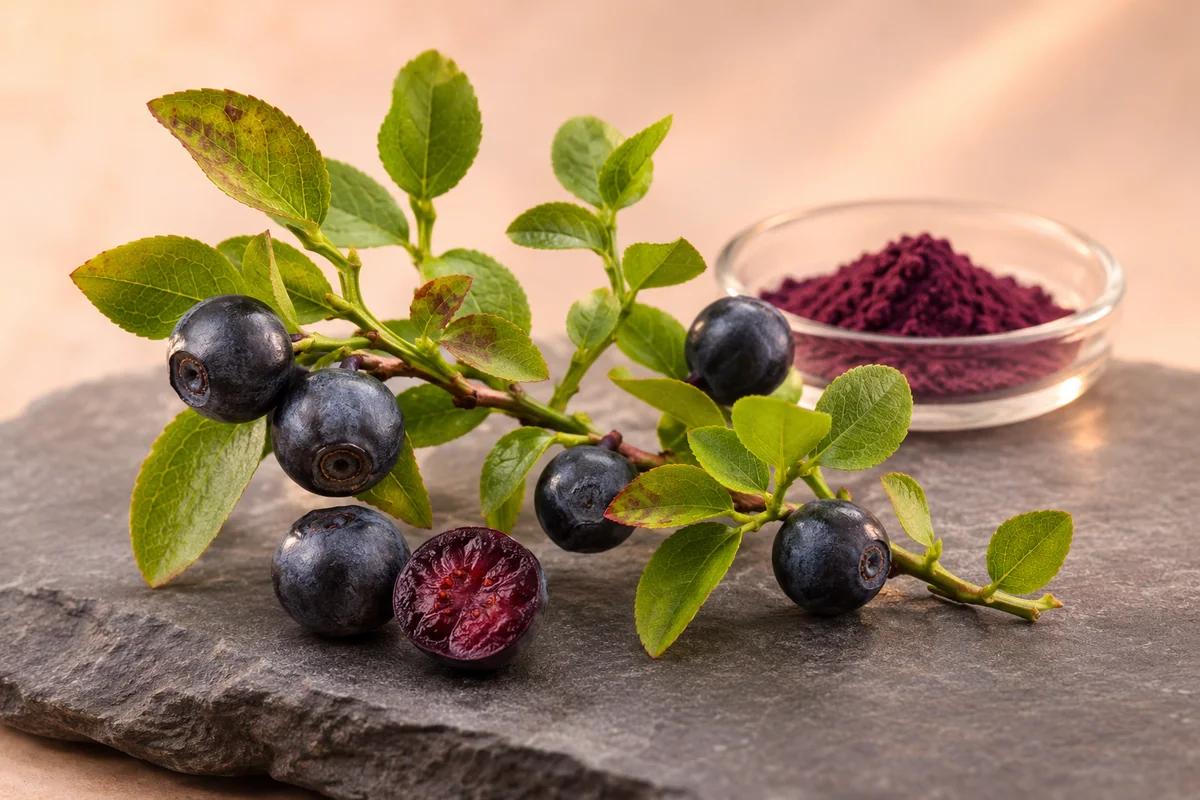
Fruit, leaves and an extract are different exposures
Bilberry resembles blueberry, but a result from a named bilberry extract cannot automatically be transferred to another berry, a mixed supplement or a different plant part. NCCIH discusses the fruit and leaves separately, including different safety limits.See reference 1
The later eye-fatigue trial used a standardized fruit extract with a defined anthocyanin composition. That product detail matters: the mass of an extract is not itself a measure of every compound inside it, and a bowl of berries is not the same research intervention.See reference 3
Separate night vision from screen-work findings
- Study and question
- Night vision, 2000: 15 men with good vision in a blinded crossover study.
- Studied exposure
- 160 mg extract three times daily for 21 days in each active period.
- Result and boundary
- No improvement in night visual acuity or contrast sensitivity versus placebo. A small study in this population, not every eye condition.See reference 2
- Study and question
- Screen-related focusing, published 2020: 109 adults completed the schedule; 97 entered the focusing analysis.
- Studied exposure
- A particular standardized extract, 240 mg/day for 12 weeks.
- Result and boundary
- Some objective focusing measurements after screen tasks improved. This was not a night-driving test, disease-prevention trial or demonstration of restored eyesight.See reference 3
An objective measurement can still be a narrow outcome
In the 2020 study, researchers measured small fluctuations in the eye’s focusing response after a controlled screen task. That gives information about the tested measurement under those conditions. It does not establish less eye disease, better vision in darkness or a benefit for every person with tired eyes.See reference 3
The trial was funded by Omnica, and two authors reported employment there. This does not by itself negate the finding, but makes the exact formulation, analysis and need for confirmation relevant when comparing the paper with a broad product claim.See reference 3
Why the overall evidence remains uncertain
NCCIH says that bilberry has not been clearly shown helpful for a health condition and notes weaknesses in much of the human research. The lack of a confirmed broad benefit is compatible with a positive, narrower laboratory finding; the two statements concern different levels of evidence.See reference 1,See reference 3
The negative night-vision study is also not proof that no preparation could ever have an effect. It is a reason to avoid presenting the popular night-vision claim as established. New research would need to specify the extract, population and meaningful outcome.See reference 2
Short-term tolerability does not settle long-term suitability
NCCIH distinguishes bilberry fruit in food amounts from concentrated products and warns that high or prolonged exposure to the leaves may be unsafe. It also advises discussing herbal products with a health professional when medicines are used. Do not assume a leaf product inherits a fruit-extract safety finding. NCCIH says there is little safety information for bilberry above usual food amounts during pregnancy or breastfeeding.See reference 1
The eye-fatigue trial did not identify adverse events judged related to the test food during its short study. That is limited reassurance for the selected participants, not a guarantee about rare harms, higher amounts, years of use or combinations with medicines.See reference 3
LactMed reports a lack of adequate information about components entering breast milk and about safety in nursing mothers or infants. A food-history argument cannot fill that evidence gap for concentrated supplements.See reference 4
A useful product-and-evidence check
Compare the Latin name, fruit versus leaf, extract amount, standardization and other ingredients with the actual study. Then compare the promised outcome: a claim about night vision cannot be supported only by a screen-task focusing measurement.See reference 1,See reference 2,See reference 3
The study amounts above describe research, not a recommended dose. Persistent vision or eye symptoms need an appropriate eye assessment, and a supplement should not be used to postpone it. This guide does not diagnose a cause or replace prescribed eye care.See reference 1
Common questions
Has bilberry been proved to improve night vision?
The controlled study summarized here did not show better night visual acuity or contrast sensitivity, and NCCIH does not consider the claim established.See reference 1,See reference 2
Are bilberry leaves interchangeable with fruit extract?
No. Plant part and preparation matter, and NCCIH gives specific safety cautions for high or prolonged leaf use.See reference 1
Get the weekly longevity brief
The week's best longevity research in plain English. Free, every Tuesday.
References
- 1. Bilberry: Usefulness and Safety
National Center for Complementary and Integrative HealthOfficial guidance
- 2. The effect of bilberry nutritional supplementation on night visual acuity and contrast sensitivity
Muth, Laurent and Jasper, Alternative Medicine ReviewRandomized trial
- 3. A 12-Week-Long Intake of Bilberry Extract Improved Objective Findings of Ciliary Muscle Contraction of the Eye
Kosehira and colleagues, NutrientsRandomized trial
- 4. Bilberry
Drugs and Lactation Database (LactMed), National Library of MedicineOfficial guidance
Editorial transparency
- Published by
- LongevityMate Editorial
- Reviewed by
- Editorial evidence review (AI-assisted)
- Published
- Updated
Medical disclaimer
General education only. AI-assisted editorial evidence review is not a qualified clinical assessment. This guide does not diagnose a condition, interpret a personal result, choose treatment or recommend a supplement dose. Discuss results, symptoms, medicines and supplements with a qualified health professional.