
The short answer
GLA content is not proof of a clinical benefit
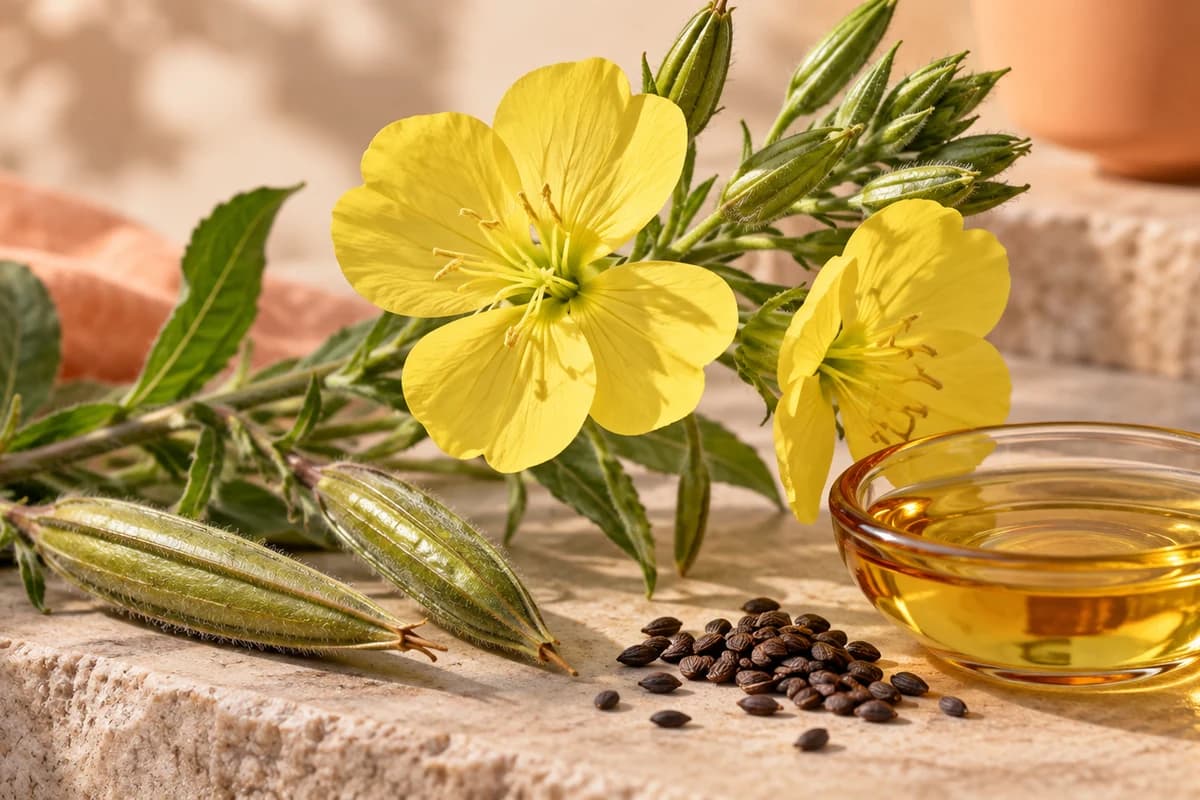
Evening primrose oil is extracted from Oenothera biennis seeds and contains gamma-linolenic acid, or GLA, an omega-6 fatty acid. Oral eczema studies have not shown benefit over placebo. Claims for other uses need their own evidence; this guide does not recommend a dose.See reference 1,See reference 2
Read the oil amount and GLA amount separately
A label can name the oil, a constituent such as GLA, or a blend. Record exactly what each amount refers to and whether it is per capsule or per serving. The total oil amount and the GLA amount describe different things; do not treat the two numbers as interchangeable.See reference 1,See reference 3
For a hypothetical label that states both amounts, compare the named ingredient before comparing the number. A larger oil figure does not automatically establish more GLA, and neither number alone establishes a benefit. This is label-reading logic, not a supplement prescription.See reference 1,See reference 3
What outcome-specific evidence shows
- Claim
- Oral treatment for eczema
- Evidence and boundary
- The 2013 Cochrane review included 19 evening primrose oil trials and found no significant advantage over placebo. Its search ended in August 2012.See reference 2
- Claim
- Breast pain
- Evidence and boundary
- NCCIH reports that evening primrose oil is probably no more effective than placebo.See reference 1
- Claim
- PMS, menopause or other promoted uses
- Evidence and boundary
- Evidence is insufficient to support broad benefit claims. One advertised use cannot validate another.See reference 1
- Claim
- A topical skin product
- Evidence and boundary
- The oral eczema findings concern swallowed oil. They do not establish that a topical preparation works.See reference 2
Keep the intervention and outcome together
Cochrane examined 27 studies with 1,596 adults and children across evening primrose and borage oil combined; that is not the participant count for evening primrose alone. The review looked at eczema symptoms, with quality-of-life data in only two evening primrose trials. Short-term tolerability does not settle long-term safety.See reference 2
When reading a product claim, identify the route, ingredient and outcome in its cited study. “Contains GLA” describes composition. “Improves eczema” describes an effect. Evidence for the first statement cannot substitute for evidence for the second.See reference 1,See reference 2
Safety needs more than the word “natural”
Stomach pain, nausea and diarrhoea can occur. Medicines may interact with the oil. Pregnancy and breastfeeding evidence is inconclusive, and use in children is less understood. Studies around labour are inconsistent; they do not establish a safe self-directed method.See reference 1
Quality seals can address manufacturing or ingredient checks, but do not guarantee safety or effectiveness. Take the full label and medicine list to a qualified professional if considering use, particularly during pregnancy or breastfeeding.See reference 1,See reference 3
What to check next
- The oil name, any stated GLA amount, serving size and other ingredients.See reference 1,See reference 3
- Whether the cited study used oral or topical oil and measured the same claimed outcome.See reference 2
- Medicine interactions and pregnancy, breastfeeding or child-use uncertainties.See reference 1
Common questions
Is evening primrose oil the same as GLA?
No. The oil contains GLA among other fatty acids. Read which substance an amount on the label describes.See reference 1,See reference 3
Is it proven to treat eczema when swallowed?
The Cochrane review found no advantage over placebo, and NCCIH’s summary does not support oral use for eczema.See reference 1,See reference 2
Does a quality seal prove it works?
No. Product quality testing and clinical effectiveness answer different questions.See reference 3
References
- 1. Evening Primrose Oil: Usefulness and Safety
National Center for Complementary and Integrative HealthOfficial guidance
- 2. Oral evening primrose oil and borage oil for eczema
CochraneSystematic review
- 3. Dietary Supplements: What You Need To Know
NIH Office of Dietary SupplementsOfficial guidance
Editorial transparency
- Published by
- LongevityMate Editorial
- Published
- Updated
Medical disclaimer
General education only. This guide does not diagnose a condition, choose treatment or recommend a supplement dose. Discuss your own result, symptoms, medicines or product use with a qualified health professional.