
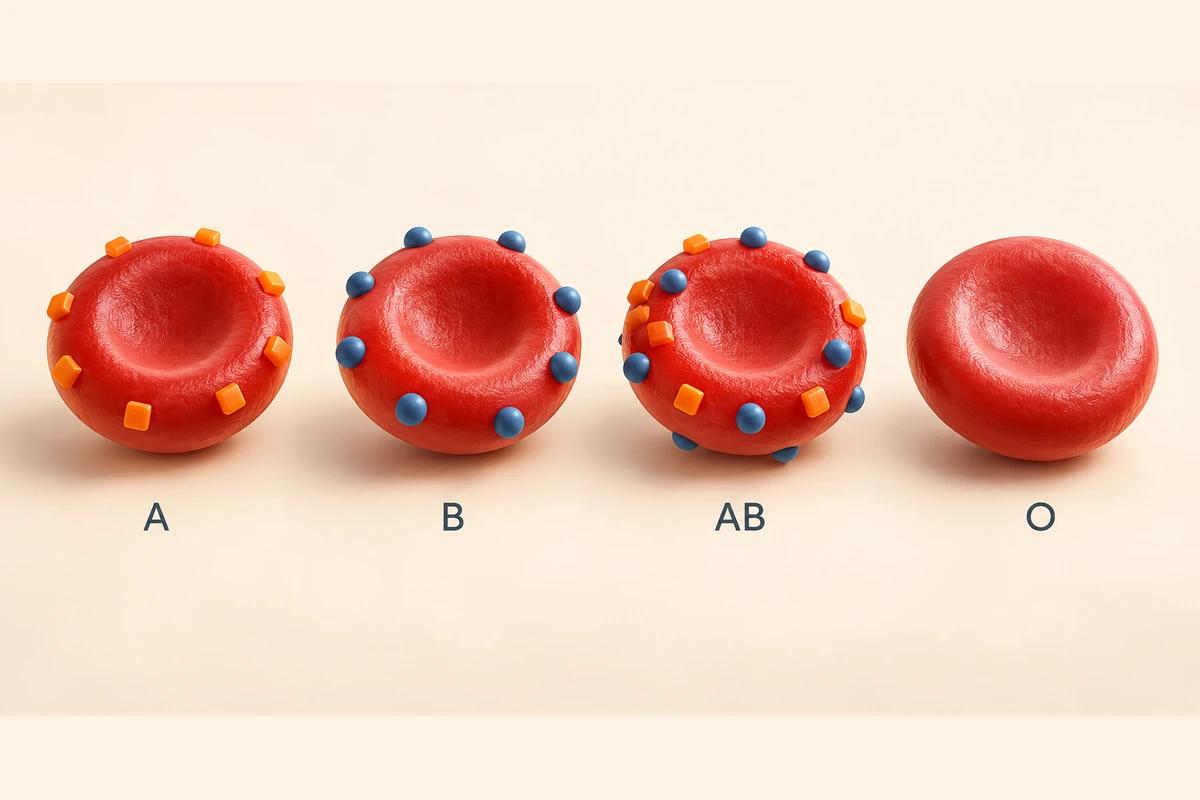
What A, B, AB and O describe
- ABO group
- A
- A/B markers on red cells
- A
- Usual anti-A/anti-B antibodies in plasma
- Anti-BSee reference 2
- ABO group
- B
- A/B markers on red cells
- B
- Usual anti-A/anti-B antibodies in plasma
- Anti-ASee reference 2
- ABO group
- AB
- A/B markers on red cells
- A and B
- Usual anti-A/anti-B antibodies in plasma
- Neither anti-A nor anti-BSee reference 2
- ABO group
- O
- A/B markers on red cells
- Neither A nor B
- Usual anti-A/anti-B antibodies in plasma
- Anti-A and anti-BSee reference 2
Group O does not mean a cell has no markers
A and B are only part of the blood-group picture. Group O lacks those two markers, but its red cells still have other blood-group features. The illustration uses coloured symbols for A and B only; their shapes are conceptual, not a microscopic photograph or a compatibility test.See reference 2
How the laboratory checks the group
Typing tests how red cells react with reagents directed against A and B. A separate check of plasma against known cells helps confirm the pattern. RhD testing asks whether the D marker is present. A plus or minus sign belongs to RhD, rather than meaning more or less of the ABO group.See reference 1
Compatibility depends on the blood component
Red-cell transfusion and plasma transfusion raise different matching questions: one supplies cells with markers, while the other supplies plasma containing antibodies. Their ABO matching rules therefore differ. A simplified label such as universal donor should not be treated as permission to use every blood component.See reference 2
An old blood-group record is not transfusion clearance
Before transfusion, laboratories normally establish ABO and RhD, screen for clinically significant antibodies, and perform the appropriate compatibility check, called a crossmatch. Antibodies beyond anti-A and anti-B can matter. Correct patient and sample identification are essential parts of this process.See reference 3
The required sample and its validity depend on circumstances, including recent pregnancy or transfusion and local procedures. Share any known blood group or previous antibody finding with the care team; they determine what testing is needed. This page does not choose a component or authorize transfusion.See reference 3
Keep the useful details
- Keep the complete ABO/Rh label, collection date and original laboratory report.See reference 4
- Keep any antibody-screen information separate from the ABO label.See reference 3
- Use the clinical reason for testing as context; a blood-group category is not an improvement target.See reference 4
Common questions
Is O negative automatically compatible in every situation?
No. The component, other antibodies and the clinical situation matter. A care team uses blood-bank testing and emergency protocols to select blood.See reference 3
Does a positive sign mean an abnormal result?
No. In an ABO/Rh label, positive means the RhD marker was detected. It is not a high-result flag.See reference 1
Can ABO typing replace a full blood count?
No. ABO is a group classification. Other blood tests measure different things; keep their names, results and purposes separate.See reference 4
Get the weekly longevity brief
The week's best longevity research in plain English. Free, every Tuesday.
See your blood results in context
If you already have blood test results, the paid LongevityMate app can help you view related markers together. It provides educational context, not a diagnosis or a replacement for your clinician.
Explore blood test analysisReferences
- 1. Blood groups
NHSOfficial guidance
- 2. Matching blood groups
Australian Red Cross LifebloodOfficial guidance
- 3. Pretransfusion specimen collection and compatibility testing
Australian Red Cross LifebloodOfficial guidance
- 4. How to understand your lab results
MedlinePlusOfficial guidance
Editorial transparency
- Published by
- LongevityMate Editorial
- Published
- Updated
Medical disclaimer
General education only. This guide does not diagnose a condition, interpret your personal result, choose a treatment or recommend a supplement dose. Discuss testing, symptoms, medicines and supplements with a qualified health professional.