
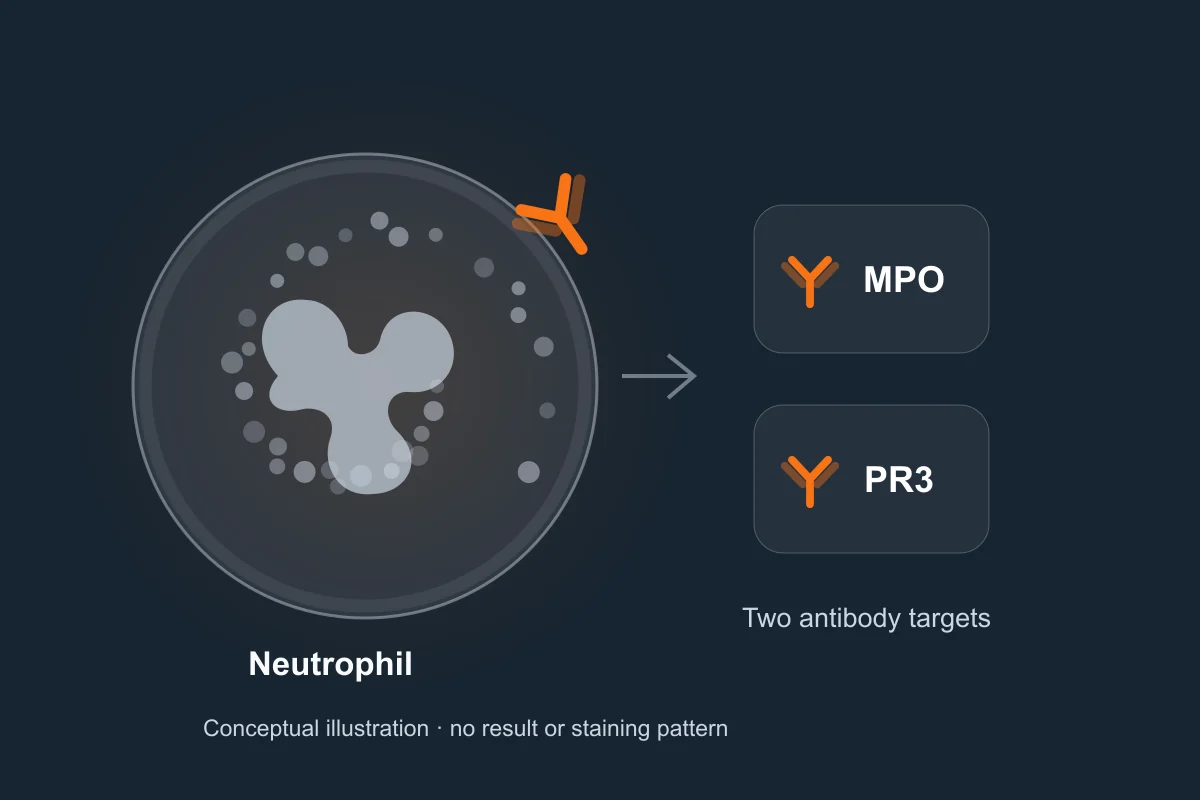
Read the target and method separately
- Report term
- MPO-ANCA
- What it describes
- Antibodies directed against myeloperoxidaseSee reference 4
- Report term
- PR3-ANCA
- What it describes
- Antibodies directed against proteinase 3See reference 4
- Report term
- c-ANCA · p-ANCA
- What it describes
- Cytoplasmic or perinuclear staining seen by indirect immunofluorescenceSee reference 2
- Report term
- ANCA screen
- What it describes
- A panel name: check which methods and targets the laboratory actually usedSee reference 2,See reference 4
A staining pattern is not an exact synonym for a target
PR3 antibodies are often associated with a cytoplasmic pattern, while MPO antibodies are often associated with a perinuclear pattern. These are associations, rather than interchangeable test names. Other reactivities and method differences can complicate a pattern result.See reference 2
Modern high-quality MPO and PR3 immunoassays can be used as the first test when investigating suspected GPA or MPA; an immunofluorescence screen is not categorically required first. That consensus applies to a defined clinical question, not general population screening.See reference 2
Positive does not mean that vasculitis has been diagnosed
GPA and MPA are forms of ANCA-associated vasculitis, meaning inflammation of blood vessels. Clinicians combine antibody findings with the illness history, examination and evidence from affected organs. EULAR describes ANCA testing and, when appropriate, biopsy as tools that assist diagnosis.See reference 3
ANCA can also be encountered outside those conditions. MedlinePlus describes its use in some inflammatory bowel disease assessments. The same positive label therefore cannot be turned into a disease name without knowing why the test was requested.See reference 1
Negative does not exclude every relevant condition
The EULAR update notes that some people with ANCA-associated vasculitis are ANCA-negative. When clinical suspicion remains high, clinicians may consider another assay or immunofluorescence as part of further assessment. A negative screen does not overrule organ findings or explain persistent symptoms.See reference 3
Keep the laboratory’s scale attached to the number
An antibody concentration, assay index and immunofluorescence titre are different report formats. North West London Pathology, for example, reports MPO and PR3 using an assay-specific unit and interpretive bands. Those local bands are not a universal scale for every laboratory or method.See reference 4
Save the full report, method, units and reference information when comparing results. A numerical change alone is not a self-directed treatment instruction. The purpose of repeat testing belongs within the treating team’s assessment.See reference 3,See reference 4
Preparation and the wider panel
ANCA usually requires a blood sample without special preparation, but other tests taken at the same visit may have instructions. Tell the testing team what medicines and supplements you use and follow their collection advice. This page does not advise a medicine washout.See reference 1
Keep the useful details
- Ask which target and method produced the result.See reference 2,See reference 4
- Separate a laboratory association from a diagnosis.See reference 1,See reference 3
- Keep antibody trends within the clinical assessment.See reference 3
Common questions
Is p-ANCA the same as MPO-ANCA?
No. The first is a staining pattern; the second identifies an antibody target. They are often associated, but are not exact synonyms.See reference 2
Can vasculitis occur with a negative ANCA test?
Yes. EULAR describes ANCA-negative disease; the clinical findings and further assessment still matter.See reference 3
Does everyone need immunofluorescence before MPO or PR3 testing?
No. The international consensus permits high-quality target-specific immunoassays as primary tests for suspected GPA or MPA.See reference 2
Get the weekly longevity brief
The week's best longevity research in plain English. Free, every Tuesday.
See your blood results in context
If you already have blood test results, the paid LongevityMate app can help you view related markers together. It provides educational context, not a diagnosis or a replacement for your clinician.
Explore blood test analysisReferences
- 1. Antineutrophil cytoplasmic antibodies (ANCA) test
MedlinePlus, U.S. National Library of MedicineOfficial guidance
- 2. Revised 2017 international consensus on testing of ANCAs in GPA and MPA
Bossuyt and colleagues, Nature Reviews Rheumatology; 2017Guideline
- 3. EULAR recommendations for the management of ANCA-associated vasculitis: 2022 update
Hellmich and colleagues; online 2023, journal issue 2024Guideline
- 4. ANCA: MPO, PR3 and ANCA IIF
North West London Pathology, NHSOfficial guidance
Editorial transparency
- Published by
- LongevityMate Editorial
- Review
- Editorial evidence review (AI-assisted)
- Published
- Updated
Medical disclaimer
General education only. AI-assisted editorial evidence review is not a qualified clinical assessment. This guide does not diagnose a condition, interpret a personal result, choose treatment or recommend a supplement dose. Discuss testing, symptoms, medicines and supplements with a qualified health professional.