Quick answer
What does a cystatin C result mean?
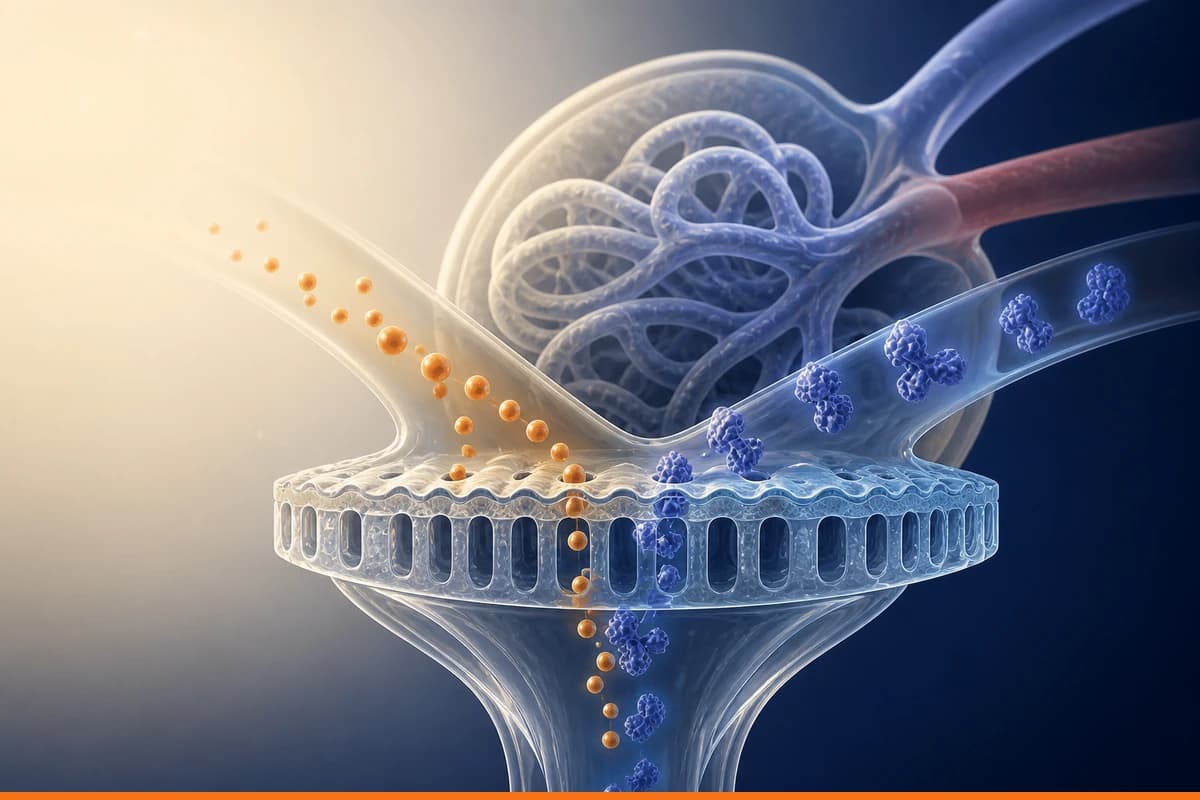
Cystatin C is a small protein filtered from blood by the kidneys. A higher concentration often goes with lower filtration, but the raw number is not interpreted by itself. Laboratories use cystatin C, usually together with creatinine, age and sex, to calculate an estimated glomerular filtration rate (eGFR). The combined creatinine-cystatin C estimate is generally more accurate than either marker alone. Use the reporting laboratory's range and equation, then read the result with previous eGFR values, urine albumin, medicines and the clinical reason for testing.See reference 1,See reference 2,See reference 3,See reference 4
The essentials in eight points
- Cystatin C is measured in blood; eGFRcys and eGFRcr-cys are calculated estimates, not direct filtration measurements.See reference 1,See reference 2,See reference 4
- KDIGO recommends creatinine-based eGFR first and combined creatinine-cystatin C eGFR when cystatin C is available and a more accurate estimate is appropriate.See reference 1
- The combined equation is especially useful near a treatment, referral or diagnostic threshold, or when creatinine may be misleading.See reference 1,See reference 2
- Low or unusually high muscle mass affects creatinine more than cystatin C, so the two-marker estimate can reduce one source of error.See reference 1,See reference 2,See reference 4
- Systemic glucocorticoids, untreated thyroid dysfunction, inflammation and adiposity can raise cystatin C independently of filtration.See reference 3,See reference 4,See reference 5
- A single eGFR below 60 does not by itself establish chronic kidney disease; persistence or other evidence of kidney damage matters.See reference 1,See reference 2
- Urine albumin-creatinine ratio adds a different risk signal and should not be replaced by cystatin C.See reference 1,See reference 2
- Trends are usually more informative than small changes between isolated results.See reference 1,See reference 2
Cystatin C, eGFRcys and combined eGFR are different outputs
| Report item | What it is | How to use it |
|---|---|---|
| Cystatin C, usually mg/L | The measured protein concentration | Compare with that laboratory's interval and assay; KDIGO advises reporting to two decimals.See reference 1,See reference 4 |
| eGFRcys, mL/min/1.73 m² | An equation based mainly on cystatin C, age and sex | Useful when creatinine has important non-kidney limitations, but cystatin C also has non-kidney determinants.See reference 1,See reference 2,See reference 3 |
| eGFRcr-cys, mL/min/1.73 m² | A combined equation using creatinine and cystatin C | Generally the most accurate of the three common estimating approaches when both results are valid.See reference 1,See reference 2 |
| Measured GFR | A specialist reference procedure using an external filtration marker | Considered when an exact answer is important and estimating equations remain unreliable.See reference 1,See reference 2 |
When cystatin C can add useful information
| Situation | Why creatinine may be uncertain | What cystatin C adds |
|---|---|---|
| Low muscle mass, frailty, amputation or neuromuscular disease | Less creatinine production can make filtration look better than it is | A marker less dependent on muscle can improve a combined estimate.See reference 1,See reference 2,See reference 4 |
| Very muscular build or creatine use | More creatinine production can make filtration look lower | Discordance can show that one-marker eGFR deserves review.See reference 1,See reference 2 |
| A result near a medicine, imaging, donation or referral threshold | Normal equation error may change the decision | The combined estimate is more accurate on average and may reduce misclassification.See reference 1,See reference 2 |
| Creatinine result does not fit the clinical picture | Diet, medicines, secretion or recent illness may contribute | A same-sample cystatin C and creatinine pair helps compare independent limitations.See reference 1,See reference 2,See reference 3 |
| Chronic kidney disease risk assessment | Filtration is only one part of kidney risk | Use the refined eGFR together with urine albumin, cause and trend.See reference 1,See reference 2 |
eGFR categories are not a diagnosis on their own
| KDIGO category | eGFR (mL/min/1.73 m²) | Interpretation boundary |
|---|---|---|
| G1 | 90 or higher | Normal or high filtration; CKD requires another marker of kidney damage.See reference 1 |
| G2 | 60 to 89 | Mildly decreased; not CKD without persistent kidney damage.See reference 1 |
| G3a | 45 to 59 | Mildly to moderately decreased; confirm chronicity and use urine albumin for risk.See reference 1,See reference 2 |
| G3b | 30 to 44 | Moderately to severely decreased; medicine dosing and complications need review.See reference 1 |
| G4 | 15 to 29 | Severely decreased; specialist planning is commonly needed.See reference 1 |
| G5 | Below 15 | Kidney failure category; symptoms, trajectory and replacement planning determine care.See reference 1 |
What if creatinine and cystatin C disagree?
Discordance is information, not proof that one result is wrong. Review muscle mass, diet, creatine, medicines that affect creatinine secretion, systemic glucocorticoids, thyroid status, inflammation, body composition and whether both samples were collected together.See reference 1,See reference 2,See reference 3,See reference 5
The combined eGFR often gives the most dependable estimate because the non-kidney influences on creatinine and cystatin C differ. When the decision is high stakes and the estimates remain implausible, a clinician may use measured GFR rather than choosing the preferred-looking number.See reference 1,See reference 2
A sensible follow-up sequence
| Step | Why it helps | What not to assume |
|---|---|---|
| Verify units, assay range and equation | Prevents comparing a raw concentration with an eGFR or another laboratory's method | There is no universal cystatin C number that diagnoses CKD.See reference 1,See reference 4 |
| Pair it with a same-sample creatinine | Allows the validated combined equation and a fair discordance check | Do not combine results collected during different clinical states.See reference 1 |
| Add urine albumin-creatinine ratio | Shows kidney damage and improves risk classification | A reassuring eGFR does not exclude albuminuria.See reference 1,See reference 2 |
| Repeat an unexpected result after reversible factors are reviewed | Tests chronicity and reduces overreaction to short-term variation | A repeat is not a reason to delay care when the person is acutely unwell.See reference 1,See reference 2 |
| Define the decision the estimate will change | Determines whether combined eGFR or measured GFR is worth pursuing | More testing is not automatically better without a clinical question.See reference 1,See reference 2 |
Treat symptoms and rapid change as the urgent signal
A cystatin C result alone is not an emergency label. Seek urgent care for markedly reduced urine, severe breathlessness, new confusion, fainting, persistent vomiting, rapidly worsening swelling, chest symptoms, or severe illness with a sudden kidney-function change. Do not wait for a routine repeat test when symptoms are serious.See reference 1,See reference 2
Frequently asked questions
Is cystatin C better than creatinine?
Neither is universally better alone. Their non-kidney limitations differ, and the combined creatinine-cystatin C equation is generally more accurate when both measurements are valid.See reference 1,See reference 2,See reference 3
What is a normal cystatin C level?
Use the interval printed by the reporting laboratory. Assays and populations differ, and clinicians usually focus on the calculated eGFR and context rather than a universal raw cutoff.See reference 1,See reference 4
Can steroids raise cystatin C?
Yes. Systemic glucocorticoids can raise cystatin C independently of measured filtration, so the medicine and dose should be part of interpretation.See reference 3,See reference 5
Does cystatin C replace a urine test?
No. Cystatin C helps estimate filtration. Urine albumin detects a different sign of kidney damage and adds important risk information.See reference 1,See reference 2
Can one low eGFR diagnose chronic kidney disease?
Usually not. CKD requires persistence for at least three months or another persistent marker of kidney damage, unless the clinical situation already establishes chronic disease.See reference 1
Why did my eGFRcr-cys land between the two separate estimates?
The combined equation integrates both markers and their different sources of error. It may fall between them, but not always; use the laboratory calculation rather than averaging the numbers yourself.See reference 1,See reference 2
References
- 1. KDIGO 2024 Clinical Practice Guideline for the Evaluation and Management of Chronic Kidney Disease
Kidney Disease: Improving Global OutcomesGuideline
- 2. eGFR Equations for Adults
National Institute of Diabetes and Digestive and Kidney DiseasesOfficial guidance
- 3. Clinical Measurements and eGFR Accuracy
National Institute of Diabetes and Digestive and Kidney DiseasesOfficial guidance
- 4. Cystatin C
National Kidney FoundationOfficial guidance
- 5. Medication effects on cystatin C independent of measured glomerular filtration rate
PubMed-indexed measured-GFR studyObservational study
Editorial transparency
- Published by
- LongevityMate Editorial Team
- Published
- Updated
Medical disclaimer
Educational information, not diagnosis or a personal testing plan. Interpret cystatin C with the reporting assay, creatinine, calculated eGFR, urine albumin, trend, medicines, thyroid and inflammatory context. Do not change medicines or delay urgent care because of an online guide.