
What FSH does
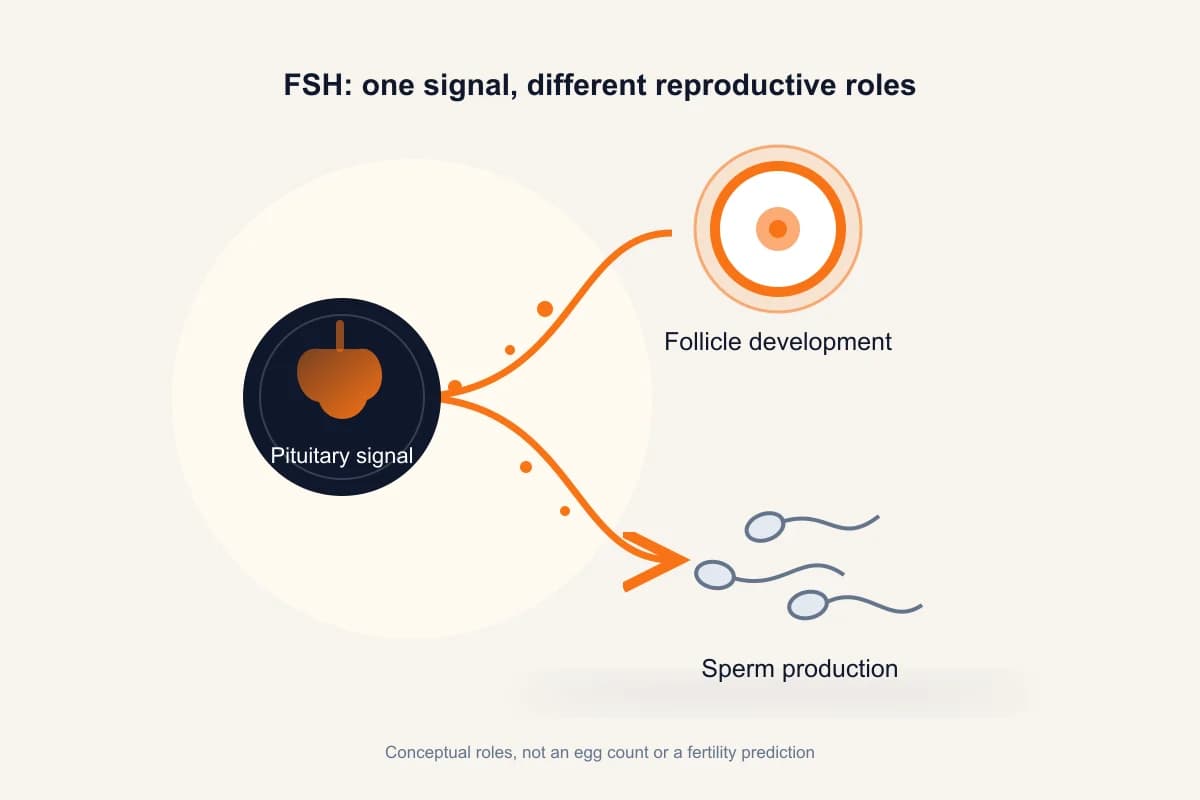
The pituitary is a small gland below the brain. It works with the hypothalamus and reproductive glands in a feedback system. FSH supports ovarian follicles, which contain developing eggs, and supports sperm production in the testicles.See reference 1
The same test can answer different questions
- Context
- Menstrual changes or fertility assessment
- Useful information
- FSH alongside cycle history and other hormones.
- Limit
- One concentration cannot explain every cause.See reference 1
- Context
- Ovarian-reserve assessment
- Useful information
- An early-cycle marker used with other findings.
- Limit
- Reserve markers predict stimulation response better than reproductive potential.See reference 2
- Context
- Testicular or pituitary assessment
- Useful information
- A hormone pattern alongside other testing.
- Limit
- FSH does not replace a complete fertility evaluation.See reference 1
- Context
- Possible menopause
- Useful information
- The role depends on age, symptoms and hormonal treatment.
- Limit
- Routine testing is often unnecessary in typical symptoms after 45.See reference 3
Why timing and estradiol belong beside FSH
ASRM describes basal FSH assessment during the early follicular phase, commonly cycle days 2, 3 or 4. That describes a particular ovarian-reserve assessment, not the collection day for every FSH test. Follow the ordering clinician’s instructions for your actual question.See reference 2
FSH varies within and between cycles, and assays can give different absolute values. Early-cycle estradiol can suppress an otherwise elevated FSH result into the normal range. A single apparently normal value therefore does not settle an ovarian-reserve question.See reference 2
Egg quantity, egg quality and pregnancy are different outcomes
Ovarian reserve concerns remaining egg quantity. FSH is an indirect marker, not a count. ASRM cautions that reserve tests are poor predictors of reproductive potential independently of age, even when they help anticipate response to ovarian stimulation.See reference 2
A report flag should not become a percentage chance of conception or a decision to abandon fertility care. Ask which clinical question the test was ordered to answer and what other information is needed. This page provides no individual prediction or treatment decision.See reference 2
Menopause is not identified by one universal FSH cutoff
NICE usually identifies perimenopause or menopause clinically in otherwise healthy people aged 45 or over who have typical symptoms, taking menstrual history and hormonal contraception into account. Selected younger or unclear presentations need a different assessment.See reference 3
NICE advises against using FSH to identify menopause during combined estrogen-progestogen contraception or high-dose progestogen use. Do not stop hormones to make a test interpretable yourself; disclose them and ask the ordering clinician about the result’s limits.See reference 3
Use the range on your own report
A reference interval is a comparison range, not a goal to optimize. Laboratories may use different methods and intervals. Retain the original number, unit, range, collection date and laboratory rather than copying a cutoff from another website.See reference 4
A result inside a range does not rule out every problem, and an outside value does not establish a diagnosis. Trends are easier to compare when the method and collection context match. Personal interpretation belongs with the clinician who knows why testing was requested.See reference 4
Useful questions for the result discussion
- What question was this FSH test ordered to answer?See reference 1
- If cycle timing matters here, was collection timed as requested?See reference 2
- Was estradiol or another relevant hormone measured with it?See reference 1,See reference 2
- Do the laboratory method, medicines or hormonal treatments limit comparison?See reference 2,See reference 3,See reference 4
Common questions
Is a low FSH always better?
No. The meaning depends on the clinical question and other findings. This guide sets no target and recommends no way to raise or lower FSH.See reference 1,See reference 4
Can normal FSH prove normal egg quality?
No. FSH does not directly measure egg quality, and a single reserve marker cannot supply a personal pregnancy forecast.See reference 2
Must everyone test on day 3?
No. Early-cycle timing applies to a particular basal ovarian-reserve assessment. Other reasons for testing need their own collection instructions.See reference 2
Get the weekly longevity brief
The week's best longevity research in plain English. Free, every Tuesday.
See your blood results in context
If you already have blood test results, the paid LongevityMate app can help you view related markers together. It provides educational context, not a diagnosis or a replacement for your clinician.
Explore blood test analysisReferences
- 1. Follicle-Stimulating Hormone (FSH) Levels Test
MedlinePlus, U.S. National Library of MedicineOfficial guidance
- 2. Testing and interpreting measures of ovarian reserve: a committee opinion (2020)
American Society for Reproductive MedicineGuideline
- 3. Menopause: identification and management, recommendations
National Institute for Health and Care ExcellenceGuideline
- 4. How to Understand Your Lab Results
MedlinePlus, U.S. National Library of MedicineOfficial guidance
Editorial transparency
- Published by
- LongevityMate Editorial
- Published
- Updated
Medical disclaimer
General education only. This guide does not diagnose a condition, interpret your personal result, choose a treatment or recommend a supplement dose. Discuss testing, symptoms, medicines and supplements with a qualified health professional.