
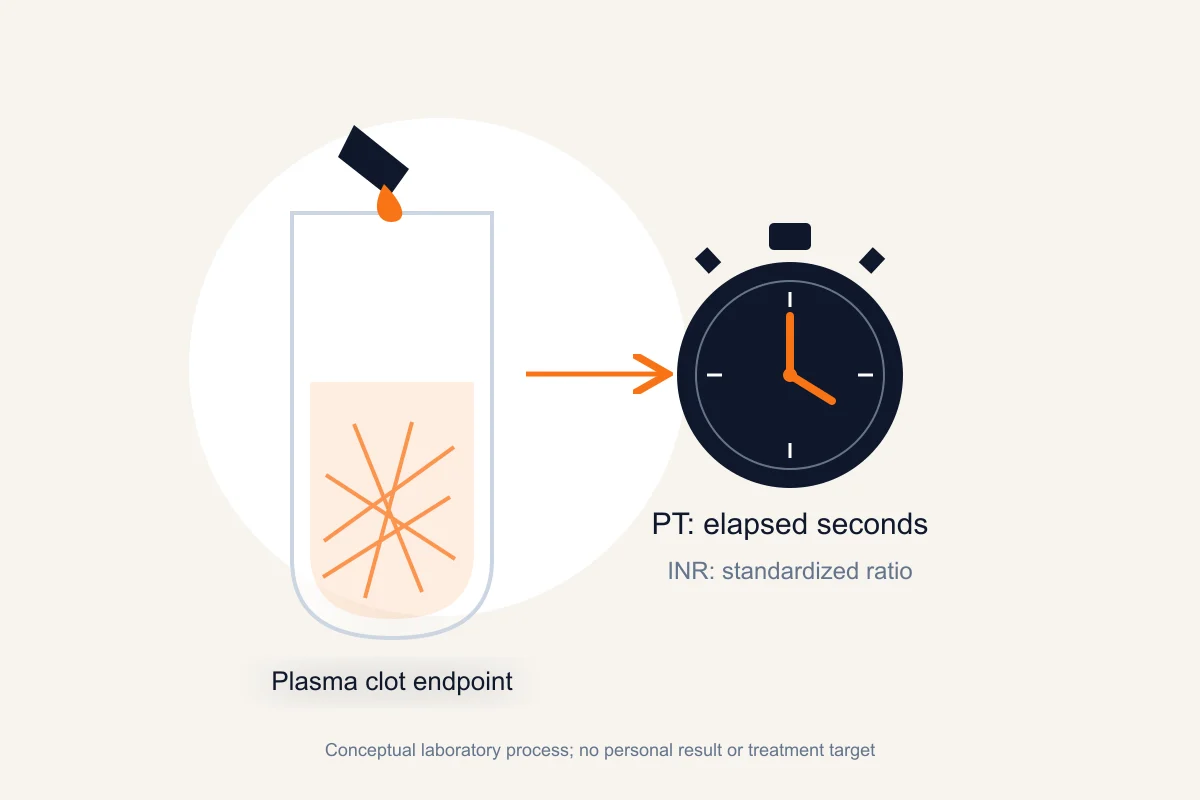
Keep three different numbers separate
- Report item
- PT, in seconds
- What it describes
- Elapsed clotting time in the sample.
- How to use it
- Keep the testing laboratory and its range.See reference 1
- Report item
- INR, a ratio
- What it describes
- A standardized PT result.
- How to use it
- Retain the collection date and reason for testing.See reference 1
- Report item
- Personal warfarin target
- What it describes
- The range set by your anticoagulant care team.
- How to use it
- Use the team’s instructions, not a website cutoff.See reference 2
Why a clinician requests the test
A common reason is monitoring warfarin. PT/INR may also help investigate unusual bleeding or clotting and questions involving liver function or vitamin K. Other tests may be needed to explain the result. The purpose should stay attached to the number.See reference 1
A laboratory range is not your treatment target
A reference interval compares results with a reference population. People taking warfarin have a different, deliberately prescribed monitoring goal. An INR flagged against the laboratory interval is therefore not, by itself, an instruction to lower your medicine.See reference 1,See reference 4
The anticoagulant service assesses the current result and decides whether the prescribed dose or testing schedule needs to change. Do not hold, increase or reduce warfarin from this guide. If you have no clear instructions for a result, contact your care team or pharmacist.See reference 2,See reference 3
INR does not monitor every anticoagulant
NHS guidance distinguishes warfarin from apixaban, dabigatran, edoxaban and rivaroxaban: those newer medicines do not require regular INR monitoring. That does not mean they need no follow-up, and it does not make INR a universal measurement of their effect.See reference 2
Bring the exact medicine name to a result discussion. A familiar INR number cannot be used to substitute one medicine’s monitoring plan for another’s. This page provides no anticoagulant conversion or dosing calculation.See reference 2
Consistency matters more than avoiding every green food
Vitamin K intake can affect warfarin management. NHS advice is to keep vitamin K-containing foods reasonably consistent rather than eliminate all green vegetables. Discuss a major diet change, new supplement or interacting medicine with the team managing your anticoagulant.See reference 3
Tell the service about prescription medicines, over-the-counter products and herbal supplements. Do not stop a prescribed product to obtain a different test result yourself. Follow the collection instructions for your actual test appointment.See reference 3
Keep the original report when comparing results
Retain the value, PT or INR label, unit where applicable, laboratory range, collection date and clinical purpose. A reference flag is not a diagnosis. Results from different methods or laboratories may need context before being treated as a trend.See reference 4
Some people use a home INR device through an agreed care plan. NHS guidance stresses training and discussion with a doctor or nurse first. A home result still belongs within that monitoring plan; it is not an unrestricted self-dosing tool.See reference 2
Useful questions for your care team
- Is this number PT in seconds or INR?
- Was the test ordered for warfarin monitoring or another question?
- Which target applies to my prescribed treatment?
- Do I have clear next-step instructions from the service?
Common questions
Is a lower INR always better?
No. The meaning depends on why it was measured and any prescribed treatment target. There is no optimization target in this guide.See reference 1,See reference 2
Does INR replace all clotting tests?
No. PT/INR answers particular questions, and clinicians may request other tests. It is not a complete bleeding or clotting assessment.See reference 1
Should I change warfarin when my report has a flag?
Do not use the flag alone to change it. Follow the anticoagulant service’s instructions and contact the service when the plan is unclear.See reference 2,See reference 3
Get the weekly longevity brief
The week's best longevity research in plain English. Free, every Tuesday.
See your blood results in context
If you already have blood test results, the paid LongevityMate app can help you view related markers together. It provides educational context, not a diagnosis or a replacement for your clinician.
Explore blood test analysisReferences
- 1. Prothrombin Time Test and INR (PT/INR)
MedlinePlus, U.S. National Library of MedicineOfficial guidance
- 2. Anticoagulant medicines: dosage and monitoring
NHSOfficial guidance
- 3. Anticoagulant medicines: considerations
NHSOfficial guidance
- 4. How to Understand Your Lab Results
MedlinePlus, U.S. National Library of MedicineOfficial guidance
Editorial transparency
- Published by
- LongevityMate Editorial
- Published
- Updated
Medical disclaimer
General education only. This guide does not diagnose a condition, interpret your personal result, choose a treatment or recommend a supplement dose. Discuss testing, symptoms, medicines and supplements with a qualified health professional.