
Why LH is often measured with other hormones
LH works with FSH in reproductive development and function. Clinicians often consider LH with FSH and, depending on the question, estradiol, testosterone or progesterone. Age, symptoms, medicines and menstrual history help explain the pattern.See reference 1
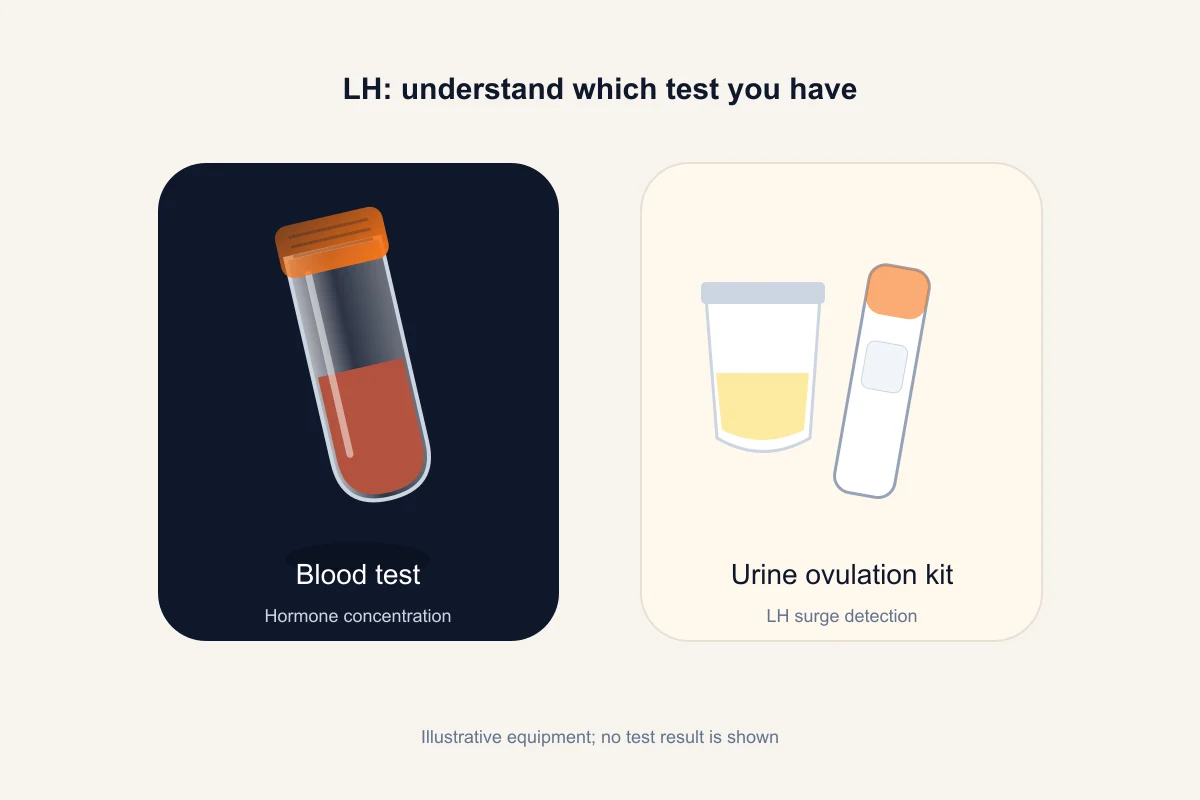
Blood concentration and a urine surge are different
- Test
- Laboratory blood test
- What it reports
- An LH concentration at collection.
- What it cannot establish alone
- The cause of a reproductive or pituitary problem.See reference 1
- Test
- Home urine ovulation kit
- What it reports
- Whether urine meets the kit’s LH-surge criterion.
- What it cannot establish alone
- Whether pregnancy will occur.See reference 2
- Test
- Other fertility assessment
- What it reports
- History and tests chosen for the clinical question.
- What it cannot establish alone
- A complete answer from one hormone or kit alone.See reference 2
A kit result is a prediction aid, not a pregnancy test
The FDA describes urine LH kits as qualitative tests for an LH rise preceding expected ovulation. They do not show that pregnancy will happen. Read the instructions for that exact kit rather than treating a strip’s appearance as a universal concentration scale.See reference 2
The FDA specifically warns that an ovulation kit is not reliable for preventing pregnancy. A home surge result also does not answer every fertility question; clinical assessment may use history and other laboratory tests. This guide provides no contraception or conception schedule.See reference 2
A high result needs its collection context
LH changes across the menstrual cycle, with a marked rise around ovulation. A concentration that fits one cycle phase may mean something different in another. In people without menstrual cycles, the interpretation follows a different hormone context.See reference 1
Do not convert a flagged LH value, or an LH-to-FSH ratio, into a diagnosis or a supplement plan. One measurement cannot establish the cause. Keep the clinician’s original testing question beside the result.See reference 1,See reference 3
Read the original laboratory report
The printed reference range belongs to the laboratory method and relevant population. A website’s general interval may not match it. Keep the unit and collection date; a number copied without them loses important information.See reference 3
An in-range value does not exclude every condition. An out-of-range value is a reason for clinical interpretation, not proof of a specific disorder. Comparing results across laboratories may require extra care because methods and ranges can differ.See reference 3
Preparation depends on why testing is being done
If you menstruate, the clinician may request collection at a particular cycle time. Share all medicines, hormonal treatments and supplements, and follow that service’s instructions. Do not stop a prescribed medicine yourself to change a test result.See reference 1
For a urine kit, collection and reading rules come from its own instructions. Use a pregnancy test for a pregnancy question. A blood LH concentration and a kit’s positive/negative display should not be copied into each other’s reporting scale.See reference 2
Bring the details that make the result useful
- Was the result a blood concentration or a urine-kit reading?
- What symptoms or testing question prompted it?
- What were the collection date, cycle context and relevant hormone results?
- Which medicines, hormonal treatments or supplements were being used?
Common questions
Does a positive ovulation kit mean I am pregnant?
No. It detects a hormone rise associated with approaching ovulation. It is not a pregnancy test and cannot promise pregnancy.See reference 2
Can LH alone diagnose a fertility problem?
No. Its interpretation depends on history, the testing purpose and other relevant findings.See reference 1
Should I try to lower a high LH result?
This guide sets no hormone target or treatment. Discuss the complete report before making decisions based on a single flag.See reference 3
Get the weekly longevity brief
The week's best longevity research in plain English. Free, every Tuesday.
See your blood results in context
If you already have blood test results, the paid LongevityMate app can help you view related markers together. It provides educational context, not a diagnosis or a replacement for your clinician.
Explore blood test analysisReferences
- 1. Luteinizing Hormone (LH) Levels Test
MedlinePlus, U.S. National Library of MedicineOfficial guidance
- 2. Ovulation (Urine Test)
U.S. Food and Drug AdministrationOfficial guidance
- 3. How to Understand Your Lab Results
MedlinePlus, U.S. National Library of MedicineOfficial guidance
Editorial transparency
- Published by
- LongevityMate Editorial
- Published
- Updated
Medical disclaimer
General education only. This guide does not diagnose a condition, interpret your personal result, choose a treatment or recommend a supplement dose. Discuss testing, symptoms, medicines and supplements with a qualified health professional.