
Three labels that should stay separate
- Label
- Measured blood osmolality
- What produced it
- A laboratory measurement of serum or plasma
- Main limitation
- Counts the overall particle effect, without identifying each substanceSee reference 3
- Label
- Calculated estimate
- What produced it
- An equation using measured substances such as sodium, glucose and urea
- Main limitation
- Depends on the formula and input units; it can miss substances outside the equationSee reference 3
- Label
- Urine osmolality
- What produced it
- A measurement in urine
- Main limitation
- Reflects a different specimen; its interval is not the blood intervalSee reference 1
Why mOsm/kg matters
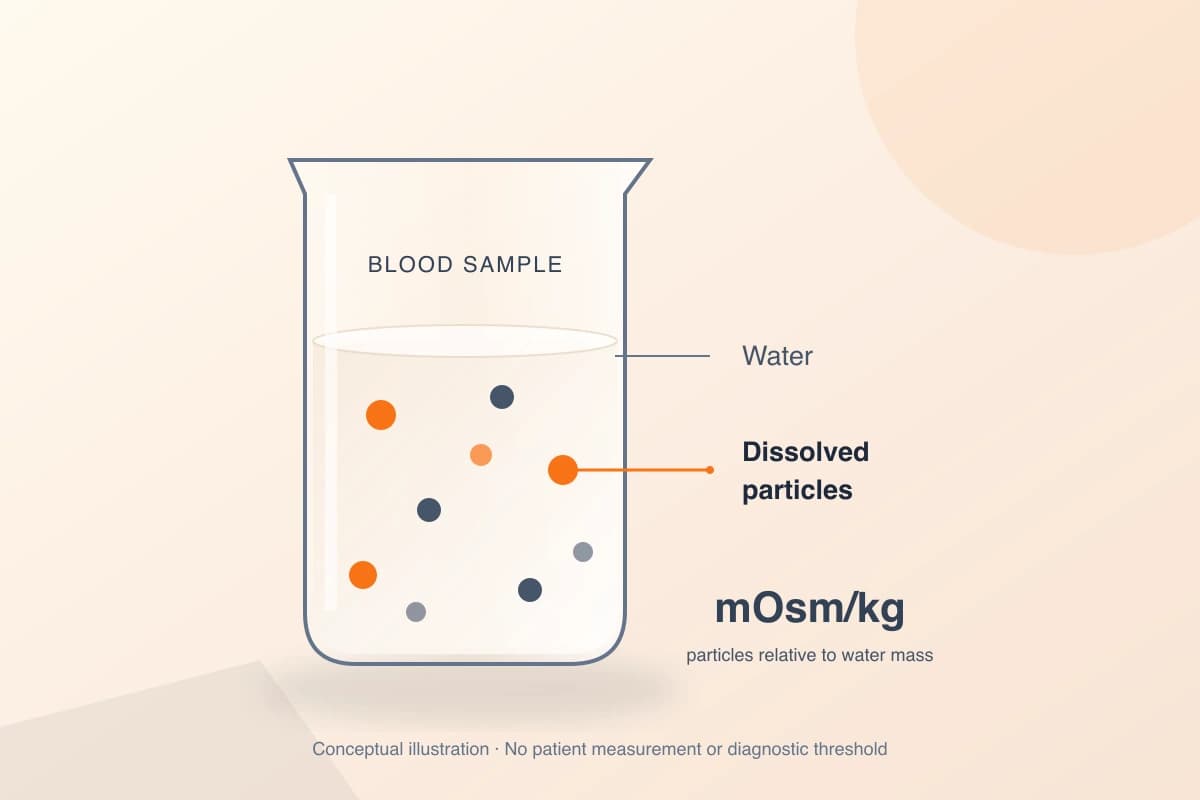
Osmolality is commonly reported in milliosmoles per kilogram of water, written mOsm/kg. Osmolarity describes particles per litre of solution. Reports may use related terminology for calculated estimates; preserve the original label and unit rather than silently swapping them.See reference 3
MedlinePlus gives 275–295 mOsm/kg as an example blood reference interval. It also states that intervals vary by laboratory. Use the interval on your own report; this example is not a hydration target or a treatment threshold.See reference 2,See reference 4
What the osmolar gap can and cannot show
The gap compares the measured result with a calculated estimate. A difference may prompt investigation of substances the equation does not capture. It is not a stand-alone diagnosis of poisoning, and a small gap does not provide a general safety clearance. The calculation and sampling context matter.See reference 3,See reference 5
Read it with the surrounding results
Water balance, sodium, glucose and urea can affect the result. Clinicians may compare blood and urine measurements to understand how the kidneys are handling water. Symptoms, medicines, kidney function and the reason for testing help determine what the pattern means.See reference 1,See reference 2
A high or low flag has several possible explanations. Changing water or salt intake without understanding the cause can miss the real problem. Discuss interpretation and follow-up with the clinician who requested the test.See reference 2,See reference 4
Keep the useful details
- Keep the specimen: serum, plasma and urine are not interchangeable.See reference 1
- Keep whether the result was measured or calculated, plus the equation if supplied.See reference 3
- Retain the date, exact units and laboratory interval; ask which other results provide context.See reference 4
Common questions
Is osmolality a simple dehydration score?
No. Both water and dissolved substances influence it. The result needs other findings and clinical context; it does not prescribe a drinking plan.See reference 1,See reference 2
Can I compare a urine value with a blood interval?
No. They describe different specimens. Use the correct specimen-specific interval and interpret them together only in the appropriate clinical context.See reference 1
Do I need to fast or stop a medicine?
Preparation depends on the ordered tests. Follow your care team’s instructions, disclose medicines, and do not stop a prescription on your own.See reference 2
Get the weekly longevity brief
The week's best longevity research in plain English. Free, every Tuesday.
See your blood results in context
If you already have blood test results, the paid LongevityMate app can help you view related markers together. It provides educational context, not a diagnosis or a replacement for your clinician.
Explore blood test analysisReferences
- 1. Osmolality tests
MedlinePlusOfficial guidance
- 2. Osmolality blood test
MedlinePlus Medical EncyclopediaOfficial guidance
- 3. Osmolality, Serum: test interpretation
Mayo Clinic LaboratoriesOfficial guidance
- 4. How to understand your lab results
MedlinePlusOfficial guidance
- 5. Osmolality gap: calculation and interpretation
University of Iowa Health Care, Pathology HandbookOfficial guidance
Editorial transparency
- Published by
- LongevityMate Editorial
- Published
- Updated
Medical disclaimer
General education only. This guide does not diagnose a condition, interpret your personal result, choose a treatment or recommend a supplement dose. Discuss testing, symptoms, medicines and supplements with a qualified health professional.