
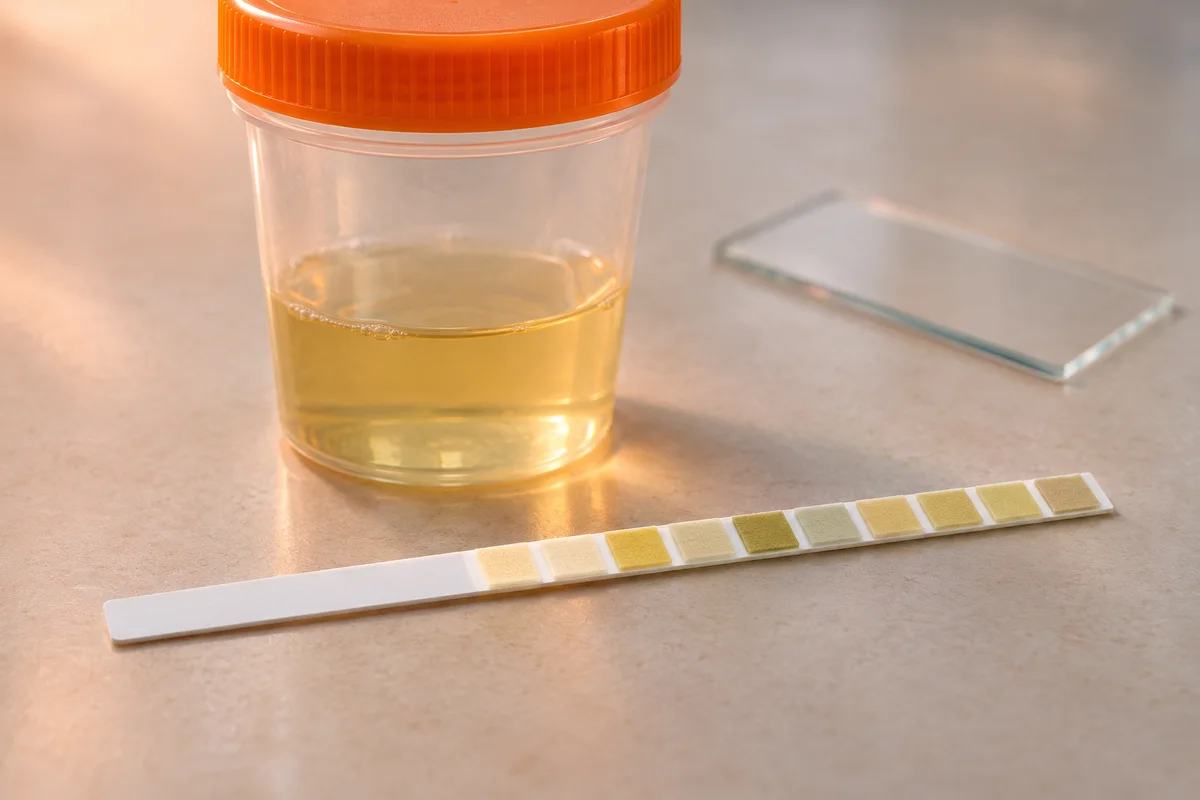
Three ways a urine report can describe blood
- Report line
- Urine color
- What it describes
- What the sample looks like.
- How to compare it
- Urine can look normal when blood is only visible under a microscope. Foods or medicines can also color urine.See reference 1,See reference 3
- Report line
- Blood or heme on dipstick
- What it describes
- A chemical reaction on the strip, often reported as negative, trace or a higher grade.
- How to compare it
- A grade describes the strip reaction. It cannot be converted to a cell count.See reference 2,See reference 3
- Report line
- Red blood cells on microscopy
- What it describes
- Cells seen in the sample, sometimes reported per high-power field (HPF), a magnified view.
- How to compare it
- Use the lab’s own unit and comment. A separate strip grade can disagree.See reference 2,See reference 3
Why a positive strip can come with few visible cells
Red cells can break apart in dilute urine. Hemoglobin released from those cells may still trigger the strip, while the microscope finds fewer intact cells. Myoglobin can also give a positive strip reaction without red cells. The two results alone cannot tell which explanation applies.See reference 2
Menstrual blood can enter the container and affect the result. Strenuous activity can also affect a sample. If the lab requested a clean-catch sample, follow its collection instructions and tell the person reviewing the report about factors that could have affected it.See reference 1,See reference 2,See reference 3
What to bring to a report discussion
Keep the Blood strip grade and the microscopic red cell count together, with the date and the lab’s comments. If the report gives only a strip result, ask whether microscopy was done. The U.S. AUA and SUFU guideline uses microscopic findings to define microhematuria, the term for blood detected under a microscope.See reference 1,See reference 2
A blood finding can have several causes, including urinary infection or stones. A strip grade cannot identify a cause or show how serious it is. A report discussion can take into account why the sample was collected and whether you saw blood yourself.See reference 1,See reference 2
Common questions
Can a trace result be converted to red blood cells per field?
The strip has an ordinal scale such as negative or trace. A microscopic count describes cells in the sample. Use the separate results as printed.See reference 2,See reference 3
Does pink urine always contain blood?
Some foods and medicines change urine color. A report can help distinguish appearance from a chemical reaction and any cells actually seen. Tell a healthcare professional if you see blood in your urine.See reference 1,See reference 2
Get the weekly longevity brief
The week's best longevity research in plain English. Free, every Tuesday.
See your blood results in context
If you already have blood test results, the paid LongevityMate app can help you view related markers together. It provides educational context, not a diagnosis or a replacement for your clinician.
Explore blood test analysisReferences
- 1. Blood in Urine
MedlinePlus, U.S. National Library of MedicineOfficial guidance
- 2. Microhematuria guideline, amended 2025
American Urological Association and Society of Urodynamics, Female Pelvic Medicine & Urogenital ReconstructionGuideline
- 3. Urinalysis
MedlinePlus, U.S. National Library of MedicineOfficial guidance
Editorial transparency
- Published by
- LongevityMate Editorial
- Reviewed by
- Editorial evidence review (AI-assisted)
- Published
- Updated
Medical disclaimer
For general education. A qualified health professional can interpret your results and advise on testing, medicines or supplements.