
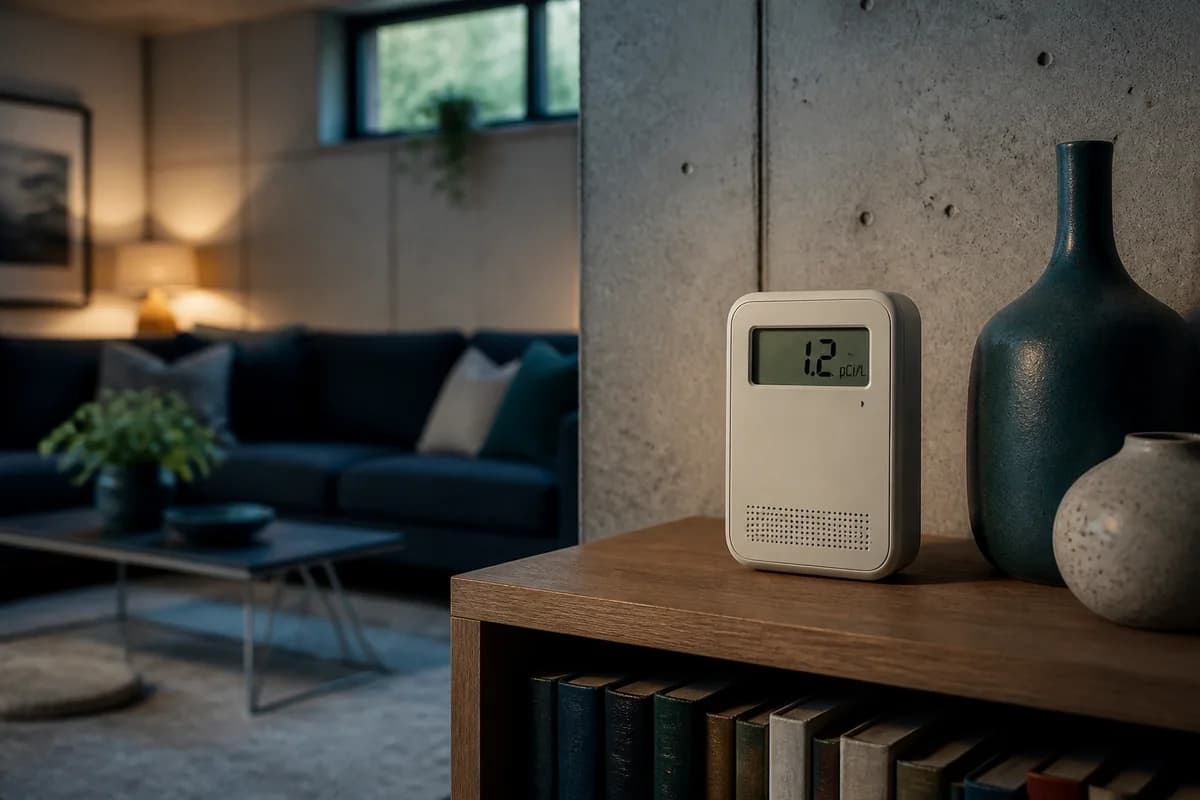
The 10 rules to remember
- Test the home rather than guessing from location or building age.See reference 1
- Use an approved test device or laboratory.See reference 2
- Place it on the lowest regularly occupied level.See reference 3
- Follow device instructions for height, drafts and closed-house conditions.See reference 4
- Prefer long-term measurement for average exposure when time permits.See reference 5
- Act using the reference level in your country.See reference 6
- Use qualified mitigation for elevated results.See reference 7
- Retest after mitigation and major building changes.See reference 8
- Combine radon reduction with smoking cessation.See reference 9
- A low reading from the wrong location or duration is false reassurance, not proof that exposure is controlled.See reference 10,See reference 9
First principles: what this tool can actually change
Radon forms naturally from uranium in soil and rock, enters through building gaps and decays into particles that irradiate lung tissue.See reference 1,See reference 2
Concentration varies hourly and seasonally with weather, pressure, ventilation and building operation, so measurement duration matters.See reference 2,See reference 3
Lung-cancer risk rises with long-term exposure and is much greater for people who smoke; there is no known threshold below which risk is exactly zero.See reference 3,See reference 4
A practical protocol
- Stage
- Choose
- What to do
- Approved passive kit or calibrated continuous monitor
- Why it matters
- Ensures the result is interpretableSee reference 2
- Stage
- Place
- What to do
- Lowest occupied level in a normal-use room
- Why it matters
- Targets meaningful exposureSee reference 3
- Stage
- Measure
- What to do
- Follow short- or long-term instructions exactly
- Why it matters
- Controls avoidable errorSee reference 4
- Stage
- Act
- What to do
- Confirm or mitigate using local guidance
- Why it matters
- Reduces long-term exposureSee reference 5
Timing and frequency
- When
- Initial test
- Action
- Test when moving in or if the home has never been testedSee reference 3
- When
- Long-term
- Action
- Measure for months when estimating annual exposureSee reference 4
- When
- After high result
- Action
- Confirm promptly or proceed to mitigation as guidance directsSee reference 5
- When
- After mitigation
- Action
- Retest immediately and periodically thereafterSee reference 6
What to measure
- Signal
- Radon concentration
- How
- Bq/m³ or pCi/L
- Interpretation
- Long-term exposure estimateSee reference 4
- Signal
- Measurement duration
- How
- Hours, days or months
- Interpretation
- Confidence in average levelSee reference 5
- Signal
- Device location
- How
- Room and floor
- Interpretation
- Whether the sample represents occupied spaceSee reference 6
- Signal
- Mitigation performance
- How
- Post-installation retest
- Interpretation
- Whether exposure actually fellSee reference 7
What the evidence supports
Residential radon measurement identifies a carcinogen that cannot be seen, smelled or reliably predicted without testing.See reference 2,See reference 4
Sub-slab depressurization and other proven systems can substantially reduce indoor concentrations.See reference 3,See reference 5
Radon control directly reduces exposure; the exact reduction in an individual's lifetime cancer risk cannot be measured from one test.See reference 4,See reference 6
Evidence strength by claim
- Claim
- Testing estimates radon concentration in the sampled location
- Confidence
- Moderate to strong
- Important boundary
- Duration, placement and season affect the estimateSee reference 1,See reference 2
- Claim
- Mitigation lowers indoor radon
- Confidence
- Variable
- Important boundary
- Performance must be confirmed by retestingSee reference 3,See reference 4
- Claim
- A single normal test guarantees no future lung-cancer risk
- Confidence
- Limited or indirect
- Important boundary
- Risk-factor change is not proof of disease preventionSee reference 5,See reference 6
- Claim
- It extends human lifespan
- Confidence
- Not established
- Important boundary
- Association is not proof of causationSee reference 7,See reference 8,See reference 9,See reference 10
Limitations and common overclaims
One short test may not represent the annual average because radon varies over time.See reference 5,See reference 7
A neighbor's result cannot substitute for testing your home.See reference 6,See reference 8
Consumer monitors do not eliminate the need for qualified mitigation design and post-work verification.See reference 7,See reference 9
How to make it stick
Choose the smallest version you can repeat under normal conditions. Consistency creates a useful signal; a heroic one-off session does not.See reference 1,See reference 2
Change one variable at a time and write down the protocol. Otherwise an apparent improvement may reflect different timing, equipment or conditions.See reference 3,See reference 4
Review the result after a pre-defined period. Continue only when the benefit is meaningful, the burden is acceptable and no safety signal has appeared.See reference 5,See reference 6
Troubleshooting
- Problem
- Results vary by season
- Likely issue
- Normal building and weather variation
- Better next step
- Use a longer test or repeat under guidanceSee reference 5
- Problem
- Monitor is near a window
- Likely issue
- Drafts can bias placement
- Better next step
- Move it to a compliant location and restartSee reference 6
- Problem
- High result after mitigation
- Likely issue
- System or building pathway problem
- Better next step
- Contact the mitigator and retestSee reference 7
- Problem
- Units are confusing
- Likely issue
- Bq/m³ and pCi/L differ
- Better next step
- Use the unit and action level specified locallySee reference 8
Safety and when to stop
Radon is a long-term exposure, not usually an acute emergency, but elevated results deserve timely action. Do not enter crawlspaces or alter foundations without appropriate safety controls. Use qualified radon professionals and follow local building rules. Smoking cessation is critical because smoking and radon greatly compound lung-cancer risk.See reference 1,See reference 5,See reference 9
Who is most likely to benefit
Every household benefits from at least one valid baseline because no home can be cleared by appearance alone.See reference 2,See reference 6
Basements and ground-contact rooms deserve careful placement when they are regularly occupied.See reference 3,See reference 7
People who smoke or formerly smoked have especially high absolute benefit from reducing both exposures.See reference 4,See reference 8
Track five things
- Device type and certification.See reference 1
- Exact floor, room and placement.See reference 2
- Start and end time plus test conditions.See reference 3
- Result in the original unit.See reference 4
- Mitigation work and every post-mitigation retest.See reference 5
Frequently asked questions
What is a safe radon level?
Risk rises with exposure and no exact zero-risk threshold is known; act using your country's reference or action level.See reference 1
Where should I place a radon test?
Use the lowest regularly occupied level and follow the device instructions for distance from drafts, walls, heat and humidity.See reference 2
Is a short-term test enough?
It can screen quickly, but a long-term test better estimates average exposure.See reference 3
Do new homes need testing?
Yes. New construction and mitigation features reduce risk but do not replace measurement.See reference 4
Can opening windows fix radon?
It may temporarily change a reading but is not a reliable permanent mitigation strategy.See reference 5
When should I retest?
Retest after mitigation, renovation or major building changes and periodically according to local guidance.See reference 6
Connect the protocol to your wider health picture
LongevityMate helps organize measurements, habits, symptoms and trends so one tool stays in context instead of becoming the whole plan.
See how LongevityMate worksGet the weekly longevity brief
The week's best longevity research in plain English. Free, every Tuesday.
References
- 1. WHO handbook on indoor radon
World Health OrganizationGuideline
- 2. Radon and health
World Health OrganizationOfficial guidance
- 3. A Citizen's Guide to Radon
U.S. Environmental Protection AgencyOfficial guidance
- 4. Radon Testing
U.S. Environmental Protection AgencyOfficial guidance
- 5. Consumer's Guide to Radon Reduction
U.S. Environmental Protection AgencyOfficial guidance
- 6. Radon and Your Health
Centers for Disease Control and PreventionOfficial guidance
- 7. Residential radon and lung cancer risk: pooled European analysis
BMJMeta-analysis
- 8. Residential radon and lung cancer: pooled North American analysis
EpidemiologyMeta-analysis
- 9. European Code against Cancer: ionising radiation and cancer
International Agency for Research on CancerEvidence review
- 10. Radon measurement and mitigation guidance
Australian Radiation Protection and Nuclear Safety AgencyOfficial guidance
Editorial transparency
- Published by
- LongevityMate Editorial Team
- Published
- Updated
Medical disclaimer
This guide provides general health education. It does not diagnose a condition, prescribe treatment, replace individualized professional care, or guarantee a health or longevity outcome.