
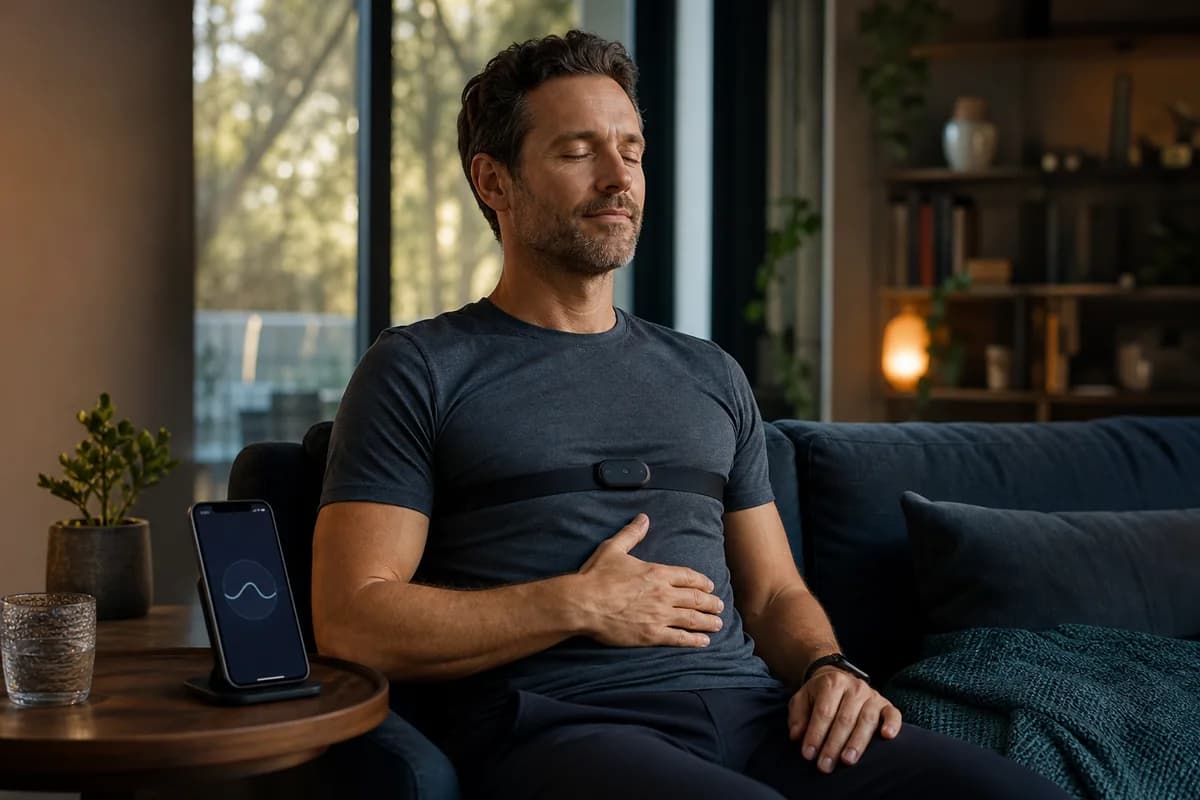
The 10 rules to remember
- Treat the practice as a skill, not a competition for the highest HRV.See reference 1
- Use reliable beat-to-beat sensing and remove obvious artifacts.See reference 2
- Begin with five to ten minutes in a quiet seated position.See reference 3
- Slow the breathing rate without increasing breath size.See reference 4
- Use a longer easy exhale only if comfortable.See reference 5
- Find a comfortable range before chasing an exact resonance frequency.See reference 6
- Practice regularly rather than using one long session.See reference 7
- Transfer the skill to real stress after learning it at rest.See reference 8
- Track symptoms and function alongside the waveform.See reference 9
- A high session HRV during paced breathing is not the same as a higher resting HRV or proof of better health.See reference 10,See reference 9
First principles: what this tool can actually change
Breathing changes the interval between heartbeats through respiratory sinus arrhythmia and the baroreflex.See reference 1,See reference 2
Near the cardiovascular resonance range, breathing and blood-pressure oscillations can align and produce large heart-rate swings.See reference 2,See reference 3
Slow breathing itself can help; evidence that individually measured resonance always produces superior clinical outcomes is not conclusive.See reference 3,See reference 4
A practical protocol
- Stage
- Set up
- What to do
- Reliable sensor, quiet seat and normal posture
- Why it matters
- Reduces artifactSee reference 2
- Stage
- Pace
- What to do
- Gentle breathing near 5–6 breaths/min
- Why it matters
- Stimulates oscillation without hyperventilationSee reference 3
- Stage
- Adjust
- What to do
- Test comfort and waveform across nearby rates
- Why it matters
- Finds a practical individual rangeSee reference 4
- Stage
- Transfer
- What to do
- Use the learned breathing during real stress
- Why it matters
- Turns a lab signal into a useful skillSee reference 5
Timing and frequency
- When
- Daily start
- Action
- 5–10 minutes for two weeksSee reference 3
- When
- Progression
- Action
- Increase only when comfortable and usefulSee reference 4
- When
- Before stress
- Action
- Use a short familiar practiceSee reference 5
- When
- Monthly review
- Action
- Compare symptoms and standardized resting measurementsSee reference 6
What to measure
- Signal
- Interbeat intervals
- How
- ECG-quality or validated chest strap
- Interpretation
- Raw input for HRVSee reference 4
- Signal
- Breathing rate
- How
- Breaths per minute
- Interpretation
- Whether practice matches the protocolSee reference 5
- Signal
- Session oscillation
- How
- Waveform and spectral response
- Interpretation
- Training feedback, not a health gradeSee reference 6
- Signal
- Functional outcome
- How
- Stress, sleep or performance goal
- Interpretation
- Whether the practice mattersSee reference 7
What the evidence supports
Meta-analyses report small-to-moderate average improvements across stress, anxiety and selected performance outcomes.See reference 2,See reference 4
Methods vary substantially, and many studies do not report enough detail to reproduce their protocol.See reference 3,See reference 5
HRV biofeedback is best understood as a complementary self-regulation practice, not a standalone treatment for disease.See reference 4,See reference 6
Evidence strength by claim
- Claim
- Slow breathing increases respiratory heart-rate oscillation
- Confidence
- Moderate to strong
- Important boundary
- Large session oscillation is partly created by the breathing patternSee reference 1,See reference 2
- Claim
- HRV biofeedback can reduce stress or anxiety symptoms
- Confidence
- Variable
- Important boundary
- Average evidence is promising but heterogeneousSee reference 3,See reference 4
- Claim
- Raising HRV through biofeedback prevents cardiovascular disease
- Confidence
- Limited or indirect
- Important boundary
- Risk-factor change is not proof of disease preventionSee reference 5,See reference 6
- Claim
- It extends human lifespan
- Confidence
- Not established
- Important boundary
- Association is not proof of causationSee reference 7,See reference 8,See reference 9,See reference 10
Limitations and common overclaims
Wrist optical sensors are more vulnerable to artifact than ECG or a good chest strap.See reference 5,See reference 7
Breathing near six per minute is not automatically each person's exact resonance frequency.See reference 6,See reference 8
Device readiness scores and session HRV use different algorithms and should not be compared as if they were one measure.See reference 7,See reference 9
How to make it stick
Choose the smallest version you can repeat under normal conditions. Consistency creates a useful signal; a heroic one-off session does not.See reference 1,See reference 2
Change one variable at a time and write down the protocol. Otherwise an apparent improvement may reflect different timing, equipment or conditions.See reference 3,See reference 4
Review the result after a pre-defined period. Continue only when the benefit is meaningful, the burden is acceptable and no safety signal has appeared.See reference 5,See reference 6
Troubleshooting
- Problem
- Lightheadedness
- Likely issue
- Breaths are too deep or fast
- Better next step
- Make breaths smaller and return to normal breathingSee reference 5
- Problem
- Jagged trace
- Likely issue
- Movement or sensor artifact
- Better next step
- Improve contact and remain stillSee reference 6
- Problem
- Score rises but stress does not
- Likely issue
- Measurement has replaced the goal
- Better next step
- Track the real symptom or taskSee reference 7
- Problem
- Slow breathing triggers panic
- Likely issue
- Practice is unsuitable right now
- Better next step
- Stop and seek appropriate supportSee reference 8
Safety and when to stop
Keep breathing gentle; slow does not mean deep. Stop for dizziness, tingling, chest pain, marked shortness of breath, faintness or panic. People with significant heart or lung disease, unexplained fainting, arrhythmia symptoms or pregnancy complications should seek individualized guidance. Never delay urgent care because an app labels a trace as calm.See reference 1,See reference 5,See reference 9
Who is most likely to benefit
People who want a measurable stress-regulation practice and tolerate paced breathing are the clearest candidates.See reference 2,See reference 6
Athletes and performers may use it as a pre-performance skill, not proof of recovery.See reference 3,See reference 7
People prone to panic or air hunger may need a gentler approach or professional support.See reference 4,See reference 8
Track five things
- Sensor type and signal quality.See reference 1
- Breathing rate and session duration.See reference 2
- Comfort and adverse symptoms.See reference 3
- Stress or performance goal before and after.See reference 4
- A standardized resting trend separate from paced sessions.See reference 5
Frequently asked questions
What is HRV biofeedback?
It uses real-time heartbeat information to guide breathing and self-regulation practice.See reference 1
Is six breaths per minute best for everyone?
It is a useful starting point, but comfortable resonance rates vary and exact superiority is not proven for every goal.See reference 2
Which sensor is best?
ECG or a validated chest strap usually provides more reliable beat-to-beat data than a wrist optical sensor.See reference 3
How long should I practice?
Start with 5–10 minutes regularly and increase only if it remains comfortable and useful.See reference 4
Does higher HRV always mean better health?
No. Context, breathing, posture, artifacts and health conditions all affect HRV.See reference 5
Can it replace therapy or medication?
No. It can complement appropriate treatment but should not replace indicated care.See reference 6
Connect the protocol to your wider health picture
LongevityMate helps organize measurements, habits, symptoms and trends so one tool stays in context instead of becoming the whole plan.
See how LongevityMate worksGet the weekly longevity brief
The week's best longevity research in plain English. Free, every Tuesday.
References
- 1. Methods for Heart Rate Variability Biofeedback: systematic review and guidelines
Applied Psychophysiology and BiofeedbackSystematic review
- 2. HRV biofeedback and stress and anxiety: meta-analysis
Psychological MedicineMeta-analysis
- 3. HRV biofeedback improves health and performance: meta-analysis
Applied Psychophysiology and BiofeedbackMeta-analysis
- 4. A practical guide to resonance frequency assessment
Frontiers in NeuroscienceEvidence review
- 5. Heart rate variability biofeedback: how and why does it work?
Frontiers in PsychologyEvidence review
- 6. Effect of slow breathing on cardiovascular and emotional functions
Frontiers in Human NeuroscienceSystematic review
- 7. Heart rate variability: standards of measurement
European Heart JournalGuideline
- 8. Photoplethysmography and HRV: current technology limitations
Frontiers in PhysiologyEvidence review
- 9. Breathing at a rate of 5.5 breaths per minute with equal inhalation-to-exhalation ratio
International Journal of PsychophysiologyRandomized trial
- 10. Relaxation Techniques: What You Need To Know
National Center for Complementary and Integrative HealthOfficial guidance
Editorial transparency
- Published by
- LongevityMate Editorial Team
- Published
- Updated
Medical disclaimer
This guide provides general health education. It does not diagnose a condition, prescribe treatment, replace individualized professional care, or guarantee a health or longevity outcome.