
The 10 rules to remember
- Base treatment on absolute and lifetime riskSee reference 1
- Treat established atherosclerotic disease intensivelySee reference 2
- Use lifestyle with—not instead of—indicated medicineSee reference 3
- Statins remain the first-line foundation for most patientsSee reference 4
- Set a percentage reduction and targetSee reference 5
- Measure response after every treatment changeSee reference 6
- Evaluate symptoms without assuming every ache is a statin effectSee reference 7
- Use non-statins according to needed LDL reduction and outcomes evidenceSee reference 8
- Consider apoB and Lp(a) when they refine riskSee reference 9
- Use shared decision-making for benefits, harms, cost and preferencesSee reference 10
First principles: what this can actually change
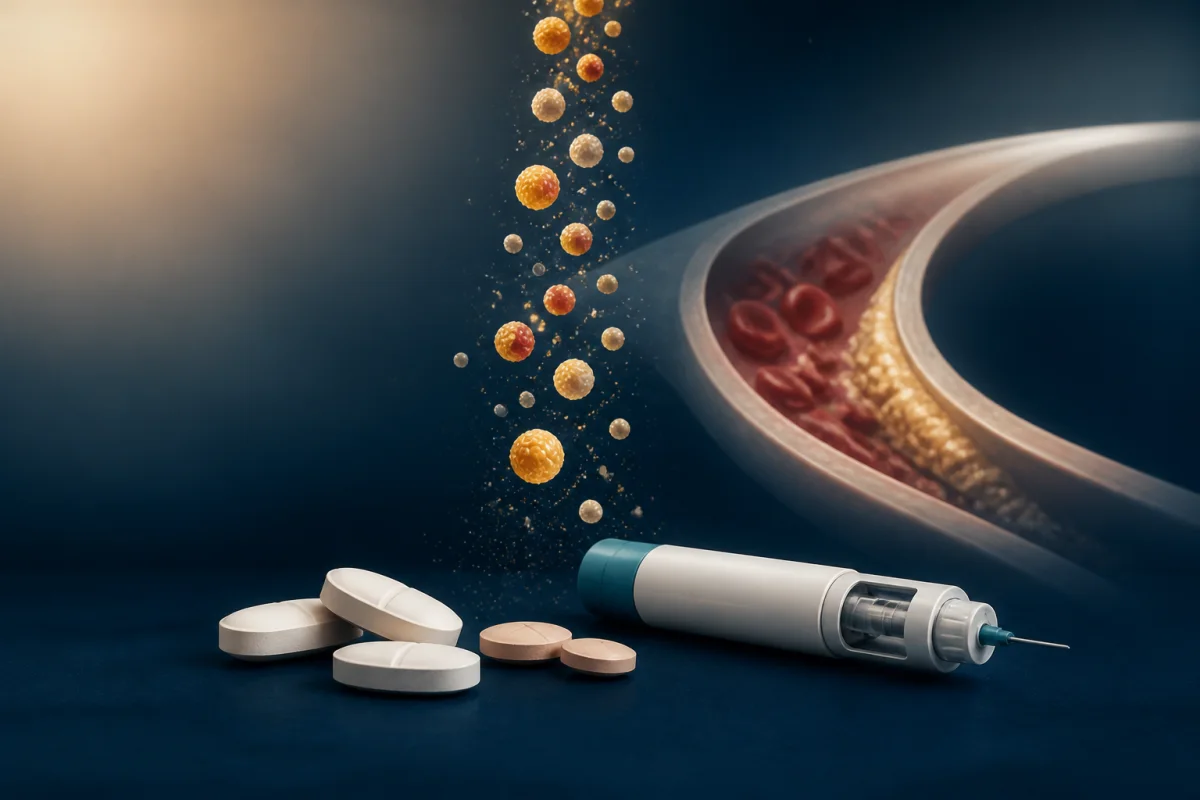
ApoB-containing particles enter artery walls and drive atherosclerosis over time. Risk reflects both concentration and duration of exposure.See reference 1,See reference 2
Lowering LDL reduces future events in proportion to the absolute amount lowered and baseline cardiovascular risk; high-risk patients gain more absolute benefit.See reference 3,See reference 4
Different medicines reduce LDL through different pathways. Combination therapy can achieve a larger reduction at tolerable doses, but each drug should have a defined purpose and monitoring plan.See reference 5,See reference 6
A practical decision protocol
- Stage
- 1. Classify risk
- What to do
- Identify ASCVD, diabetes, CKD, LDL severity and calculated risk
- Why it matters
- Benefit depends on starting riskSee reference 1,See reference 2
- Stage
- 2. Set the goal
- What to do
- Agree on LDL/non-HDL target and percentage reduction
- Why it matters
- Creates a measurable treatment objectiveSee reference 2,See reference 3
- Stage
- 3. Start therapy
- What to do
- Use maximally tolerated evidence-based treatment
- Why it matters
- Dose and combination match required reductionSee reference 3,See reference 4
- Stage
- 4. Verify
- What to do
- Repeat lipids, adherence and symptom review
- Why it matters
- Confirms biological response and safetySee reference 4,See reference 5
Timing and frequency
- Decision
- Baseline
- Practical answer
- Obtain a lipid profile and relevant clinical history; check additional labs when indicated.See reference 3,See reference 4
- Decision
- After starting or changing
- Practical answer
- Recheck in roughly 4–12 weeks or according to the prescribing guideline and medicine.See reference 4,See reference 5
- Decision
- Stable treatment
- Practical answer
- Monitor every 3–12 months according to risk, adherence and local guidance.See reference 5,See reference 6
- Decision
- New symptoms
- Practical answer
- Review promptly rather than stopping permanently without an alternative prevention plan.See reference 6,See reference 7
What to measure
- Signal
- LDL-C and non-HDL-C
- How
- Use the same laboratory when practical
- Interpretation
- Assess achieved level and percentage reductionSee reference 4,See reference 5
- Signal
- ApoB
- How
- Consider when triglycerides, diabetes or discordance complicate LDL
- Interpretation
- Reflects atherogenic particle numberSee reference 5,See reference 6
- Signal
- Lp(a)
- How
- Measure at least once in adulthood under current guidance
- Interpretation
- Inherited risk that can intensify preventionSee reference 6,See reference 7
- Signal
- Symptoms and adherence
- How
- Use a structured timeline and rechallenge when appropriate
- Interpretation
- Distinguishes treatment effect from background symptomsSee reference 7,See reference 8
What the evidence actually shows
Randomized evidence consistently shows that lowering LDL with statins reduces myocardial infarction, stroke and vascular events across a wide range of risk.See reference 1,See reference 3
Outcome trials support additional event reduction with ezetimibe and PCSK9 inhibitors in selected high-risk patients, and bempedoic acid in statin-intolerant populations.See reference 4,See reference 6
The 2026 ACC/AHA guideline emphasizes earlier cumulative-risk management, PREVENT risk assessment, selective CAC, and choosing non-statin therapy by patient risk and the LDL reduction required.See reference 7,See reference 8
Evidence strength by claim
- Claim
- Statins reduce major vascular events
- Confidence
- High
- Important boundary
- Absolute benefit depends on baseline riskSee reference 1,See reference 2
- Claim
- Ezetimibe adds benefit in selected high-risk patients
- Confidence
- High
- Important boundary
- LDL reduction is smaller than PCSK9 therapySee reference 3,See reference 4
- Claim
- PCSK9 inhibitors reduce events in established ASCVD
- Confidence
- High
- Important boundary
- Cost, injections and access matterSee reference 5,See reference 6
- Claim
- Supplements can replace indicated therapy
- Confidence
- Low
- Important boundary
- Outcome evidence and potency are not equivalentSee reference 7,See reference 8,See reference 9
Limits and common overclaims
A target is a treatment tool, not a guarantee that events cannot occur.See reference 3,See reference 7
Muscle symptoms are real for some patients but are also common without statins; structured assessment can often find a tolerable regimen.See reference 5,See reference 8
Online debates often compare relative benefit without baseline risk, or focus on one biomarker while ignoring smoking, blood pressure, diabetes and adherence.See reference 9,See reference 10
A four-step implementation plan
- 1. Identify ASCVD, diabetes, CKD, LDL severity and calculated riskSee reference 1
- 2. Agree on LDL/non-HDL target and percentage reductionSee reference 2
- 3. Use maximally tolerated evidence-based treatmentSee reference 3
- 4. Repeat lipids, adherence and symptom reviewSee reference 4
Troubleshooting
- Problem
- Muscle pain
- Likely issue
- Possible drug effect, interaction, exercise or unrelated cause
- Better next step
- Review timing, medicines and alternatives; do not abandon preventionSee reference 2,See reference 3
- Problem
- LDL response is small
- Likely issue
- Adherence, dose, absorption or secondary cause
- Better next step
- Confirm use and consider intensification or combinationSee reference 4,See reference 5
- Problem
- Target reached but risk stays high
- Likely issue
- Other risk pathways remain
- Better next step
- Manage blood pressure, smoking, diabetes, activity and weightSee reference 6,See reference 7
- Problem
- Injection cost is prohibitive
- Likely issue
- Treatment choice does not fit access
- Better next step
- Discuss oral combinations, coverage and highest-value sequenceSee reference 8,See reference 9
Safety and when to get medical help
Prescription lipid-lowering therapy requires individualized review, especially in pregnancy, breastfeeding, liver disease, major drug interactions or severe unexplained muscle symptoms. Seek urgent care for severe weakness with dark urine, signs of a serious allergic reaction, chest pain or stroke symptoms. Do not stop secondary-prevention treatment without promptly arranging an alternative plan.See reference 1,See reference 5,See reference 9
Who is most likely to benefit
People with established atherosclerotic cardiovascular disease, who generally receive the largest absolute benefit.See reference 2,See reference 4
Adults with severe LDL elevation, diabetes, chronic kidney disease or sufficiently high calculated risk under current guidance.See reference 5,See reference 7
Selected lower-risk adults whose risk enhancers or CAC result make the long-term benefit worth the burden and cost.See reference 8,See reference 10
Track five things
- Baseline and achieved LDL-C/non-HDL-CSee reference 1
- Percentage LDL reductionSee reference 2
- ApoB and Lp(a) when relevantSee reference 3
- Symptoms, interactions and adherenceSee reference 4
- Blood pressure, smoking, diabetes and overall risk planSee reference 5
Frequently asked questions
Are statins safe?
They are among the most studied medicines. Most people tolerate them, while benefits and adverse effects should be individualized.See reference 1
Do statins cause muscle pain?
They can, but muscle symptoms also occur commonly without statins. A structured stop/rechallenge or alternative regimen can clarify.See reference 2
What is ezetimibe?
An oral medicine that reduces intestinal cholesterol absorption and is often added when statin lowering is insufficient or limited.See reference 3
What are PCSK9 inhibitors?
Potent injectable LDL-lowering medicines with cardiovascular outcome evidence in high-risk populations.See reference 4
What is bempedoic acid?
An oral LDL-lowering medicine with outcome evidence, particularly useful in selected statin-intolerant patients.See reference 5
How low should LDL go?
The target depends on risk. Current guidance uses lower goals for people with established or very high-risk disease.See reference 6
Can diet replace medication?
Diet improves risk and may lower LDL, but often cannot replace the magnitude or outcome evidence of indicated therapy.See reference 7
Should everyone take a statin?
No. Treatment depends on established disease, overall risk, expected absolute benefit, preferences and contraindications.See reference 8
Connect this decision to your wider health picture
LongevityMate helps organize measurements, symptoms, habits and trends so a test or treatment stays in context instead of becoming the whole plan.
See how LongevityMate worksGet the weekly longevity brief
The week's best longevity research in plain English. Free, every Tuesday.
References
- 1. 2026 Guideline on the Management of Dyslipidemia
American College of CardiologyGuideline
- 2. ACC/AHA Updated Lipid Guideline Summary
American College of CardiologyOfficial guidance
- 3. Statins and Major Vascular Events
The LancetMeta-analysis
- 4. Ezetimibe Added to Statin Therapy
New England Journal of MedicineRandomized trial
- 5. Evolocumab and Cardiovascular Outcomes
New England Journal of MedicineRandomized trial
- 6. Alirocumab After Acute Coronary Syndrome
New England Journal of MedicineRandomized trial
- 7. Bempedoic Acid and Cardiovascular Outcomes
New England Journal of MedicineRandomized trial
- 8. Statin-Associated Muscle Symptoms
European Heart JournalGuideline
- 9. Lipid Manager
American College of CardiologyOfficial guidance
- 10. Lp(a) Scientific Statement
European Atherosclerosis SocietyGuideline
Editorial transparency
- Published by
- LongevityMate Editorial Team
- Published
- Updated
Medical disclaimer
This guide provides general health education. It does not diagnose a condition, prescribe treatment, replace individualized medical care, or guarantee a health or longevity outcome.