
The rules to remember
- Prefer slower breathing firstSee reference 1,See reference 2
- Screen contraindicationsSee reference 2,See reference 3
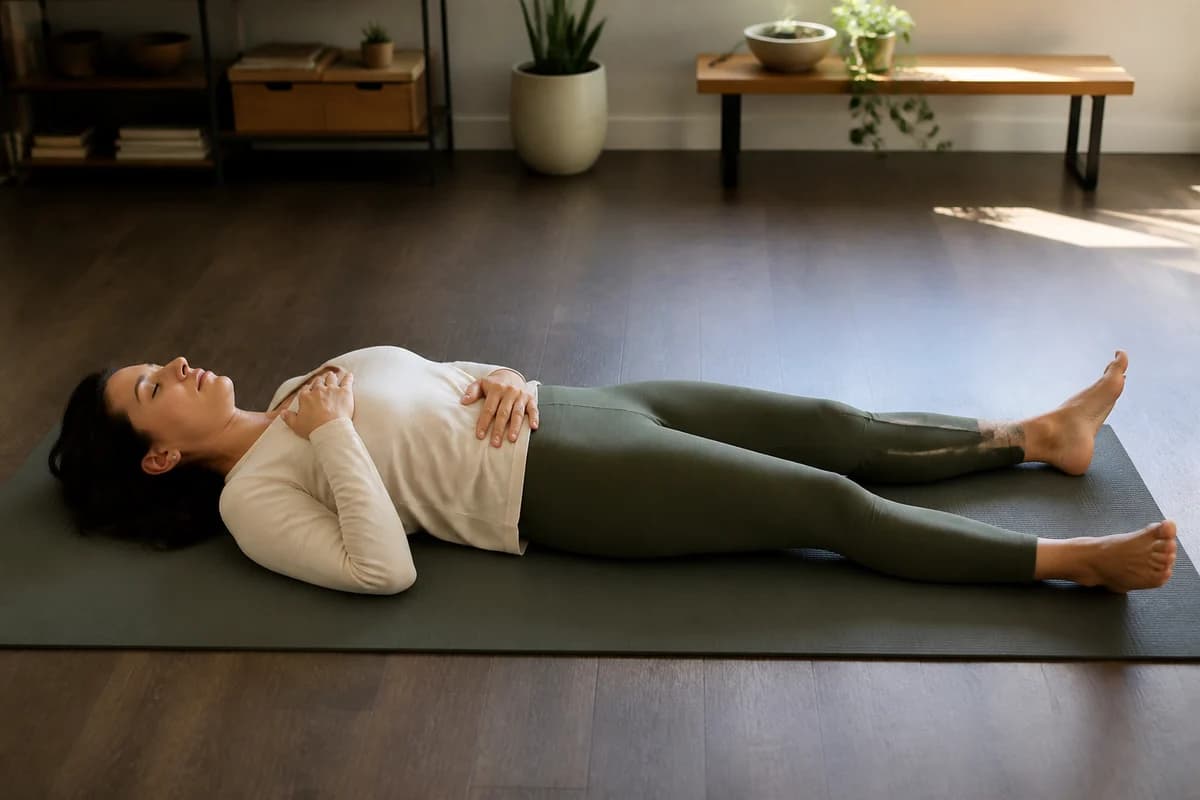
- Lie on a clear floorSee reference 3,See reference 4
- Stay far from all water and cold exposureSee reference 4,See reference 5
- Use fewer gentle breaths than maximal effortSee reference 5,See reference 6
- Never compete on breath-hold durationSee reference 6,See reference 7
- Resume normal breathing at symptomsSee reference 7,See reference 8
- Do not combine with driving or machinerySee reference 8,See reference 9
- Stop permanently after faintingSee reference 9,See reference 10
- Check the official guidance and evidence boundaries before escalating the protocol.See reference 10,See reference 1
First principles: what this can actually change
Repeated large breaths lower carbon dioxide and can cause respiratory alkalosis.See reference 1,See reference 2
Breath retention after overbreathing can delay the urge to breathe while oxygen falls.See reference 2,See reference 3
Acute adrenaline and immune-marker changes do not establish lasting disease prevention or better immunity.See reference 3,See reference 4
A practical protocol
- Stage
- Define
- What to do
- Prefer slower breathing first
- Why it matters
- Reduce avoidable errorSee reference 1,See reference 2
- Stage
- Screen
- What to do
- Screen contraindications
- Why it matters
- Reduce avoidable errorSee reference 2,See reference 3
- Stage
- Apply
- What to do
- Lie on a clear floor
- Why it matters
- Keep the dose repeatableSee reference 3,See reference 4
- Stage
- Apply
- What to do
- Stay far from all water and cold exposure
- Why it matters
- Keep the dose repeatableSee reference 4,See reference 5
- Stage
- Review
- What to do
- Use fewer gentle breaths than maximal effort
- Why it matters
- Keep the dose repeatableSee reference 5,See reference 6
- Stage
- Review
- What to do
- Never compete on breath-hold duration
- Why it matters
- Keep only what helpsSee reference 6,See reference 7
Timing and frequency
- Decision
- Starting frequency
- Practical answer
- No evidence-based health dose exists. Avoid unsupervised high-volume daily practice and never combine a breath-hold cycle with cold-water immersion.See reference 2,See reference 3
- Decision
- First review
- Practical answer
- Assess tolerability immediately; there is no validated longevity review periodSee reference 3,See reference 4
- Decision
- Best timing
- Practical answer
- Only when fully awake, sober, lying safely and with no immediate need to drive, swim, bathe or perform hazardous tasks.See reference 4,See reference 5
- Decision
- Stop rule
- Practical answer
- Stop for dizziness, tunnel vision, ringing ears, tingling, cramping, confusion, panic, chest pain, palpitations or near-fainting. Any loss of consciousness requires discontinuation and medical review.See reference 5,See reference 6,See reference 7
What to measure
- Signal
- Adverse effects and whether a defined wellbeing goal improves
- How to use it
- Record a baseline and compare at the review point
- Caveat
- Use the same method and conditionsSee reference 3,See reference 4
- Signal
- Mood or stress perception
- How to use it
- Track a weekly trend
- Caveat
- Expect normal variationSee reference 4,See reference 5
- Signal
- Adherence
- How to use it
- Record the exact dose and timing
- Caveat
- No exposure means no fair testSee reference 5,See reference 6
- Signal
- Interpretation
- How to use it
- Ask whether the result changes a real decision
- Caveat
- Longer breath holds largely reflect carbon-dioxide manipulation and are not proof of better oxygenation, lung health or fitness.See reference 6,See reference 7
What the evidence actually shows
A small trained-group experiment found altered autonomic and inflammatory responses to endotoxin; later reviews describe physiological effects but insufficient evidence for broad clinical claims.See reference 1,See reference 2,See reference 3
Evidence does not establish treatment of infection, autoimmune disease, depression, athletic performance or lifespan, and the branded method cannot be separated from training and expectation in many studies.See reference 4,See reference 5,See reference 6
Most studies measure short-term symptoms, physiology or biomarkers rather than clinical events or lifespan. The evidence supports a bounded experiment, not a longevity guarantee.See reference 6,See reference 7,See reference 8
Evidence strength by claim
- Claim
- Adverse effects and whether a defined wellbeing goal improves
- Evidence
- Preliminary mechanistic evidence; insufficient clinical benefit evidence
- Verdict
- A small trained-group experiment found altered autonomic and inflammatory responses to endotoxin; later reviews describe physiological effects but insufficient evidence for broad clinical claims.See reference 1,See reference 2
- Claim
- Mood or stress perception
- Evidence
- Mixed or context-dependent
- Verdict
- Evidence does not establish treatment of infection, autoimmune disease, depression, athletic performance or lifespan, and the branded method cannot be separated from training and expectation in many studies.See reference 3,See reference 4
- Claim
- Safety
- Evidence
- Depends on screening and dose
- Verdict
- Never practice in or near water, in a bath or shower, while driving, standing, at height, using machinery or during cold exposure. Avoid with pregnancy, epilepsy or seizure history, serious heart or lung disease, uncontrolled blood pressure, prior fainting, panic triggered by breathwork or recent surgery unless medically cleared.See reference 5,See reference 7
- Claim
- Longer life
- Evidence
- Not directly tested
- Verdict
- Do not turn an intermediate outcome into a lifespan promise.See reference 6,See reference 8
Limits and common overclaims
Studies are small and participants cannot be blinded.See reference 2,See reference 3
Training combines breathing, meditation and cold exposure.See reference 3,See reference 4
Rare catastrophic water-related harms are not captured well in trials.See reference 4,See reference 5
A four-step implementation plan
- Define the exact reason you are trying Wim Hof breathing.See reference 1
- Record a baseline for adverse effects and whether a defined wellbeing goal improves.See reference 2
- Use the same protocol until the Assess tolerability immediately; there is no validated longevity review period review point.See reference 3
- Continue only if benefit outweighs cost, time, discomfort and risk.See reference 4
Troubleshooting
- Problem
- No benefit
- What to do
- Check adherence, dose and whether adverse effects and whether a defined wellbeing goal improves is the right outcomeSee reference 2
- Problem
- Discomfort
- What to do
- Reduce the dose and stop for warning symptomsSee reference 3
- Problem
- Confusing data
- What to do
- Use the same measurement conditions and a longer trendSee reference 4
- Problem
- Too much burden
- What to do
- Choose the simpler intervention that solves the same problemSee reference 5
Safety and who should be cautious
Never practice in or near water, in a bath or shower, while driving, standing, at height, using machinery or during cold exposure. Avoid with pregnancy, epilepsy or seizure history, serious heart or lung disease, uncontrolled blood pressure, prior fainting, panic triggered by breathwork or recent surgery unless medically cleared. Stop for dizziness, tunnel vision, ringing ears, tingling, cramping, confusion, panic, chest pain, palpitations or near-fainting. Any loss of consciousness requires discontinuation and medical review.See reference 5,See reference 6,See reference 7
Who is most likely to benefit
People mainly seeking stress regulation can choose safer slow-breathing practices. Anyone who uses this method must accept that the dramatic sensations are not evidence of superior health benefit.See reference 2,See reference 3
It is less useful when adopted only because a score, trend or influencer made Wim Hof breathing seem mandatory.See reference 4,See reference 5
People with symptoms, diagnosed disease, pregnancy, recent surgery or complex medicines should adapt the protocol with an appropriate clinician.See reference 6,See reference 7
Track five things
- Adverse effects and whether a defined wellbeing goal improvesSee reference 1
- Mood or stress perceptionSee reference 2
- The exact dose and timingSee reference 3
- Symptoms and adverse effectsSee reference 4
- Whether the result changes a real decisionSee reference 5
Frequently asked questions
What is Wim Hof breathing method?
The Wim Hof breathing method alternates repeated deep breaths with breath holds. It can acutely lower carbon dioxide, alter blood pH and change stress responses; a small laboratory study showed trained participants could influence an experimentally induced inflammatory response. This does not prove broad immunity, disease treatment or longevity benefits.See reference 1,See reference 2
How often should I use Wim Hof breathing?
No evidence-based health dose exists. Avoid unsupervised high-volume daily practice and never combine a breath-hold cycle with cold-water immersion.See reference 2,See reference 3
How long before Wim Hof breathing works?
Use Assess tolerability immediately; there is no validated longevity review period as the first meaningful review point. Immediate sensations or device scores are not durable health outcomes.See reference 3,See reference 4
What should I track?
Track adverse effects and whether a defined wellbeing goal improves, mood or stress perception, adherence and adverse effects under similar conditions.See reference 4,See reference 5
Is Wim Hof breathing safe?
Never practice in or near water, in a bath or shower, while driving, standing, at height, using machinery or during cold exposure. Avoid with pregnancy, epilepsy or seizure history, serious heart or lung disease, uncontrolled blood pressure, prior fainting, panic triggered by breathwork or recent surgery unless medically cleared.See reference 5,See reference 6
When should I stop?
Stop for dizziness, tunnel vision, ringing ears, tingling, cramping, confusion, panic, chest pain, palpitations or near-fainting. Any loss of consciousness requires discontinuation and medical review.See reference 6,See reference 7
Does Wim Hof breathing increase lifespan?
No human trial proves that this tool extends an individual's lifespan. Its value depends on whether it improves a relevant symptom, behavior, function or established risk factor.See reference 7,See reference 8
Can it replace sleep, exercise, nutrition or medical care?
No. It is an optional layer around the fundamentals and should not delay evaluation of persistent or serious symptoms.See reference 8,See reference 9
Connect the protocol to your wider health picture
LongevityMate helps organize habits, symptoms, measurements and trends so one intervention stays in context instead of becoming the whole plan.
See how LongevityMate worksGet the weekly longevity brief
The week's best longevity research in plain English. Free, every Tuesday.
References
- 1. Voluntary activation of the sympathetic nervous system and attenuation of the innate immune response in humans.
Proceedings of the National Academy of Sciences of the United States of AmericaRandomized trial
- 2. A semi-randomised control trial assessing psychophysiological effects of breathwork and cold immersion.
Scientific reportsRandomized trial
- 3. Respiratory responses to cold water immersion: neural pathways, interactions, and clinical consequences awake and asleep.
Journal of applied physiology (Bethesda, Md. : 1985)Evidence review
- 4. Brief structured respiration practices enhance mood and reduce physiological arousal.
Cell reports. MedicineRandomized trial
- 5. The diving response and cardiac vagal activity: A systematic review and meta-analysis.
PsychophysiologyMeta-analysis
- 6. Applied physiology of diving.
Sports medicine (Auckland, N.Z.)Evidence review
- 7. Drowning prevention
World Health OrganizationOfficial guidance
- 8. Hyperventilation
MedlinePlusOfficial guidance
- 9. Fainting
National Health ServiceOfficial guidance
- 10. Epilepsy
National Institute of Neurological Disorders and StrokeOfficial guidance
Editorial transparency
- Published by
- LongevityMate Editorial Team
- Published
- Updated
Medical disclaimer
This guide provides general health education. It does not diagnose a condition, prescribe treatment, replace individualized medical care, or guarantee a health or longevity outcome.