
The 10 rules to remember
- Cold-water immersion is optional. Exercise, sleep, nutrition and medical care have stronger evidence for long-term health.See reference 1
- Start warmer and shorter than social-media protocols: 15-20 C (59-68 F) for 30-60 seconds is enough to learn your response.See reference 1,See reference 6
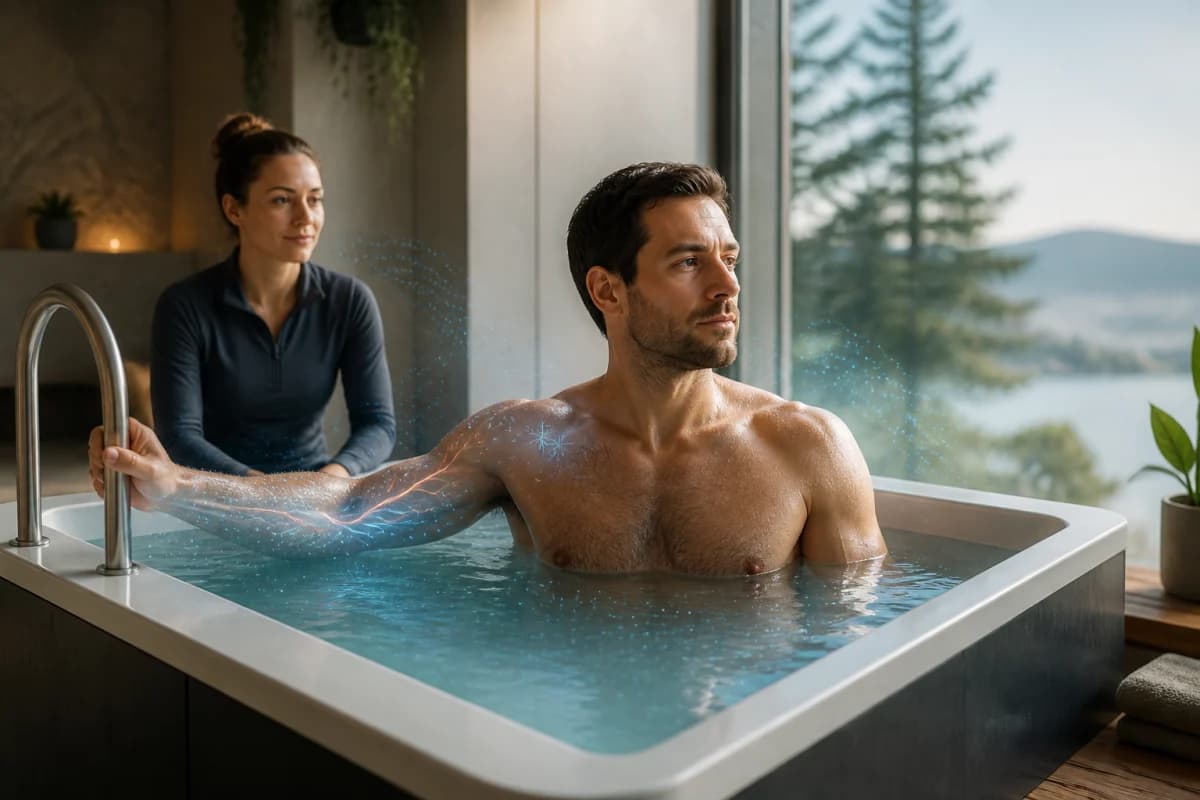
- Keep your head out, breathe normally and use a stable exit. Do not combine cold shock with face immersion or breath-holding.See reference 6,See reference 7
- Progress only one variable at a time—temperature, duration or frequency. Colder is not proven better.See reference 1,See reference 11
- For soreness after demanding exercise, roughly 10-15 C (50-59 F) for about 5-15 minutes is common in studies, but this is a recovery intervention, not a beginner wellness target.See reference 2,See reference 3,See reference 11
- Avoid routine immediate immersion after resistance training when maximizing muscle growth is the goal; use another time or a rest day instead.See reference 4
- Never use alcohol, sedatives, hyperventilation, breath-holds or a locked room around a plunge.See reference 6,See reference 7,See reference 8
- Never plunge alone. Cold shock can impair breathing and movement before hypothermia develops.See reference 6,See reference 8
- Dry off, dress warmly and rewarm gradually. Persistent violent shivering, confusion or loss of coordination is not a successful session.See reference 8
- There is no established cold-plunge dose for longevity, immunity, depression, fat loss or a sustained dopamine benefit.See reference 1,See reference 5
Choose the lowest cold dose that fits the goal
- Level
- First exposures
- Water and time
- Cool shower, or 15-20 C (59-68 F) for 30-60 seconds
- Frequency
- 1-2 times weekly
- Purpose
- Learn whether breathing, balance and rewarming remain normalSee reference 1,See reference 6
- Level
- Practical habit
- Water and time
- About 12-18 C (54-64 F) for 1-2 minutes
- Frequency
- 2-3 times weekly
- Purpose
- A conservative self-directed exposure; not a proven optimumSee reference 1,See reference 11
- Level
- Sport recovery protocol
- Water and time
- Often 10-15 C (50-59 F) for 5-15 minutes in trials
- Frequency
- After selected hard events, not automatically
- Purpose
- May reduce soreness and improve perceived recoverySee reference 2,See reference 3,See reference 11
- Level
- Not a public target
- Water and time
- Ice water, below 10 C (50 F), long exposure or forced shivering
- Frequency
- Any frequency
- Purpose
- Adds risk without proof of extra long-term benefitSee reference 1,See reference 6,See reference 8
Step by step: before, during and after
- Before: use a controlled tub with a thermometer, non-slip access and an easy exit. Tell another adult what you are doing and keep them nearby.See reference 6,See reference 8
- Before: skip the session if ill, feverish, intoxicated, sleep-deprived, already cold, dehydrated or unable to rewarm afterward.See reference 8
- Entry: step in gradually while holding the rail. Keep the head and face out; focus on a slow exhale without forcing a breathing pattern.See reference 6,See reference 7
- During: end the session at the planned time even if it feels easy. Do not wait for numbness, uncontrolled shivering or a wearable target.See reference 6,See reference 8
- Exit: move slowly, dry completely and add warm layers. Walk gently only if coordination is normal; avoid immediately driving if light-headed.See reference 8
- After: use warm air, clothing and a warm non-alcoholic drink. Do not use scalding water or another extreme temperature to chase rapid rewarming.See reference 8
First principles: what the water is doing
Water removes heat far faster than air. Sudden immersion activates a cold-shock response: an involuntary gasp, faster breathing, increased heart rate and a sharp rise in blood pressure. That immediate breathing and cardiovascular load—not just low core temperature—is why a short plunge can be dangerous.See reference 6,See reference 7
The body then constricts blood vessels in the skin and limbs to preserve central temperature. Dexterity and useful movement can fall while a person still feels mentally determined. Numbness is therefore a warning, not evidence of adaptation.See reference 6,See reference 8
Face immersion and breath-holding can activate a competing diving response while cold shock is accelerating the heart. The combination has been proposed as an arrhythmia mechanism called autonomic conflict. Keep the head out and do not perform underwater breath work.See reference 7
Before or after training? Match the timing to the goal
After a tournament, race or unusually hard session, cold-water immersion can reduce next-day soreness and improve perceived recovery. Pooled research also finds some benefits for power-related recovery, but strength recovery is less consistent. Feeling less sore does not prove that tissue repaired faster.See reference 2,See reference 3,See reference 15
Immediately after lifting is a different decision. A 2024 meta-analysis found that repeated post-exercise cold-water immersion may modestly attenuate resistance-training hypertrophy, although the underlying studies were small and certainty was limited. If muscle gain matters, separate plunging from lifting by using a rest day or another part of the day; research has not established an exact safe number of hours.See reference 4
Before hard training, cooling can reduce muscle temperature, nerve conduction and power until you are fully rewarmed. It is not a default warm-up. If cold is used for heat management before an endurance event, it should be a sport-specific plan followed by a complete warm-up.See reference 2,See reference 3
What the evidence actually supports
- Claim
- Less muscle soreness
- What studies show
- Small-to-moderate reductions after strenuous exercise
- Confidence
- Moderate
- Practical meaning
- Useful when short-term recovery mattersSee reference 2,See reference 3
- Claim
- Faster performance recovery
- What studies show
- Some power and perceived-recovery measures improve; strength findings vary
- Confidence
- Low to moderate
- Practical meaning
- Do not promise universal recoverySee reference 3,See reference 15
- Claim
- Stress, sleep and wellbeing
- What studies show
- A 2025 review found limited, time-dependent signals from a small evidence base
- Confidence
- Low
- Practical meaning
- Interesting, not a treatment protocolSee reference 1
- Claim
- Anti-inflammatory effect
- What studies show
- Inflammatory markers can rise immediately after immersion and vary later
- Confidence
- Low
- Practical meaning
- Cold is not simply an inflammation off-switchSee reference 1
- Claim
- Brown fat and metabolism
- What studies show
- Cold adaptation can alter thermogenesis in small physiological studies
- Confidence
- Low for clinical benefit
- Practical meaning
- Not proof of meaningful fat lossSee reference 5,See reference 12
- Claim
- Longer life or fewer chronic diseases
- What studies show
- No cold-plunge trial demonstrates this
- Confidence
- Very low
- Practical meaning
- Do not call plunging a proven longevity interventionSee reference 1,See reference 5
Popular claims that go beyond the data
- Claim
- Everyone needs 11 minutes per week
- Better answer
- No universal clinical threshold exists
- Why
- The number is public guidance, not a validated minimum dose for longevitySee reference 12
- Claim
- A plunge boosts dopamine for hours
- Better answer
- Acute catecholamine studies do not establish a durable mental-health benefit
- Why
- Hormone changes are not the same as better outcomesSee reference 5,See reference 12
- Claim
- Cold plunges prevent colds
- Better answer
- Not established
- Why
- Cold-shower absenteeism results do not prove fewer infections, and plunge evidence is sparseSee reference 10
- Claim
- Cold is a practical fat-loss tool
- Better answer
- Energy expenditure may rise, but meaningful weight loss has not been demonstrated
- Why
- Adaptation, appetite and total energy balance matterSee reference 5
- Claim
- More pain means more benefit
- Better answer
- Use the lowest repeatable exposure
- Why
- Distress increases risk and has no validated health scoreSee reference 1,See reference 6
Stop immediately—and know the emergency signs
Exit for chest pain, palpitations, severe or uncontrollable breathlessness, dizziness, near-fainting, panic that does not settle, confusion, slurred speech, loss of coordination, marked weakness, blue or grey skin, numbness or violent shivering. Call emergency services for collapse, persistent chest pain, serious breathing difficulty, altered consciousness or suspected hypothermia. Keep the person horizontal and sheltered, remove wet clothing, insulate them and do not leave them alone.See reference 6,See reference 8
Who should avoid it or get medical guidance first?
Do not self-prescribe immersion with unstable heart disease, recent cardiac events, uncontrolled high blood pressure, serious arrhythmia, recurrent unexplained fainting or a history of cold-triggered chest pain. Sudden cold raises cardiovascular workload before any supposed benefit begins.See reference 6,See reference 9
Ask a clinician first if you have Raynaud phenomenon, peripheral vascular disease, neuropathy or impaired sensation, cold urticaria, asthma triggered by cold, seizure disorder, autonomic dysfunction, diabetes complications, pregnancy, or medicines that alter blood pressure, rhythm, alertness or temperature control.See reference 6,See reference 8,See reference 9
Children, adolescents and people unable to understand or communicate symptoms should not follow an adult social-media protocol. Open-water swimming requires separate safety skills and supervision.See reference 8
A cold tub is not the same as open water
Currents, waves, depth, poor visibility and a distant exit turn cold shock into a drowning risk. Never use an outdoor swim as your first cold exposure, never go alone, and use local safety guidance, appropriate flotation and an observed exit plan. Water below 15 C (59 F) can trigger cold shock even when the air feels warm.See reference 8
Cold plunge after sauna and contrast therapy
A cold plunge is not required after sauna. Comfortable air or shower cooling is enough. Moving straight from high heat into cold water creates another abrupt cardiovascular stress; no clinical trial proves that the dramatic contrast adds longevity benefit.See reference 6,See reference 9
If a healthy, experienced person enjoys contrast bathing, finish the sauna, restore balance and breathing, use milder water, keep the head out and have another adult nearby. Do not copy a rigid number of rounds. The safest ending temperature is the one that leaves you stable and able to rewarm.See reference 6,See reference 8
How public health figures describe cold exposure
- Person
- Andrew Huberman
- Public guidance
- About 11 total minutes weekly, split across 2-4 sessions, with uncomfortably cold but safe water
- Useful idea
- Progressive, repeatable exposure is more sensible than maximum cold
- Evidence boundary
- Public science communication—not a validated universal threshold or longevity doseSee reference 12,See reference 13
- Person
- Rhonda Patrick
- Public guidance
- Discusses cold stress, brown fat and exercise timing in public Q&A
- Useful idea
- Separates mechanisms from practical timing questions
- Evidence boundary
- Educational interpretation, not a personal prescription for every risk profileSee reference 14
How to personalize it without chasing extremes
- Record water temperature, immersion time, head position, breathing control and who was present.See reference 1,See reference 6
- Track rewarming time, shivering, sleep, soreness and next-day training—not just how brave the session felt.See reference 1,See reference 3
- Change only temperature, duration or weekly frequency at one time and repeat several sessions before progressing.See reference 1,See reference 11
- Stop progressing if you need breath-holding, forced hyperventilation, prolonged shivering or external help to exit.See reference 6,See reference 8
- Use cold only when its outcome matters. Skipping it is a valid evidence-based choice.See reference 1,See reference 4
Cold plunge questions people ask most
What temperature should a beginner use?
Start around 15-20 C (59-68 F), or with a cool shower. The goal is to learn controlled breathing and safe rewarming, not to reach ice-water temperatures.See reference 1,See reference 6
How long should I stay in a cold plunge?
Begin with 30-60 seconds and build toward one to two minutes only if well tolerated. Longer 5-15 minute protocols appear in sports-recovery trials at controlled temperatures, but they are not a beginner longevity requirement.See reference 1,See reference 2,See reference 3
How often should I cold plunge?
One or two weekly exposures are enough to learn your response; two or three can be a practical habit. No trial establishes an optimal weekly frequency for longevity.See reference 1,See reference 5
Should I cold plunge after lifting weights?
Not routinely if maximizing muscle growth is the priority. Repeated immediate post-lifting immersion may modestly blunt hypertrophy. Use it selectively when rapid recovery matters, or place it on a rest day or another part of the day.See reference 4
Is cold plunging good before exercise?
It is not a normal warm-up. Cooling can reduce muscle temperature and performance until you rewarm. Pre-cooling can be useful in specialist hot-weather endurance plans, followed by a full warm-up.See reference 2,See reference 3
Should I put my head under?
No for a general plunge. Keep the head and face out. Face immersion plus breath-holding can create competing autonomic responses and may increase arrhythmia risk.See reference 7
Should I do breathing exercises in the water?
Breathe normally and emphasize a calm exhale. Never hyperventilate or hold your breath in or near water because loss of consciousness can be fatal.See reference 6,See reference 7
Does cold plunge burn fat?
Cold can increase thermogenesis, but no practical plunge protocol has been shown to produce meaningful long-term fat loss. It should not replace nutrition, activity or evidence-based obesity care.See reference 5
Does cold plunge boost immunity or prevent illness?
This is not established. A large cold-shower trial found less sickness absence but not fewer reported illness days, and that result does not prove that cold plunges prevent infections.See reference 10
Is the 11-minutes-per-week protocol scientifically proven?
No. It is a public protocol popularized by Andrew Huberman, not a validated minimum effective dose for longevity, mental health or fat loss.See reference 12,See reference 13
Can I cold plunge every day?
Some healthy experienced users do, but daily exposure has not been proven necessary or superior. More frequency means more chances for cold shock and may conflict with resistance-training adaptation.See reference 1,See reference 4,See reference 6
What is the safest way to rewarm?
Exit slowly, dry completely, add warm layers and use a warm non-alcoholic drink. Seek help for confusion, loss of coordination, persistent violent shivering or worsening symptoms.See reference 8
Make recovery fit your complete health picture
LongevityMate brings your blood results, wearable trends, goals and habits into one place so you can judge whether a recovery routine supports—or disrupts—your progress.
See how LongevityMate worksGet the weekly longevity brief
The week's best longevity research in plain English. Free, every Tuesday.
References
- 1. Effects of cold-water immersion on health and wellbeing: A systematic review and meta-analysis
PLOS ONESystematic review
- 2. Cold-water immersion for preventing and treating muscle soreness after exercise
CochraneSystematic review
- 3. Effects of post-exercise cold-water immersion on recovery characteristics
Sports MedicineMeta-analysis
- 4. Effects of post-exercise cold-water immersion on resistance training-induced gains in muscular strength and hypertrophy
European Journal of Sport ScienceMeta-analysis
- 5. Cold exposure and musculoskeletal conditions; effects on body composition and metabolic health
European Journal of Applied PhysiologySystematic review
- 6. You're not a polar bear: The plunge into cold water comes with risks
American Heart AssociationOfficial guidance
- 7. Autonomic conflict: a different way to die during cold water immersion?
The Journal of PhysiologyEvidence review
- 8. Cold water shock
Royal National Lifeboat InstitutionOfficial guidance
- 9. Nonoptimal temperature and cardiovascular health
American Heart AssociationOfficial guidance
- 10. The effect of cold showering on health and work: a randomized controlled trial
PLOS ONERandomized trial
- 11. Optimizing the dose of cold-water immersion for post-exercise recovery
Sports MedicineMeta-analysis
- 12. The science and use of cold exposure for health and performance
Huberman LabEvidence review
- 13. Using deliberate cold exposure for health and performance
Huberman LabEvidence review
- 14. Cold exposure, brown fat and exercise timing Q&A
FoundMyFitnessEvidence review
- 15. Temporal effects of post-exercise cold-water immersion on strength recovery
European Journal of Sport ScienceMeta-analysis
Editorial transparency
- Published by
- LongevityMate Editorial Team
- Published
- Updated
Medical disclaimer
This guide provides general education for adults. It does not determine whether cold-water immersion is safe for you, diagnose hypothermia, prescribe treatment or replace advice from a qualified clinician who knows your heart, circulation, medicines, pregnancy status and prior response to cold.