
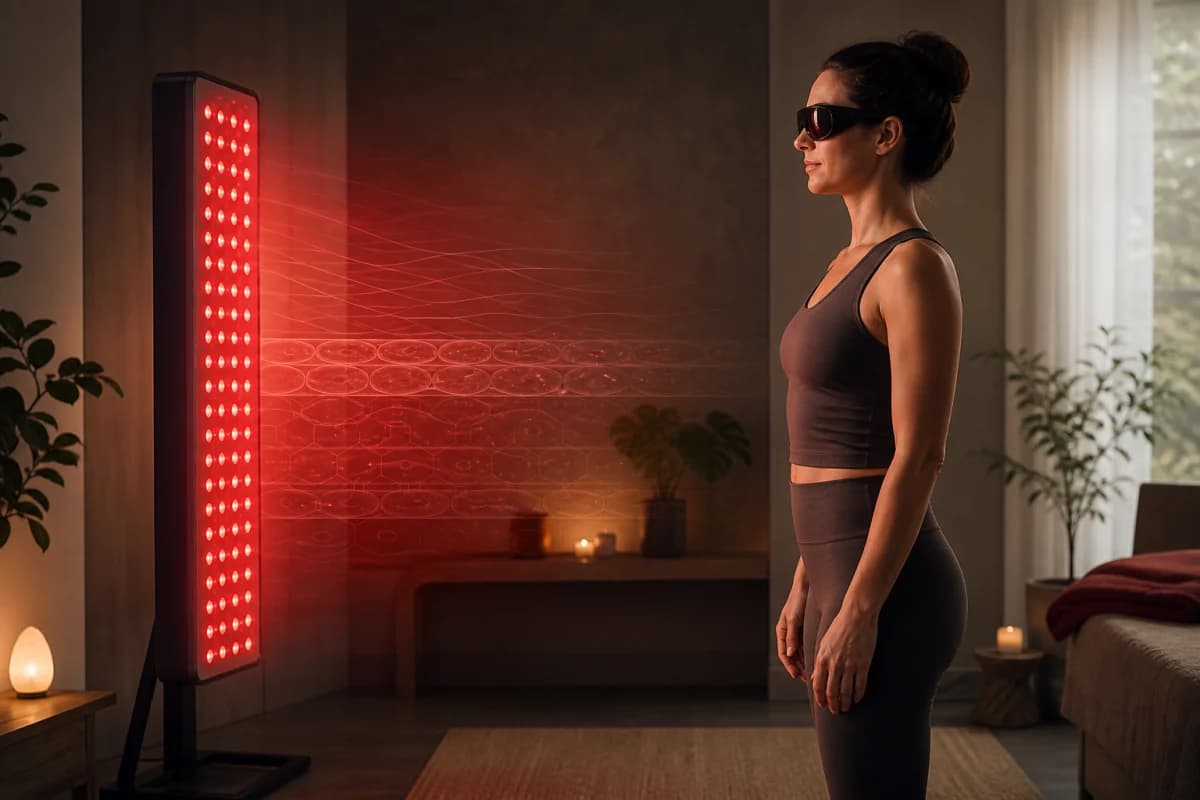
The 10 rules to remember
- Treat photobiomodulation as a device-specific intervention, not a generic red glow.See reference 1,See reference 6
- Choose the target first, then a device tested or regulated for that target. Do not buy a full-body panel and assume it treats everything.See reference 1,See reference 5
- Record wavelength, measured irradiance at your distance, session time, area and frequency. Minutes alone are not a dose.See reference 6,See reference 7
- Follow the device distance. Irradiance can change sharply with distance, beam angle and treatment area.See reference 6
- Use the supplied eye protection exactly as instructed and never stare into LEDs or invisible near-infrared emitters.See reference 1,See reference 5
- Start with the minimum recommended exposure. Photobiomodulation can show a biphasic response: too much may be less effective than a moderate dose.See reference 7
- Do not assume equal joules per square centimetre from different wavelengths, pulse patterns or devices are biologically equivalent.See reference 6,See reference 7
- The best-supported consumer uses are selected hair-loss and skin outcomes; evidence is not equally strong for every claim.See reference 1,See reference 2,See reference 3,See reference 4
- Whole-body longevity, fat loss, testosterone, detox and broad mitochondrial-optimization claims are not established clinical outcomes.See reference 2,See reference 8
- Track a visible or functional outcome and stop if it does not improve after the evidence-aligned trial period.See reference 1,See reference 3,See reference 4
Start with the goal—not a universal timer
- Goal
- Androgenetic hair loss
- Best starting approach
- A cap, comb or helmet cleared for pattern hair loss; use its exact schedule
- Assessment window
- Often 16-26 weeks
- Evidence boundary
- Can improve hair density on average; not all hair loss is androgeneticSee reference 1,See reference 3
- Goal
- Fine lines and photoaging
- Best starting approach
- A face device studied for that use, with eye protection and consistent photography
- Assessment window
- About 8-12 weeks
- Evidence boundary
- Changes are usually subtle and products differSee reference 1,See reference 4,See reference 9
- Goal
- Local musculoskeletal pain
- Best starting approach
- Use a clinician-guided or indication-specific device and protocol
- Assessment window
- Condition-specific
- Evidence boundary
- Results vary by diagnosis, location and doseSee reference 2,See reference 6
- Goal
- Exercise performance or recovery
- Best starting approach
- Do not buy a panel solely on broad recovery claims
- Assessment window
- Training block
- Evidence boundary
- Some small effects, inconsistent subgroups and no clear whole-body benefitSee reference 8,See reference 11,See reference 12
- Goal
- Longevity or general wellness
- Best starting approach
- No validated self-directed protocol
- Assessment window
- Not established
- Evidence boundary
- No trial shows that a consumer panel extends healthy lifespanSee reference 2,See reference 8
Step by step: before, during and after
- Before: confirm the exact model, intended use, wavelength, treatment distance, session time, frequency and eye instructions in the manual.See reference 1,See reference 5,See reference 6
- Before: remove makeup, sunscreen or clothing over the target unless the tested instructions say otherwise; avoid adding untested photosensitizing skincare.See reference 1
- During: position the device at the specified distance and angle. Use a timer and do not move closer to make the session feel stronger.See reference 5,See reference 6
- During: wear the required goggles. Closed eyelids or ordinary sunglasses are not substitutes unless the manufacturer explicitly validates them.See reference 1,See reference 5
- After: record the dose and any warmth, redness, headache, eye symptoms or pigment change. Do not stack another session because nothing was felt.See reference 1,See reference 7
- Review: compare the same outcome under the same lighting, angle and conditions. Stop paying for an intervention that produces no meaningful change.See reference 1,See reference 3,See reference 4
First principles: wavelength, power, time and tissue
Photobiomodulation uses non-ionizing red or near-infrared light, commonly in roughly the 600-1100 nanometre range, to influence biological signalling. Red wavelengths are absorbed more superficially; near-infrared can penetrate farther, but no wavelength reaches every tissue at a therapeutic dose.See reference 6,See reference 7
Irradiance is power arriving per unit area, commonly milliwatts per square centimetre. Fluence is energy per area: irradiance in watts per square centimetre multiplied by seconds. For example, 20 mW/cm2 for 300 seconds equals 6 J/cm2—if the measured irradiance is accurate at the treatment surface.See reference 6,See reference 7
That arithmetic is useful but incomplete. Wavelength, pulse pattern, beam distribution, skin optical properties, distance, reflection, tissue depth and treatment schedule all influence the biological result. Two devices reporting the same J/cm2 are not automatically equivalent.See reference 6,See reference 7
How to read a real device dose
- Variable
- Wavelength (nm)
- What it means
- The colour or near-infrared band
- What to verify
- Actual peak and bandwidth
- Common mistake
- Assuming 660 and 850 nm are best for every targetSee reference 6
- Variable
- Irradiance (mW/cm2)
- What it means
- Power reaching each area
- What to verify
- Measured at the instructed distance
- Common mistake
- Using maximum output measured directly at the LEDsSee reference 5,See reference 6
- Variable
- Fluence (J/cm2)
- What it means
- Energy delivered per area
- What to verify
- Irradiance x seconds with unit conversion
- Common mistake
- Treating the same number as universally equivalentSee reference 6,See reference 7
- Variable
- Treatment area
- What it means
- How evenly the target receives light
- What to verify
- Coverage and beam profile
- Common mistake
- Using centre-point power for the whole bodySee reference 5,See reference 6
- Variable
- Frequency and course
- What it means
- How dose accumulates over weeks
- What to verify
- Protocol tested for the indication
- Common mistake
- Doubling frequency after one missed sessionSee reference 1,See reference 3,See reference 4
What the evidence actually supports
- Use
- Androgenetic alopecia
- What studies show
- Meta-analyses find increased hair density versus sham in many studies
- Confidence
- Moderate
- Practical meaning
- Reasonable for diagnosed pattern hair loss with a tested deviceSee reference 2,See reference 3
- Use
- Wrinkles and skin rejuvenation
- What studies show
- Some randomized studies report modest improvement
- Confidence
- Low to moderate
- Practical meaning
- Expect subtle changes, not resurfacing-equivalent resultsSee reference 1,See reference 4,See reference 9
- Use
- Pain and function
- What studies show
- Benefits appear for selected conditions, but not uniformly
- Confidence
- Low to moderate by condition
- Practical meaning
- Diagnosis and protocol matter more than the red-light labelSee reference 2,See reference 6
- Use
- Cancer-treatment oral mucositis
- What studies show
- Guidelines support precise clinician-delivered protocols in selected settings
- Confidence
- Moderate for specified protocols
- Practical meaning
- This does not validate DIY light over a tumour or every mouth conditionSee reference 10
- Use
- Exercise performance and recovery
- What studies show
- Meta-analysis finds small effects in some studies; whole-body review found no clear benefit
- Confidence
- Low
- Practical meaning
- Not a dependable replacement for training and recovery basicsSee reference 8,See reference 11,See reference 12
- Use
- Sleep and general wellbeing
- What studies show
- Whole-body evidence is small and preliminary
- Confidence
- Very low
- Practical meaning
- Track personally; do not market it as established sleep treatmentSee reference 8
Skin and hair: where consumer evidence is most useful
For pattern hair loss, the central question is diagnosis. Low-level light devices can improve average hair density, but they will not correct scarring alopecia, thyroid disease, iron deficiency, medication effects or another cause of shedding. Seek assessment for sudden, patchy, painful or scarring loss.See reference 1,See reference 3
For photoaging, trials report changes in fine lines, texture and collagen-related measures, but effects are generally gradual and less dramatic than advertising images suggest. Standardized photographs and a predefined stopping rule protect against paying indefinitely for imperceptible change.See reference 1,See reference 4,See reference 9
Visible light may trigger or worsen pigmentation in some darker skin tones and photosensitive conditions. Patch testing and dermatology guidance are sensible if hyperpigmentation is a concern.See reference 1
Before or after workouts? The exact device matters more
A 2024 meta-analysis reported small-to-modest improvements in some pre-exercise performance outcomes, but effects varied by muscle group, training status and protocol. A separate whole-body review found only five small studies and no clear performance or recovery benefit.See reference 8,See reference 11
There is therefore no universal reason to schedule a home panel before or after every workout. If using a studied local protocol, match its timing. Otherwise choose the time you can repeat safely without replacing sleep, warm-up, nutrition or rehabilitation.See reference 8,See reference 11,See reference 12
Do not use symptom relief to train through a suspected fracture, tendon rupture, infection or serious injury. Light does not establish a diagnosis or prove tissue is ready for load.See reference 12
A buying checklist that filters out weak devices
- The exact intended indication is named, not a list of every possible wellness benefit.See reference 1,See reference 5
- The company distinguishes FDA cleared from registered, listed, certified or approved; these terms are not interchangeable.See reference 1,See reference 5
- Wavelength and measured irradiance are reported at the actual treatment distance, with coverage area and tolerances.See reference 5,See reference 6
- Instructions include distance, time, frequency, contraindications, skin warnings and eye protection.See reference 1,See reference 5
- Independent clinical evidence uses the same or genuinely equivalent device—not merely the same colour.See reference 2,See reference 6
- Returns, warranty, electrical safety and customer support are clear enough to protect a long treatment trial.See reference 5
Stop and seek help for important reactions
Stop the device for burning pain, blistering, persistent or worsening redness, swelling, a new rash, significant headache, dizziness, eye pain, persistent after-images or any vision change. Urgent eye symptoms, severe burns or a rapidly changing skin lesion need prompt clinical assessment. Do not keep treating through symptoms because the device is described as non-UV or non-invasive.See reference 1,See reference 5
Who should get clinical guidance first?
Ask a clinician before use if you have lupus or another photosensitive disorder, porphyria, a seizure disorder triggered by light, significant eye disease, a history of abnormal photosensitivity, or take a medicine or supplement that can increase light sensitivity. Do not stop prescribed medicine to use a device.See reference 1,See reference 5
Do not self-treat an active or suspected cancer, an unexplained mole or a changing skin lesion. Photobiomodulation is used clinically in some cancer supportive-care protocols, but that is different from directing an unmonitored home panel at a tumour or treatment site.See reference 5,See reference 10
Pregnancy and children are under-studied for broad home-panel use. Use only with the relevant clinician and a device specifically intended for that population and purpose.See reference 1,See reference 5
Marketing claims that need correction
- Claim
- It optimizes every cell's mitochondria
- Better answer
- Mechanistic signalling does not prove every clinical claim
- Why
- Benefits remain indication- and dose-specificSee reference 2,See reference 6,See reference 7
- Claim
- A full-body panel improves longevity
- Better answer
- Not established
- Why
- No lifespan or healthspan trial validates a consumer protocolSee reference 2,See reference 8
- Claim
- Red light raises testosterone
- Better answer
- No reliable clinical protocol is established
- Why
- Small or indirect findings do not support consumer claimsSee reference 2
- Claim
- It melts fat
- Better answer
- Not a proven weight-loss treatment
- Why
- Local appearance outcomes are not durable whole-body fat lossSee reference 2
- Claim
- More power and time work better
- Better answer
- Dose response can be biphasic
- Why
- Too much may add heat or irritation without adding benefitSee reference 7
- Claim
- FDA registered means proven effective
- Better answer
- Registration is not clearance or proof
- Why
- Check the exact device, indication and regulatory claimSee reference 1,See reference 5
How public longevity figures describe red light
- Person
- Bryan Johnson
- Publicly reported use
- A 2026 morning-routine post reports six minutes daily surrounded by red-light panels
- Useful idea
- He makes the routine measurable and repeatable
- Evidence boundary
- One-person, uncontrolled use; panel geometry and dose cannot be generalizedSee reference 13,See reference 14
- Person
- Andrew Huberman
- Publicly reported use
- Public education discusses red and near-infrared light by wavelength, timing and biological target
- Useful idea
- Light type and goal matter
- Evidence boundary
- Science communication is not a tested prescription for a specific consumer deviceSee reference 15
Run a useful personal trial
- Write one target outcome before starting: hair count, standardized wrinkle photo, pain score plus function, or another measurable result.See reference 1,See reference 3,See reference 4
- Record device model, wavelength, distance, intensity setting, minutes, area and eye protection each session.See reference 5,See reference 6
- Keep skincare, hair treatment, training and photography conditions stable enough to interpret the result.See reference 1,See reference 3,See reference 4
- Define the assessment date and the minimum meaningful improvement before buying or starting.See reference 1
- If there is no meaningful benefit after a complete evidence-aligned trial, stop rather than escalating dose indefinitely.See reference 7
Red light therapy questions people ask most
How long should a red light therapy session be?
There is no universal number. Use the exact time, distance and intensity tested for your device and goal. Ten minutes from one panel can deliver a very different dose from ten minutes at another.See reference 5,See reference 6,See reference 7
How often should I use red light therapy?
Follow the indication-specific instructions. Many devices use several sessions weekly, but daily use is not automatically better and missed sessions should not be doubled.See reference 1,See reference 3,See reference 4,See reference 7
What wavelength is best?
No wavelength is best for everything. Red light is generally more superficial and near-infrared penetrates farther, but the target, dose and device determine whether that matters.See reference 6,See reference 7
Do I need goggles?
Use the eye protection specified by the device. Never stare into the LEDs. Near-infrared can be invisible, so lack of brightness is not proof of eye safety.See reference 1,See reference 5
Should I use red light before or after a workout?
There is no universal timing. Some local pre-exercise protocols show small effects, while whole-body evidence is limited. Match a tested protocol or choose the time that does not displace proven training and recovery habits.See reference 8,See reference 11,See reference 12
Does red light therapy regrow hair?
It can modestly increase hair density for androgenetic alopecia on average. Diagnose the cause first and use a device tested or cleared for pattern hair loss; sudden or scarring loss needs assessment.See reference 1,See reference 3
Does red light therapy reduce wrinkles?
Some trials report modest improvements in fine lines and skin measures after consistent use. Expect gradual, subtle change and compare standardized photographs.See reference 1,See reference 4,See reference 9
Can red light therapy help pain?
It may help selected conditions, but results and doses differ by diagnosis and treatment site. A generic full-body panel is not proven treatment for unexplained pain.See reference 2,See reference 6
Is red light therapy the same as UV tanning?
No. Red and near-infrared devices do not use ultraviolet light to tan skin. That removes UV damage as the mechanism but does not make excessive heat, eye exposure or every device harmless.See reference 1,See reference 5
Can red light therapy cause cancer?
It is not UV and is not established as a cause of skin cancer, but do not direct a home device at a known or suspected tumour or changing lesion without the treating clinician. Clinical oncology protocols are highly specific.See reference 5,See reference 10
Can darker skin tones use red light therapy?
They can, but visible light may worsen pigmentation in some people. Use a cautious patch test and ask a dermatologist if you have melasma, post-inflammatory hyperpigmentation or another pigment disorder.See reference 1
Is Bryan Johnson's six-minute routine the best protocol?
No. It is his publicly reported routine with his panel setup, not a universal dose. Six minutes on a different device, distance or body area can deliver a different exposure.See reference 13,See reference 14
Does red light therapy improve longevity or testosterone?
Neither claim has an established consumer protocol or convincing clinical outcome evidence. Mechanistic mitochondrial effects should not be converted into promises about lifespan or hormones.See reference 2,See reference 8
Measure the outcome—not the marketing claim
LongevityMate brings your blood results, wearable trends, goals and habits into one place so you can judge whether a new routine produces a meaningful change.
See how LongevityMate worksGet the weekly longevity brief
The week's best longevity research in plain English. Free, every Tuesday.
References
- 1. Is red light therapy right for your skin?
American Academy of DermatologyOfficial guidance
- 2. Effects of photobiomodulation therapy on multiple health outcomes: an umbrella review of meta-analyses
BMC MedicineSystematic review
- 3. Efficacy of photobiomodulation in the treatment of androgenetic alopecia
Lasers in Medical ScienceMeta-analysis
- 4. Efficacy of light-emitting diode therapy for facial skin rejuvenation
Journal of Cosmetic DermatologyMeta-analysis
- 5. Photobiomodulation devices: premarket notification guidance
U.S. Food and Drug AdministrationOfficial guidance
- 6. Photobiomodulation therapy: a position paper from the World Association for Photobiomodulation Therapy
Photobiomodulation, Photomedicine, and Laser SurgeryGuideline
- 7. Biphasic dose response in low level light therapy
Dose-ResponseEvidence review
- 8. Whole-body photobiomodulation therapy for exercise performance, recovery and sleep
Lasers in Medical ScienceSystematic review
- 9. A randomized controlled trial of home-use LED and infrared facial treatment
Lasers in Medical ScienceRandomized trial
- 10. MASCC/ISOO clinical practice guidelines for the management of mucositis secondary to cancer therapy
CancerGuideline
- 11. Photobiomodulation therapy before exercise and muscular performance
Lasers in Medical ScienceMeta-analysis
- 12. Photobiomodulation therapy in athletes for pain and return to play
Sports HealthSystematic review
- 13. Bryan Johnson's morning routine
BlueprintEvidence review
- 14. Bryan Johnson's public protocol
BlueprintEvidence review
- 15. Using light to optimize health
Huberman LabEvidence review
Editorial transparency
- Published by
- LongevityMate Editorial Team
- Published
- Updated
Medical disclaimer
This guide provides general education for adults. It does not diagnose hair loss, skin disease, pain, eye disease or cancer; determine whether a device is safe for you; or replace device instructions and advice from a qualified clinician who knows your conditions, medicines and treatment history.