
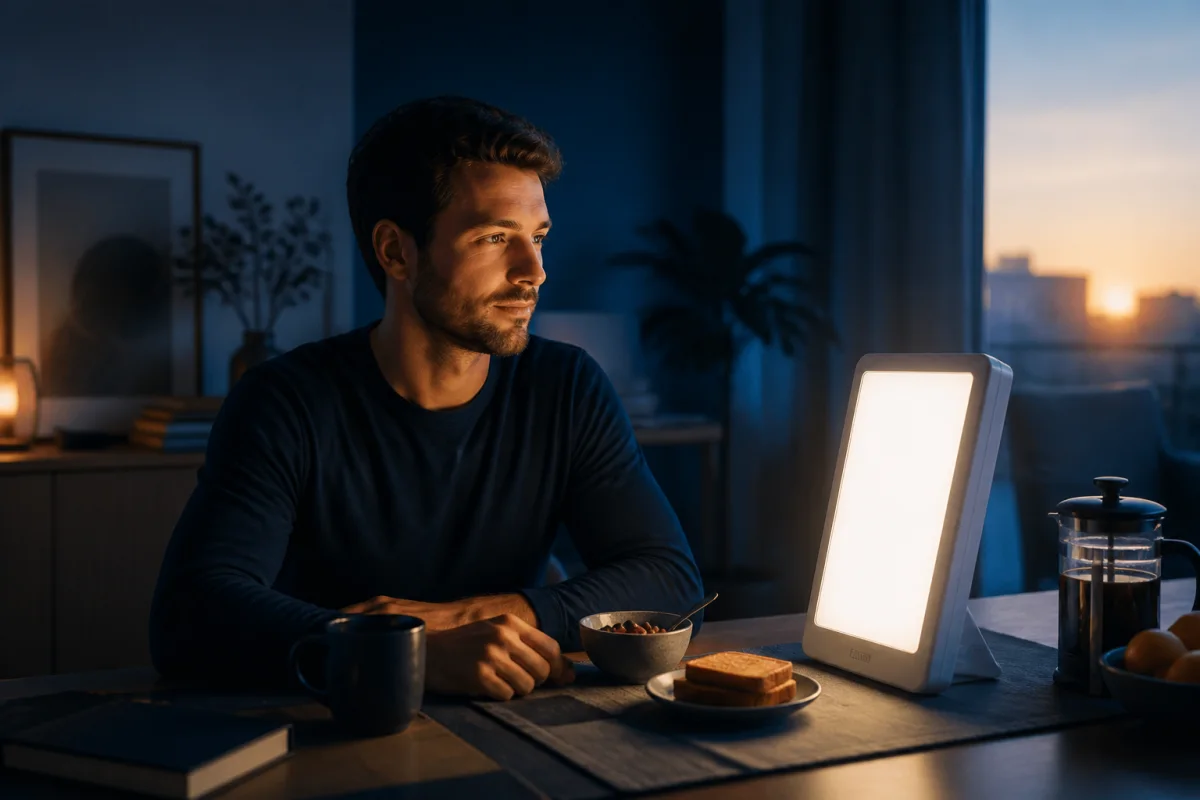
The 10 rules to remember
- Lux at your eyes—not bulb wattage—defines the dose.See reference 1
- Use the distance specified by the manufacturer.See reference 2
- Eyes stay open, but do not stare at the light.See reference 3
- Morning is common, not universally correct.See reference 4
- Keep timing consistent while evaluating response.See reference 5
- Do not assume any bright lamp is a therapeutic device.See reference 6
- UV should be filtered out.See reference 7
- Track agitation and reduced need for sleep, not only mood.See reference 8
- Natural outdoor morning light remains useful when available.See reference 9
- Light therapy is treatment, not proof that winter symptoms are SAD.See reference 10
First principles: what this tool can actually change
Light reaching specialized retinal cells signals the brain's circadian clock and suppresses melatonin. Timing determines whether the clock shifts earlier, later or receives a stabilizing daytime signal.See reference 1,See reference 2
For seasonal depression, bright light can alter circadian and non-circadian pathways involved in mood and alertness.See reference 2,See reference 3
Illuminance falls rapidly with distance, so a device delivering 10,000 lux at 20 cm may deliver far less across a room.See reference 3,See reference 4
A practical protocol
- Stage
- Typical SAD start
- What to do
- 10,000 lux for about 30 min
- Why it matters
- Soon after wakingSee reference 2
- Stage
- Lower intensity
- What to do
- Longer exposure may be needed
- Why it matters
- Follow validated protocolSee reference 3
- Stage
- Circadian delay
- What to do
- Precisely timed morning light
- Why it matters
- Specialist timing is valuableSee reference 4
- Stage
- Night-shift use
- What to do
- Timing depends on work and sleep target
- Why it matters
- Avoid generic morning ruleSee reference 5
Timing and frequency
- When
- After waking
- Action
- Common starting window for winter depressionSee reference 5
- When
- During session
- Action
- Eyes open; light angled, no direct staringSee reference 6
- When
- Evening
- Action
- May delay sleep timing and worsen insomnia in some peopleSee reference 7
- When
- 1-2 weeks
- Action
- Review symptoms and adverse effectsSee reference 8
What to measure
- Signal
- Lux
- How
- Light reaching a surface
- Interpretation
- Dose depends on distanceSee reference 8
- Signal
- Duration
- How
- Minutes per session
- Interpretation
- Trades off with intensitySee reference 9
- Signal
- Clock time
- How
- Timing relative to sleep
- Interpretation
- Changes circadian directionSee reference 10
- Signal
- Symptoms
- How
- Mood, sleep, energy, agitation
- Interpretation
- Determines benefit and safetySee reference 1
What the evidence supports
Evidence is strongest for seasonal affective disorder; light can also be used in selected circadian-rhythm disorders.See reference 1,See reference 4
Benefits for non-seasonal depression are promising in some analyses, often as an adjunct, but treatment should be coordinated clinically.See reference 2,See reference 5
A lamp cannot replace assessment for bipolar disorder, suicidality, sleep apnea, medication effects or other causes of fatigue and low mood.See reference 3,See reference 6
Evidence strength by claim
- Claim
- The protocol changes its immediate target
- Confidence
- Moderate to strong
- Important boundary
- Depends on correct technique and populationSee reference 1,See reference 2
- Claim
- It improves a clinical or functional outcome
- Confidence
- Variable
- Important boundary
- Effect size and relevance differSee reference 3,See reference 4
- Claim
- It prevents major disease
- Confidence
- Usually limited
- Important boundary
- Surrogate outcomes are not clinical eventsSee reference 5,See reference 6
- Claim
- It extends human lifespan
- Confidence
- Not established
- Important boundary
- Association is not proof of causationSee reference 7,See reference 8,See reference 9,See reference 10
Limitations and common overclaims
Studies use different spectra, intensities, timing and diagnostic groups, so one protocol cannot be generalized to every goal.See reference 5,See reference 7
Consumer product labels may describe maximum lux only at an impractically close distance.See reference 6,See reference 8
Headache, nausea, eye strain, agitation and insomnia can occur; mania or hypomania is the most important psychiatric risk.See reference 7,See reference 9
How to make it stick
Choose the smallest version you can repeat under normal conditions. Consistency creates a useful signal; a heroic one-off session does not.See reference 1,See reference 2
Change one variable at a time and write down the protocol. Otherwise an apparent improvement may simply reflect different timing, equipment or conditions.See reference 3,See reference 4
Review the result after a pre-defined period. Continue only when the benefit is meaningful, the burden is acceptable and no safety signal has appeared.See reference 5,See reference 6
Troubleshooting
- Problem
- Results vary widely
- Likely issue
- Technique or conditions changed
- Better next step
- Standardize and average repeated observationsSee reference 2,See reference 3
- Problem
- No meaningful benefit
- Likely issue
- Dose, adherence or target may be wrong
- Better next step
- Verify the protocol before escalatingSee reference 4,See reference 5
- Problem
- Symptoms appear
- Likely issue
- The intervention may be unsuitable
- Better next step
- Stop and use appropriate clinical adviceSee reference 6,See reference 7
- Problem
- Tracking creates anxiety
- Likely issue
- Measurement has replaced the goal
- Better next step
- Reduce frequency and focus on functionSee reference 8,See reference 9,See reference 10
Safety and when to stop
Get clinical advice before starting if you have bipolar disorder, previous mania or hypomania, significant eye disease, retinal disease, recent eye surgery, migraines triggered by light, or take photosensitizing medicines. Stop and seek prompt help for marked agitation, racing thoughts, unusually reduced need for sleep, suicidal thoughts, severe eye pain or visual change.See reference 1,See reference 5,See reference 9
Who is most likely to benefit
This tool is most useful when it solves a defined problem, is feasible to repeat and changes a decision. It is less useful when collected or performed only because a score or influencer made it seem mandatory.See reference 2,See reference 4
People with symptoms, diagnosed disease, pregnancy, recent surgery or complex medicines should adapt the protocol with an appropriate health professional.See reference 5,See reference 7
The foundation remains sleep, physical activity, nutrition, tobacco avoidance and evidence-based medical care. Add this tool only where it improves that foundation.See reference 8,See reference 10
Track five things
- The exact protocol, equipment and timing.See reference 1
- The outcome the tool is meant to change.See reference 2
- Symptoms and adverse effects.See reference 3
- Adherence and practical burden.See reference 4
- Whether the result changes a real decision.See reference 5
Frequently asked questions
How long should I use a 10,000-lux lamp?
About 30 minutes is a common starting protocol, but follow the device and clinical plan.See reference 3
How close should it be?
At the exact distance where the manufacturer measured 10,000 lux.See reference 4
Do I stare at it?
No. Keep eyes open with the light in your visual field.See reference 5
When will it work?
Some people improve within days; review after one to two consistent weeks.See reference 6
Can I use it at night?
Evening light may delay sleep and is not a default recommendation.See reference 7
Is it the same as red light therapy?
No. Bright light therapy targets visual and circadian pathways; red-light devices use different wavelengths and claims.See reference 8
Can it cause mania?
It can contribute to mood elevation in susceptible people, especially without monitoring.See reference 9
Is sunlight better?
Outdoor light is powerful and useful, but weather, season and timing can make a device more controllable.See reference 10
Connect the protocol to your wider health picture
LongevityMate helps organize measurements, habits, symptoms and trends so one tool stays in context instead of becoming the whole plan.
See how LongevityMate worksGet the weekly longevity brief
The week's best longevity research in plain English. Free, every Tuesday.
References
- 1. Light therapy for preventing seasonal affective disorder
Cochrane Database of Systematic ReviewsSystematic review
- 2. Bright light therapy for seasonal affective disorder
American Journal of PsychiatryRandomized trial
- 3. Dose-response relationship of phototherapy for seasonal affective disorder
Acta Psychiatrica ScandinavicaMeta-analysis
- 4. Bright light therapy for nonseasonal depression
American Journal of PsychiatryRandomized trial
- 5. Light therapy versus antidepressants and combined treatment
Sleep Medicine ReviewsMeta-analysis
- 6. Treatment of intrinsic circadian rhythm sleep-wake disorders
American Academy of Sleep MedicineGuideline
- 7. Efficacy of bright light therapy in bipolar depression
American Journal of PsychiatryRandomized trial
- 8. Bright light treatment: recommendations for clinicians
Dialogues in Clinical NeuroscienceEvidence review
- 9. Evening light and circadian-related outcomes
Sleep Medicine ReviewsSystematic review
- 10. Seasonal affective disorder
National Institute of Mental HealthOfficial guidance
Editorial transparency
- Published by
- LongevityMate Editorial Team
- Published
- Updated
Medical disclaimer
This guide provides general health education. It does not diagnose a condition, prescribe treatment, replace individualized medical or dental care, or guarantee a health or longevity outcome.