
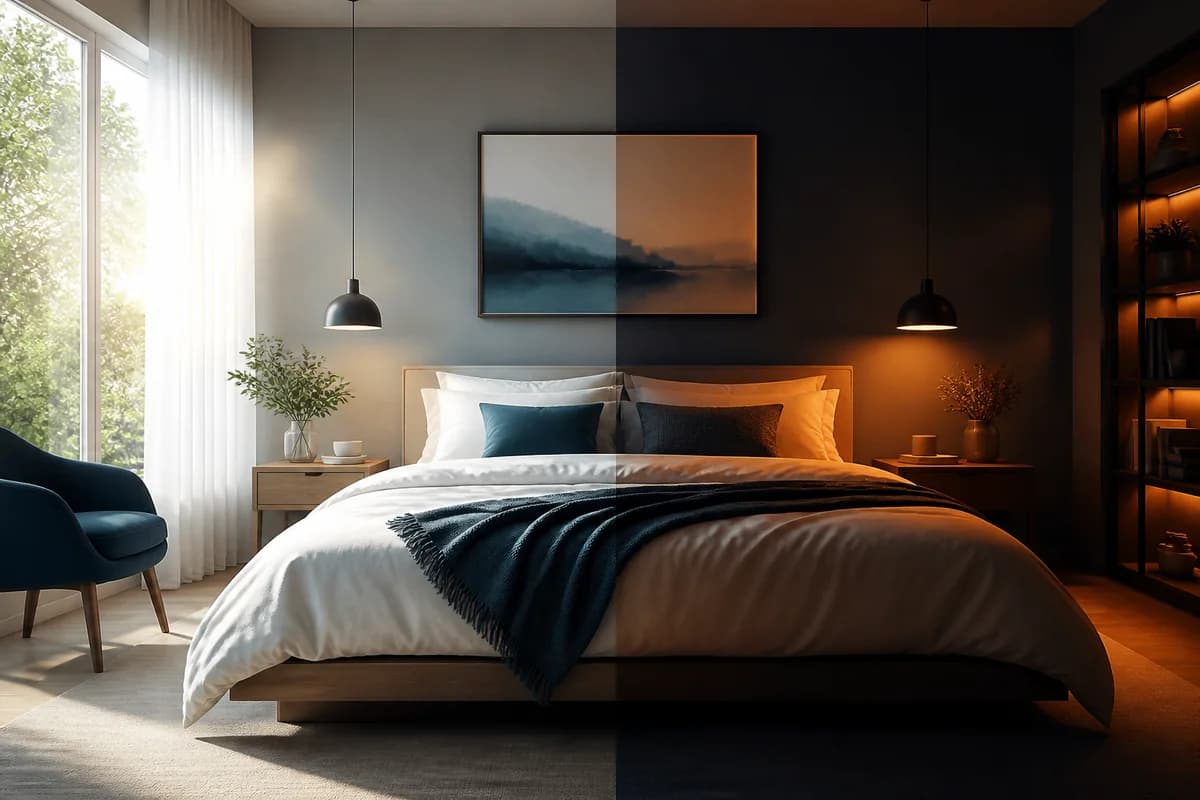
The 10 rules to remember
- Set a consistent wake timeSee reference 1
- Get outdoor light soon after wakingSee reference 2
- Keep daytime light exposure highSee reference 3
- Dim the whole environment before bedSee reference 4
- Reduce direct bright sourcesSee reference 5
- Automate lights for consistencySee reference 6
- Protect darkness during sleepSee reference 7
- Track sleep timing for two to four weeksSee reference 8
- Use clinical light therapy with guidance when neededSee reference 1
- Review sleep onset and wake-time consistency after 2–4 weeks; stop if the result does not justify the burden.See reference 2
First principles: what this can actually change
Retinal light exposure signals the brain's circadian system and can shift clock timing earlier or later depending on when it occurs.See reference 1,See reference 2
Light also has immediate alerting effects, so bright evening exposure can delay sleep even when a bulb looks warm.See reference 2,See reference 3
Spectrum matters, but intensity, duration and viewing angle mean a dim screen and a bright ceiling fixture are not biologically equivalent.See reference 3,See reference 4
A practical protocol
- Stage
- Start
- What to do
- Set a consistent wake time
- Why it matters
- Define the goal and baselineSee reference 1,See reference 2
- Stage
- Set up
- What to do
- Get outdoor light soon after waking
- Why it matters
- Reduce avoidable errorSee reference 2,See reference 3
- Stage
- Apply
- What to do
- Keep daytime light exposure high
- Why it matters
- Use a repeatable doseSee reference 3,See reference 4
- Stage
- Review
- What to do
- Dim the whole environment before bed
- Why it matters
- Keep only what helpsSee reference 4,See reference 5
Timing and frequency
- Decision
- Starting dose
- Practical answer
- Use the light-dark pattern daily; consistency matters more than occasional extreme exposure.See reference 2,See reference 3
- Decision
- First review
- Practical answer
- 2–4 weeksSee reference 3,See reference 4
- Decision
- Best timing
- Practical answer
- Bright light after waking generally advances and stabilizes timing; bright late-evening or night light generally delays it, but individual timing differs.See reference 4,See reference 5
- Decision
- Stop rule
- Practical answer
- Reduce or stop intense light exposure for eye pain, migraine, marked agitation, reduced need for sleep or a consistent shift in the wrong direction.See reference 5,See reference 6
What to measure
- Signal
- Sleep onset and wake-time consistency
- How to use it
- Record before starting and at the review point
- Caveat
- Use the same methodSee reference 3,See reference 4
- Signal
- Morning alertness and evening sleepiness
- How to use it
- Track weekly rather than reacting daily
- Caveat
- Expect normal variationSee reference 4,See reference 5
- Signal
- Adherence
- How to use it
- Record sessions or days used
- Caveat
- No exposure means no fair testSee reference 5,See reference 6
- Signal
- Adverse effects
- How to use it
- Record symptoms and severity
- Caveat
- Ordinary lux meters do not fully capture circadian-effective light at the eye.See reference 6,See reference 7
What the evidence actually shows
Laboratory and field studies show that evening electric light can suppress melatonin and delay circadian timing, while appropriately timed bright light can shift rhythms and treat some circadian sleep disorders.See reference 1,See reference 2,See reference 3
No single colour temperature, lux target or smart-home scene is optimal for everyone. Consumer bulbs cannot diagnose circadian phase, and blue-blocking alone may leave an environment too bright.See reference 4,See reference 5,See reference 6
Most studies measure short-term symptoms, physiology or performance rather than clinical events or lifespan. Results therefore support a bounded use case, not broad longevity marketing.See reference 6,See reference 7,See reference 8
Evidence strength by claim
- Claim
- Sleep onset and wake-time consistency
- Evidence
- Strong for circadian timing; device settings vary
- Verdict
- Laboratory and field studies show that evening electric light can suppress melatonin and delay circadian timing, while appropriately timed bright light can shift rhythms and treat some circadian sleep disorders.See reference 1,See reference 2
- Claim
- Morning alertness and evening sleepiness
- Evidence
- Mixed or context-dependent
- Verdict
- No single colour temperature, lux target or smart-home scene is optimal for everyone. Consumer bulbs cannot diagnose circadian phase, and blue-blocking alone may leave an environment too bright.See reference 3,See reference 4
- Claim
- Safety
- Evidence
- Depends on screening and dose
- Verdict
- Bright-light therapy can trigger eye discomfort, headache, agitation or mania in susceptible people. Seek clinical advice with bipolar disorder, retinal disease or photosensitizing medicines.See reference 5,See reference 6
- Claim
- Longer life
- Evidence
- Not directly tested
- Verdict
- Do not convert an intermediate outcome into a lifespan promiseSee reference 7,See reference 8
Limits and common overclaims
Individual light history changes sensitivity.See reference 2,See reference 3
Studies use controlled light levels that may not match homes.See reference 3,See reference 4
Season, latitude, shift work, eye disease and age change the response.See reference 4,See reference 5
A four-step implementation plan
- Define the exact reason you are trying circadian lighting.See reference 1
- Record a baseline for sleep onset and wake-time consistency.See reference 2
- Use the same protocol for 2–4 weeks.See reference 3
- Continue only if benefit outweighs cost, time, discomfort and risk.See reference 4
Troubleshooting
- Problem
- No benefit
- What to do
- Check adherence, dose and whether sleep onset and wake-time consistency is the right outcomeSee reference 2
- Problem
- Discomfort
- What to do
- Reduce the dose; stop for warning symptomsSee reference 3
- Problem
- Confusing data
- What to do
- Use a longer trend and the same measurement conditionsSee reference 4
- Problem
- Too much burden
- What to do
- Choose the simpler intervention that solves the same problemSee reference 5
Safety and who should be cautious
Bright-light therapy can trigger eye discomfort, headache, agitation or mania in susceptible people. Seek clinical advice with bipolar disorder, retinal disease or photosensitizing medicines. Reduce or stop intense light exposure for eye pain, migraine, marked agitation, reduced need for sleep or a consistent shift in the wrong direction.See reference 5,See reference 6,See reference 7
Who is most likely to benefit
It is useful for people with weak morning light, overly bright evenings, irregular schedules or a clinician-identified circadian timing problem.See reference 2,See reference 3
It is less useful when adopted only because a score, trend or influencer made it seem mandatory.See reference 4,See reference 5
People with symptoms, diagnosed disease, pregnancy, recent surgery or complex medicines should adapt the protocol with an appropriate clinician.See reference 6,See reference 7
Track five things
- Sleep onset and wake-time consistencySee reference 1
- Morning alertness and evening sleepinessSee reference 2
- The exact dose and timingSee reference 3
- Symptoms and adverse effectsSee reference 4
- Whether the result changes a real decisionSee reference 5
Frequently asked questions
What is Circadian lighting?
Light is the strongest environmental cue for the human circadian clock. Timing, intensity, duration and spectrum all matter, but the simple high-value pattern is bright light after waking and much dimmer light before sleep.See reference 1,See reference 2
How often should I use circadian lighting?
Use the light-dark pattern daily; consistency matters more than occasional extreme exposure.See reference 2,See reference 3
How long before circadian lighting works?
Use 2–4 weeks as the first meaningful review point. Immediate comfort or device readings are not the same as a durable health effect.See reference 3,See reference 4
What should I track?
Track sleep onset and wake-time consistency, morning alertness and evening sleepiness, adherence and adverse effects under similar conditions.See reference 4,See reference 5
Is circadian lighting safe?
Bright-light therapy can trigger eye discomfort, headache, agitation or mania in susceptible people. Seek clinical advice with bipolar disorder, retinal disease or photosensitizing medicines.See reference 5,See reference 6
When should I stop?
Reduce or stop intense light exposure for eye pain, migraine, marked agitation, reduced need for sleep or a consistent shift in the wrong direction.See reference 6,See reference 7
Does circadian lighting increase lifespan?
No trial proves that this tool extends an individual's lifespan. Its value depends on whether it improves a relevant symptom, behavior, function or established risk factor.See reference 7,See reference 8
Can it replace sleep, exercise, nutrition or medical care?
No. It is an optional layer around the fundamentals and should not delay evaluation of persistent or serious symptoms.See reference 8,See reference 1
Connect the protocol to your wider health picture
LongevityMate helps organize habits, symptoms, measurements and trends so one intervention stays in context instead of becoming the whole plan.
See how LongevityMate worksGet the weekly longevity brief
The week's best longevity research in plain English. Free, every Tuesday.
References
- 1. The effect of exposure to artificial light at night (ALAN) on sleep disturbance: a systematic review and meta-analysis.
Environmental researchMeta-analysis
- 2. Light therapies to improve sleep in intrinsic circadian rhythm sleep disorders and neuro-psychiatric illness: A systematic review and meta-analysis.
Sleep medicine reviewsMeta-analysis
- 3. Light therapy in insomnia disorder: A systematic review and meta-analysis.
Journal of sleep researchMeta-analysis
- 4. Interventions to reduce short-wavelength ("blue") light exposure at night and their effects on sleep: A systematic review and meta-analysis.
Sleep advances : a journal of the Sleep Research SocietyEvidence review
- 5. A systematic review of the amount and timing of light in association with objective and subjective sleep outcomes in community-dwelling adults.
Sleep healthSystematic review
- 6. Systematic review of light exposure impact on human circadian rhythm.
Chronobiology internationalSystematic review
- 7. Circadian rhythm disorders
National Heart, Lung, and Blood InstituteOfficial guidance
- 8. Light therapy
Mayo ClinicOfficial guidance
Editorial transparency
- Published by
- LongevityMate Editorial Team
- Published
- Updated
Medical disclaimer
This guide provides general health education. It does not diagnose a condition, prescribe treatment, replace individualized medical care, or guarantee a health or longevity outcome.