
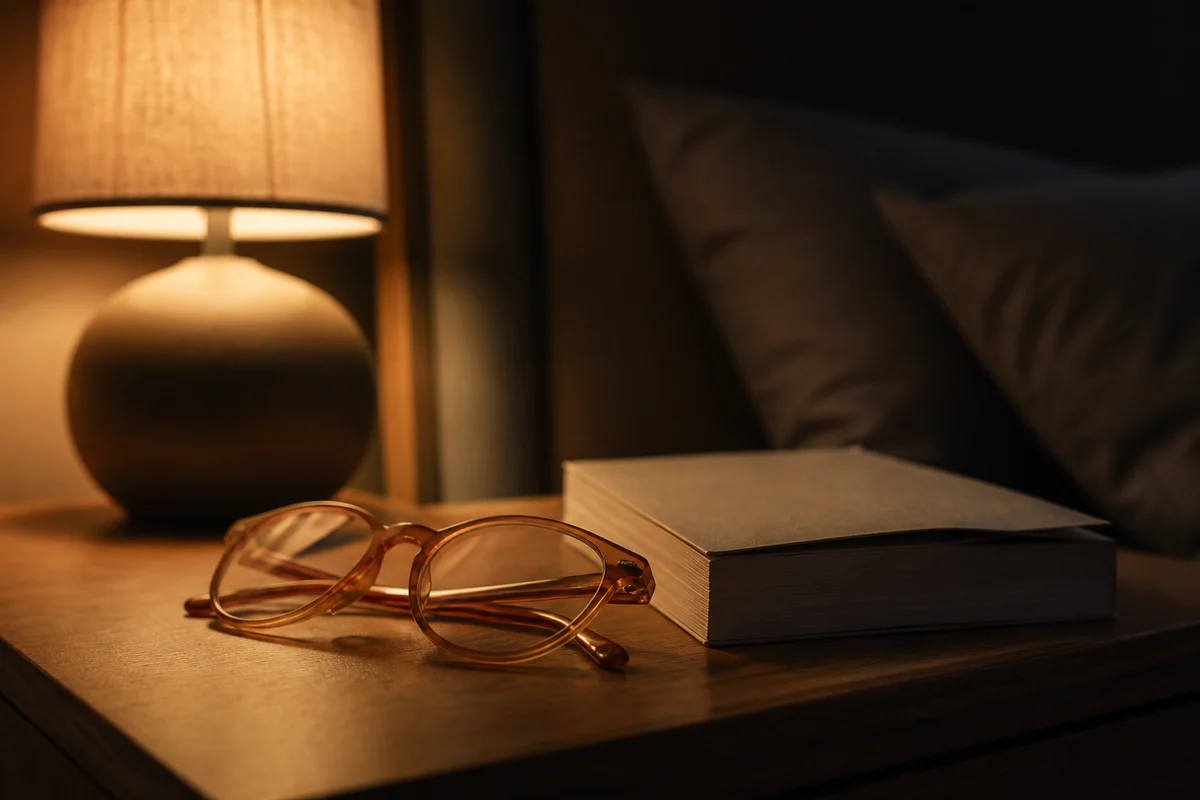
The rules to remember
- Dim the environment firstSee reference 1,See reference 2
- Choose lenses with transmission dataSee reference 2,See reference 3
- Use only during the pre-sleep windowSee reference 3,See reference 4
- Begin two to three hours before bedSee reference 4,See reference 5
- Keep daytime exposure normalSee reference 5,See reference 6
- Do not drive in vision-impairing tintSee reference 6,See reference 7
- Avoid using glasses as permission for brighter screensSee reference 7,See reference 8
- Track sleep for two weeksSee reference 8,See reference 9
- Discontinue if there is no meaningful benefitSee reference 9,See reference 10
- Check the official guidance and evidence boundaries before escalating the protocol.See reference 10,See reference 1
First principles: what this can actually change
Short-wavelength light contributes strongly to melanopsin-driven circadian responses.See reference 1,See reference 2
Lens effectiveness depends on the wavelengths and proportion of light actually blocked.See reference 2,See reference 3
Total brightness, duration and timing still matter, so glasses are one layer rather than a complete evening-light intervention.See reference 3,See reference 4
A practical protocol
- Stage
- Define
- What to do
- Dim the environment first
- Why it matters
- Reduce avoidable errorSee reference 1,See reference 2
- Stage
- Screen
- What to do
- Choose lenses with transmission data
- Why it matters
- Reduce avoidable errorSee reference 2,See reference 3
- Stage
- Apply
- What to do
- Use only during the pre-sleep window
- Why it matters
- Keep the dose repeatableSee reference 3,See reference 4
- Stage
- Apply
- What to do
- Begin two to three hours before bed
- Why it matters
- Keep the dose repeatableSee reference 4,See reference 5
- Stage
- Review
- What to do
- Keep daytime exposure normal
- Why it matters
- Keep the dose repeatableSee reference 5,See reference 6
- Stage
- Review
- What to do
- Do not drive in vision-impairing tint
- Why it matters
- Keep only what helpsSee reference 6,See reference 7
Timing and frequency
- Decision
- Starting frequency
- Practical answer
- Nightly for a two-week trial during the final two to three hours before intended sleep.See reference 2,See reference 3
- Decision
- First review
- Practical answer
- 2 weeksSee reference 3,See reference 4
- Decision
- Best timing
- Practical answer
- Evening only; remove after waking so daytime light can support alertness and circadian timing.See reference 4,See reference 5
- Decision
- Stop rule
- Practical answer
- Stop for reduced visibility, headache, eye strain, falls risk or consistently worse sleep or mood.See reference 5,See reference 6,See reference 7
What to measure
- Signal
- Sleep onset and timing
- How to use it
- Record a baseline and compare at the review point
- Caveat
- Use the same method and conditionsSee reference 3,See reference 4
- Signal
- Morning alertness
- How to use it
- Track a weekly trend
- Caveat
- Expect normal variationSee reference 4,See reference 5
- Signal
- Adherence
- How to use it
- Record the exact dose and timing
- Caveat
- No exposure means no fair testSee reference 5,See reference 6
- Signal
- Interpretation
- How to use it
- Ask whether the result changes a real decision
- Caveat
- Lens color does not reveal spectral transmission, and actigraphy cannot prove circadian phase change.See reference 6,See reference 7
What the evidence actually shows
Blue-filtering lenses can reduce light-induced melatonin suppression, but systematic reviews find low-certainty or inconsistent effects on sleep outcomes.See reference 1,See reference 2,See reference 3
Evidence does not support routine use for eye disease prevention or universal sleep improvement, and many products do not report adequate optical data.See reference 4,See reference 5,See reference 6
Most studies measure short-term symptoms, physiology or biomarkers rather than clinical events or lifespan. The evidence supports a bounded experiment, not a longevity guarantee.See reference 6,See reference 7,See reference 8
Evidence strength by claim
- Claim
- Sleep onset and timing
- Evidence
- Low to moderate and inconsistent for sleep
- Verdict
- Blue-filtering lenses can reduce light-induced melatonin suppression, but systematic reviews find low-certainty or inconsistent effects on sleep outcomes.See reference 1,See reference 2
- Claim
- Morning alertness
- Evidence
- Mixed or context-dependent
- Verdict
- Evidence does not support routine use for eye disease prevention or universal sleep improvement, and many products do not report adequate optical data.See reference 3,See reference 4
- Claim
- Safety
- Evidence
- Depends on screening and dose
- Verdict
- Do not wear dark or color-distorting lenses while driving, cycling, cooking, using stairs or doing safety-critical tasks. Seek eye care for visual symptoms rather than relying on consumer glasses.See reference 5,See reference 7
- Claim
- Longer life
- Evidence
- Not directly tested
- Verdict
- Do not turn an intermediate outcome into a lifespan promise.See reference 6,See reference 8
Limits and common overclaims
Trials use different lenses, populations and outcomes.See reference 2,See reference 3
Blinding is difficult because tint is visible.See reference 3,See reference 4
Room brightness and screen behavior often change at the same time.See reference 4,See reference 5
A four-step implementation plan
- Define the exact reason you are trying blue-light-blocking glasses.See reference 1
- Record a baseline for sleep onset and timing.See reference 2
- Use the same protocol until the 2 weeks review point.See reference 3
- Continue only if benefit outweighs cost, time, discomfort and risk.See reference 4
Troubleshooting
- Problem
- No benefit
- What to do
- Check adherence, dose and whether sleep onset and timing is the right outcomeSee reference 2
- Problem
- Discomfort
- What to do
- Reduce the dose and stop for warning symptomsSee reference 3
- Problem
- Confusing data
- What to do
- Use the same measurement conditions and a longer trendSee reference 4
- Problem
- Too much burden
- What to do
- Choose the simpler intervention that solves the same problemSee reference 5
Safety and who should be cautious
Do not wear dark or color-distorting lenses while driving, cycling, cooking, using stairs or doing safety-critical tasks. Seek eye care for visual symptoms rather than relying on consumer glasses. Stop for reduced visibility, headache, eye strain, falls risk or consistently worse sleep or mood.See reference 5,See reference 6,See reference 7
Who is most likely to benefit
People unable to dim evening occupational or household lighting are more plausible candidates than people already living in a dim environment.See reference 2,See reference 3
It is less useful when adopted only because a score, trend or influencer made blue-light-blocking glasses seem mandatory.See reference 4,See reference 5
People with symptoms, diagnosed disease, pregnancy, recent surgery or complex medicines should adapt the protocol with an appropriate clinician.See reference 6,See reference 7
Track five things
- Sleep onset and timingSee reference 1
- Morning alertnessSee reference 2
- The exact dose and timingSee reference 3
- Symptoms and adverse effectsSee reference 4
- Whether the result changes a real decisionSee reference 5
Frequently asked questions
What is Blue-light-blocking glasses?
Blue-filtering glasses can reduce short-wavelength light reaching the eye, but systematic reviews find uncertain or mixed sleep benefit. They are most biologically plausible when worn before bed in an otherwise unavoidable bright environment; they do not compensate for excessive total brightness, stimulating content or irregular sleep timing.See reference 1,See reference 2
How often should I use blue-light-blocking glasses?
Nightly for a two-week trial during the final two to three hours before intended sleep.See reference 2,See reference 3
How long before blue-light-blocking glasses works?
Use 2 weeks as the first meaningful review point. Immediate sensations or device scores are not durable health outcomes.See reference 3,See reference 4
What should I track?
Track sleep onset and timing, morning alertness, adherence and adverse effects under similar conditions.See reference 4,See reference 5
Is blue-light-blocking glasses safe?
Do not wear dark or color-distorting lenses while driving, cycling, cooking, using stairs or doing safety-critical tasks. Seek eye care for visual symptoms rather than relying on consumer glasses.See reference 5,See reference 6
When should I stop?
Stop for reduced visibility, headache, eye strain, falls risk or consistently worse sleep or mood.See reference 6,See reference 7
Does blue-light-blocking glasses increase lifespan?
No human trial proves that this tool extends an individual's lifespan. Its value depends on whether it improves a relevant symptom, behavior, function or established risk factor.See reference 7,See reference 8
Can it replace sleep, exercise, nutrition or medical care?
No. It is an optional layer around the fundamentals and should not delay evaluation of persistent or serious symptoms.See reference 8,See reference 9
Connect the protocol to your wider health picture
LongevityMate helps organize habits, symptoms, measurements and trends so one intervention stays in context instead of becoming the whole plan.
See how LongevityMate worksGet the weekly longevity brief
The week's best longevity research in plain English. Free, every Tuesday.
References
- 1. Blue-light filtering spectacle lenses for visual performance, sleep, and macular health in adults.
The Cochrane database of systematic reviewsSystematic review
- 2. Evening wear of blue-blocking glasses for sleep and mood disorders: a systematic review.
Chronobiology internationalSystematic review
- 3. The effect of blue-light blocking spectacle lenses on visual performance, macular health and the sleep-wake cycle: a systematic review of the literature.
Ophthalmic & physiological optics : the journal of the British College of Ophthalmic Opticians (Optometrists)Systematic review
- 4. Efficacy of blue-light blocking glasses on actigraphic sleep outcomes: a systematic review and meta-analysis of randomized controlled crossover trials.
Frontiers in neurologyMeta-analysis
- 5. Blue Light-Blocking Glasses Attenuate Light-Induced Melatonin Suppression in Healthy Japanese Adults.
The Tohoku journal of experimental medicineEvidence review
- 6. Blue light filtering ophthalmic lenses: A systematic review.
Seminars in ophthalmologySystematic review
- 7. Digital devices and your eyes
American Academy of OphthalmologyOfficial guidance
- 8. Circadian rhythm disorders
National Heart, Lung, and Blood InstituteOfficial guidance
- 9. Healthy sleep habits
National Heart, Lung, and Blood InstituteOfficial guidance
- 10. Preventing falls in older adults
Centers for Disease Control and PreventionOfficial guidance
Editorial transparency
- Published by
- LongevityMate Editorial Team
- Published
- Updated
Medical disclaimer
This guide provides general health education. It does not diagnose a condition, prescribe treatment, replace individualized medical care, or guarantee a health or longevity outcome.