
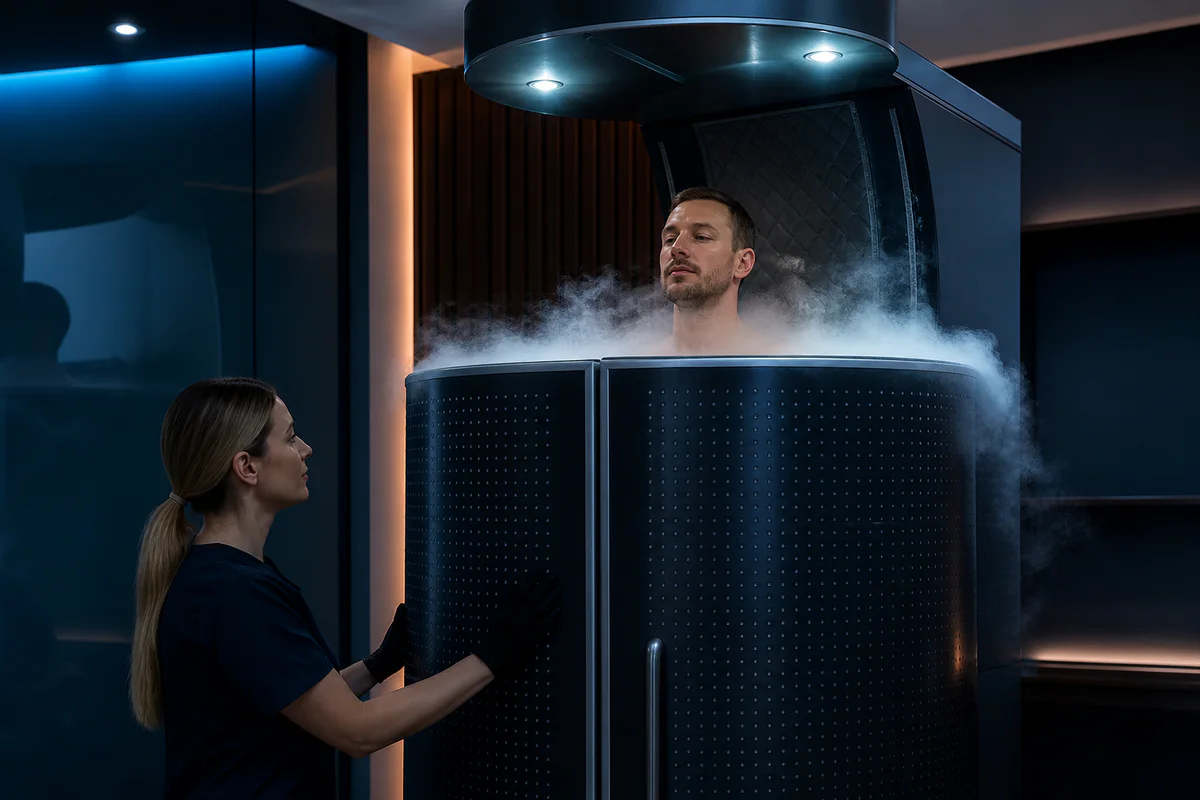
The 10 rules to remember
- Use whole-body cryotherapy only for a clearly defined problemSee reference 1
- Start with the lowest-burden evidence-based optionSee reference 2
- Record a baseline before changing anythingSee reference 3
- Do not confuse a biological mechanism with a proven health outcomeSee reference 4
- Do not let whole-body cryotherapy replace established careSee reference 5
- Use qualified clinical oversight when the intervention is medicalSee reference 6
- Stop when harms, abnormal symptoms or a worse trend appearSee reference 7
- Judge benefit with measurements that matter to the original goalSee reference 8
- Reassess cost, burden and uncertainty after the planned trialSee reference 9
- Avoid protocols based only on testimonials, influencers or clinic marketingSee reference 10
First principles: what this can actually change
Very cold air removes less heat than water at the same temperature, so chamber temperatures look dramatic but dose depends on airflow, humidity, exposure and clothing.See reference 1,See reference 2
Cold can reduce pain perception and inflammatory signals without necessarily accelerating repair or restoring performance.See reference 3,See reference 4
Extreme environments require engineered safety; a small average benefit cannot justify preventable chamber or cold injury.See reference 5,See reference 6
A practical decision protocol
- Stage
- 1. Screen
- What to do
- Review cardiovascular, vascular, neurological and cold-allergy risks
- Why it matters
- Contraindications drive safetySee reference 1,See reference 2
- Stage
- 2. Verify facility
- What to do
- Confirm trained supervision, oxygen monitoring and emergency procedures
- Why it matters
- Operations matter as much as temperatureSee reference 3,See reference 4
- Stage
- 3. Protect tissue
- What to do
- Keep skin dry and wear required gloves, socks, shoes and face protection
- Why it matters
- Extremities are vulnerableSee reference 5,See reference 6
- Stage
- 4. Reassess
- What to do
- Track soreness and function, then stop if benefit is trivial
- Why it matters
- Routine use needs a measurable returnSee reference 7,See reference 8
Timing, dose and frequency
- Decision
- After competition
- Practical answer
- May be used for subjective soreness when rapid turnaround matters.See reference 1,See reference 2
- Decision
- During hypertrophy blocks
- Practical answer
- Avoid assuming repeated post-training cold is neutral for adaptation.See reference 3,See reference 4
- Decision
- Session duration
- Practical answer
- Follow the chamber protocol exactly; never extend time to chase a stronger response.See reference 5,See reference 6
- Decision
- Rewarming
- Practical answer
- Use normal clothing and gentle movement; avoid immediately adding extreme heat.See reference 7,See reference 8
What to measure
- Signal
- Soreness
- How
- Rate before and 24–72 hours after
- Interpretation
- Small subjective change is the most plausible benefitSee reference 1,See reference 2
- Signal
- Performance
- How
- Track the actual sport or strength metric
- Interpretation
- Recovery claims require function, not biomarkers aloneSee reference 3,See reference 4
- Signal
- Skin and sensation
- How
- Check fingers, toes and exposed areas
- Interpretation
- Pain, pallor or numbness signals cold injurySee reference 5,See reference 6
- Signal
- Facility safety
- How
- Confirm monitoring and supervision every visit
- Interpretation
- A safe protocol can degrade operationallySee reference 7,See reference 8
What the evidence actually shows
A Cochrane review found very low-quality evidence and insufficient support for whole-body cryotherapy after exercise.See reference 1,See reference 2
Later reviews report possible reductions in soreness, but protocols and study quality remain heterogeneous.See reference 3,See reference 4
No credible human evidence shows detoxification, major fat loss, immune rejuvenation or longer life.See reference 5,See reference 6
Evidence strength by claim
- Claim
- Reduces post-exercise soreness
- Confidence
- Low
- Important boundary
- Small short-term studies and high heterogeneitySee reference 1,See reference 2
- Claim
- Restores performance
- Confidence
- Low
- Important boundary
- Results are inconsistentSee reference 3,See reference 4
- Claim
- Treats chronic disease
- Confidence
- Very low
- Important boundary
- Condition-specific trials are not general approvalSee reference 5,See reference 6
- Claim
- Improves longevity
- Confidence
- Very low
- Important boundary
- No clinical outcomes evidenceSee reference 7,See reference 8
Limits and common overclaims
Whole-body and partial-body nitrogen chambers are often mixed in the literature despite different risks.See reference 4,See reference 7
Blinding is difficult and subjective recovery is expectation-sensitive.See reference 5,See reference 8
Adverse events are under-reported in small performance studies.See reference 6,See reference 9
A four-step implementation plan
- 1. Review cardiovascular, vascular, neurological and cold-allergy risksSee reference 1
- 2. Confirm trained supervision, oxygen monitoring and emergency proceduresSee reference 2
- 3. Keep skin dry and wear required gloves, socks, shoes and face protectionSee reference 3
- 4. Track soreness and function, then stop if benefit is trivialSee reference 4
Troubleshooting
- Problem
- Skin pain or numbness
- Likely issue
- Cold injury may be developing
- Better next step
- Exit immediately and seek assessmentSee reference 1,See reference 2
- Problem
- Lightheadedness
- Likely issue
- Cold or oxygen environment response
- Better next step
- Exit with assistance and do not retrySee reference 3,See reference 4
- Problem
- No recovery change
- Likely issue
- The intervention is not useful for you
- Better next step
- Drop it and prioritize sleep, nutrition and loadSee reference 5,See reference 6
- Problem
- Facility leaves user alone
- Likely issue
- Critical safety failure
- Better next step
- Do not proceedSee reference 7,See reference 8
Safety and when to get medical help
Use only with continuous trained supervision and verified oxygen monitoring. Nitrogen systems can displace oxygen, and cold can cause frostbite, nerve injury, bronchospasm, blood-pressure spikes and arrhythmia. Never enter with wet skin, metal jewelry, intoxication or after sedatives. Chest pain, fainting, confusion, severe breathlessness or persistent numbness requires urgent evaluation.See reference 1,See reference 5,See reference 9
Who is most likely to benefit
Some athletes seeking short-term soreness relief during compressed competition schedules.See reference 2,See reference 6
People who accept uncertain benefit and can access a well-run facility after screening.See reference 3,See reference 7
Most recreational exercisers gain more from sleep, nutrition and training-load management.See reference 4,See reference 8
Track five things
- SorenessSee reference 1
- PerformanceSee reference 3
- Skin and sensationSee reference 5
- Facility safetySee reference 7
- Decision made after reviewing the resultSee reference 9
Frequently asked questions
How cold is it?
Facilities commonly advertise approximately -110°C or colder, but air temperature alone does not define tissue dose.See reference 1
How long?
Usually two to four minutes under the device protocol; never extend exposure independently.See reference 2
Is it better than an ice bath?
Evidence is insufficient, and the risks and heat transfer are different.See reference 3
Does it burn fat?
Any acute energy response is not evidence of meaningful or lasting fat loss.See reference 4
Does this extend lifespan?
No human trial has shown that whole-body cryotherapy extends lifespan. Any longevity claim must be separated from evidence for a specific symptom, diagnosis or surrogate marker.See reference 5
How quickly should it work?
May be used for subjective soreness when rapid turnaround matters.See reference 6
Can it replace standard treatment?
No. A complementary tool should not displace care already shown to reduce symptoms, complications or mortality.See reference 7
How do I know whether it helped?
Use a pre-defined outcome such as soreness and compare it with a baseline over an appropriate time window.See reference 8
Connect this decision to your wider health picture
LongevityMate helps organize measurements, symptoms, habits and trends so one test, device or treatment stays in context instead of becoming the whole plan.
See how LongevityMate worksGet the weekly longevity brief
The week's best longevity research in plain English. Free, every Tuesday.
References
- 1. Whole-Body Cryotherapy for Muscle Soreness
Cochrane Database of Systematic ReviewsSystematic review
- 2. Safety Risks of Whole-Body Cryotherapy
European Journal of Medical ResearchSystematic review
- 3. Whole-Body Cryotherapy as Recovery Technique
International Journal of Sports MedicineSystematic review
- 4. Cold Facts to Help Avoid Injury
U.S. Food and Drug AdministrationOfficial guidance
- 5. Cold-Water Immersion and Strength Recovery
Sports MedicineMeta-analysis
- 6. Effect of Cold Showering on Health and Work
PLOS OneRandomized trial
- 7. Passive Heating and Cardiometabolic Risk
American Journal of Preventive CardiologyMeta-analysis
- 8. 2026 Guideline on the Management of Dyslipidemia
American Heart AssociationGuideline
- 9. 2025 High Blood Pressure Guideline
American Heart AssociationGuideline
- 10. Understanding Unapproved Use of Approved Drugs
U.S. Food and Drug AdministrationOfficial guidance
Editorial transparency
- Published by
- LongevityMate Editorial Team
- Published
- Updated
Medical disclaimer
This guide provides general health education. It does not diagnose a condition, prescribe treatment, replace individualized medical care, or guarantee a health or longevity outcome.