
BCAAs are not a complete protein
NIH ODS explains that complete proteins provide all essential amino acids and include BCAAs. Foods with complementary plant proteins can also supply the full set. A BCAA-only powder is therefore a different nutritional product from a complete protein food or supplement.See reference 1
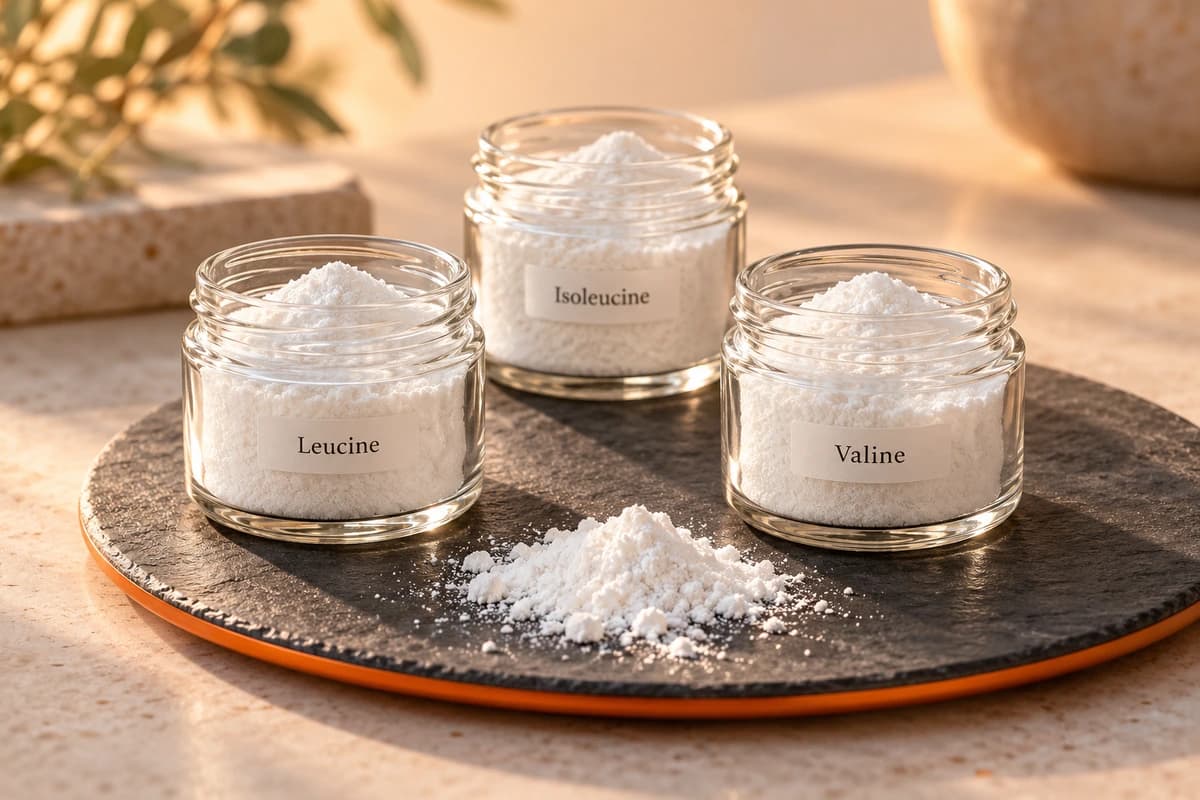
The three labelled jars in the artwork represent the named ingredients. Their positions and equal-looking jars do not show a preferred ratio or intake. This guide does not choose a leucine ratio, serving size or daily protein target.
Keep the endpoint beside the finding
- Outcome
- Acute protein synthesis
- Human evidence
- One small postexercise study found an increase versus placebo
- What it does not establish
- Long-term muscle gain or superiority to complete proteinSee reference 2
- Outcome
- Soreness and damage markers
- Human evidence
- Meta-analyses report improvements at some follow-up times
- What it does not establish
- A guaranteed recovery benefit for every activitySee reference 3,See reference 4
- Outcome
- Performance recovery
- Human evidence
- A 2021 synthesis found no significant improvement at 24 or 48 hours
- What it does not establish
- Faster return of strength because soreness is lowerSee reference 3
The often-cited muscle-building study was an acute test
A 2017 crossover study tested 5.6 g of BCAAs against a placebo drink after resistance exercise in 10 trained young men. Over four hours, muscle protein synthesis was 22% higher with BCAAs. This measured a short physiological response, not changes in muscle size over a training programme.See reference 2
The trial did not directly compare BCAAs with a complete-protein supplement. Its result cannot establish that BCAAs outperform adequate dietary protein, or prescribe the tested amount for another person. Study quantities describe the experiment rather than a supplement plan.See reference 2
Soreness and performance are different outcomes
A 2021 meta-analysis included 25 studies and 479 participants. It found lower soreness and some indirect damage markers after strenuous exercise, but no significant difference in muscle performance at 24 or 48 hours. Feeling less sore is not the same endpoint as recovering strength.See reference 3
A 2024 meta-analysis of 18 studies in healthy active participants also found reduced soreness at several times and some creatine-kinase changes, but not a consistent lactate-dehydrogenase effect. Protocols, quantities, duration and participants varied; later follow-up data were sparse. Its search ended in September 2022, despite the 2024 publication date.See reference 4
Match the formula and population before borrowing a claim
The 2024 review excluded BCAAs combined with other essential amino acids or ingredients, and excluded medical-treatment studies. A multi-ingredient sports drink or a formula used in clinical care is not the same intervention. Meta-regression associations do not independently prove the best dose or timing.See reference 4
For a product comparison, identify the individual ingredients, whether the claim is about soreness or performance, and whether complete dietary protein was considered. A favourable result in one experiment is not proof for every powder carrying the BCAA label.
Short-term observations do not establish universal safety
The ODS summary reports no safety concerns in studied BCAA amounts of 20 g/day or less for up to six weeks. That is a bounded research observation, not a safe-intake limit or a recommendation. It does not clear long-term use or extend automatically to pregnancy, children or medical conditions.See reference 1
NCCIH explains that supplements can cause problems with medicines or particular health circumstances, and quality claims need scrutiny. This guide does not assess specialist amino-acid formulas, approve a product for an allergy, or replace individual clinical advice.See reference 5
Keep the useful details
- Separate an acute muscle response from long-term growth.See reference 2
- Less soreness does not automatically mean recovered performance.See reference 3
- Match the ingredients and study population before applying the result.See reference 4
Common questions
Are BCAAs the same as all essential amino acids?
No. BCAAs are the three named amino acids; complete proteins provide the wider essential set.See reference 1
Does less soreness prove faster strength recovery?
No. The 2021 synthesis found soreness benefits without a significant performance-recovery difference at 24 or 48 hours.See reference 3
Do the studied gram amounts tell me what to take?
No. They describe selected research protocols. This page does not prescribe an amount or clear a product for personal use.
Get the weekly longevity brief
The week's best longevity research in plain English. Free, every Tuesday.
References
- 1. Dietary supplements for exercise and athletic performance
NIH Office of Dietary SupplementsOfficial guidance
- 2. Branched-chain amino acid ingestion stimulates muscle myofibrillar protein synthesis following resistance exercise in humans
Jackman et al., 2017; Frontiers in PhysiologyRandomized trial
- 3. The effect of branched-chain amino acid on muscle damage markers and performance following strenuous exercise
2021 systematic review and meta-analysisMeta-analysis
- 4. Attenuating muscle damage biomarkers and muscle soreness after exercise-induced muscle damage with BCAA supplementation
Salem et al., 2024; Sports Medicine - OpenMeta-analysis
- 5. Using dietary supplements wisely
NCCIHOfficial guidance
Editorial transparency
- Published by
- LongevityMate Editorial
- Published
- Updated
Medical disclaimer
General education only. This guide does not diagnose a condition, interpret your personal result, choose a treatment or recommend a supplement dose. Discuss testing, symptoms, medicines and supplements with a qualified health professional.