
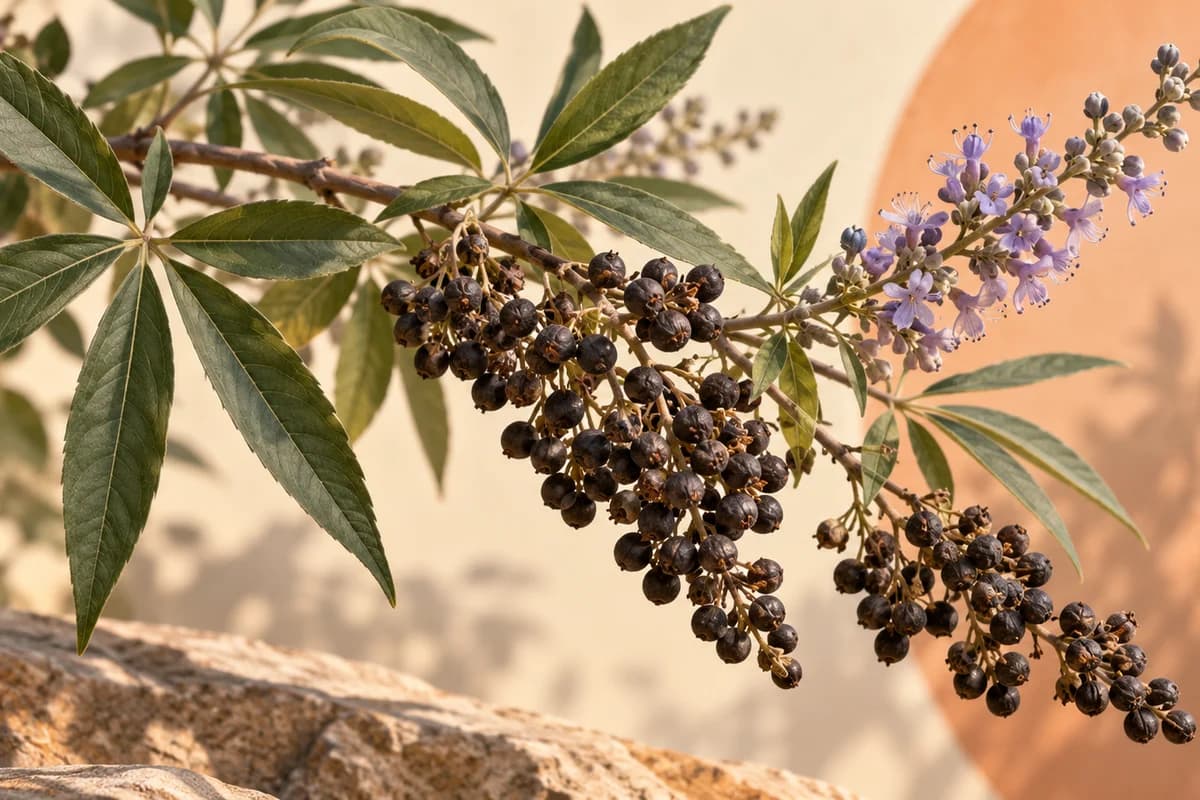
The fruit and extract matter
The EMA assessment covers chaste-tree fruit preparations, including powders, tinctures and dry extracts. Its stronger PMS conclusion applies to a particular dry extract; some other preparations have a traditional-use position. These are not interchangeable levels of evidence.See reference 2
A milligram figure does not establish that two extracts are equivalent. Record the plant part, extraction information and complete ingredient list. The botanical artwork identifies the plant; it does not certify the composition of a product.See reference 2
What the evidence supports and leaves open
- Evidence
- NCCIH overview
- Finding
- Some studies suggest improvement in PMS symptoms.
- Limit
- More high-quality evidence is needed.See reference 1
- Evidence
- 2001 randomized trial
- Finding
- A specific fruit extract improved a symptom-response outcome.
- Limit
- One preparation, three cycles and manufacturer sponsorship.See reference 3
- Evidence
- EMA monograph
- Finding
- Preparation-specific PMS use and safety cautions.
- Limit
- Not a fertility treatment or universal product endorsement.See reference 4
What the three-cycle trial actually found
The 2001 BMJ trial evaluated 170 women assigned to a named fruit extract, Ze 440, or placebo for three menstrual cycles. The responder definition was at least a 50% reduction in the assessed symptoms. Response occurred in 52% of the extract group and 24% of the placebo group.See reference 3
The manufacturer supplied the medication and sponsored the study. The result concerns the tested preparation and period; it does not demonstrate permanent symptom relief, fertility benefit or the effectiveness of every retail Vitex product.See reference 3
The proposed mechanism remains uncertain
Laboratory work has explored pituitary and dopamine-related effects, but the EMA states that the mechanism is not fully understood. Its monograph says a reduction in elevated prolactin in humans has not been conclusively demonstrated. A mechanism hypothesis should not be turned into a promise to correct a personal hormone result.See reference 2,See reference 4
Medicines and hormone-sensitive conditions need attention
EMA warnings cover a history of estrogen-sensitive cancer, pituitary disorders, and use of dopamine agonists or antagonists, estrogens or antiestrogens. They advise medical discussion before use. Potential interactions cannot be excluded; that is different from saying a particular interaction is proven.See reference 4
Reported effects include gastrointestinal symptoms, headache, skin reactions and menstrual changes. The EMA also lists severe allergic reactions, with frequency unknown. Short-term tolerability in a small trial cannot establish safety for every person or long-term use.See reference 1,See reference 4
Pregnancy, breastfeeding and fertility claims are separate questions
NCCIH cautions that chasteberry may be unsafe during pregnancy or breastfeeding. The EMA monograph does not recommend use in pregnancy or lactation and identifies gaps in the evidence. PMS research should not be applied to those situations.See reference 1,See reference 4
NCCIH finds no reliable evidence that chasteberry helps infertility. Do not use a PMS claim as evidence that it improves conception or replaces fertility assessment. This guide recommends no dose or hormone treatment.See reference 1
Questions to ask about a product claim
- Is it fruit, a powder, a tincture or a specified extract?
- Does the study actually match that preparation?
- Is the claim about PMS symptoms or an unsupported fertility outcome?
- Has a pharmacist or clinician checked my medicines and relevant history?
Common questions
Does Vitex reliably balance hormones?
That phrase is broader than the evidence. The mechanism remains uncertain, and a PMS trial does not show that it corrects an individual hormone level.See reference 2,See reference 4
Are all chasteberry extracts equivalent?
No. Preparation-specific evidence cannot be transferred automatically to another extract, powder or multi-ingredient product.See reference 2
Does PMS evidence prove a fertility benefit?
No. These are different outcomes; reliable evidence for infertility benefit is lacking.See reference 1
Get the weekly longevity brief
The week's best longevity research in plain English. Free, every Tuesday.
References
- 1. Chasteberry: usefulness and safety
National Center for Complementary and Integrative HealthOfficial guidance
- 2. Agni casti fructus: chaste-tree fruit assessment
European Medicines AgencyOfficial guidance
- 3. Treatment for the premenstrual syndrome with agnus castus fruit extract: prospective, randomised, placebo controlled study
BMJRandomized trial
- 4. European Union herbal monograph on Vitex agnus-castus L., fructus, revision 1
European Medicines AgencyOfficial guidance
Editorial transparency
- Published by
- LongevityMate Editorial
- Published
- Updated
Medical disclaimer
General education only. This guide does not diagnose a condition, interpret your personal result, choose a treatment or recommend a supplement dose. Discuss testing, symptoms, medicines and supplements with a qualified health professional.