
The same ingredient name can describe very different products
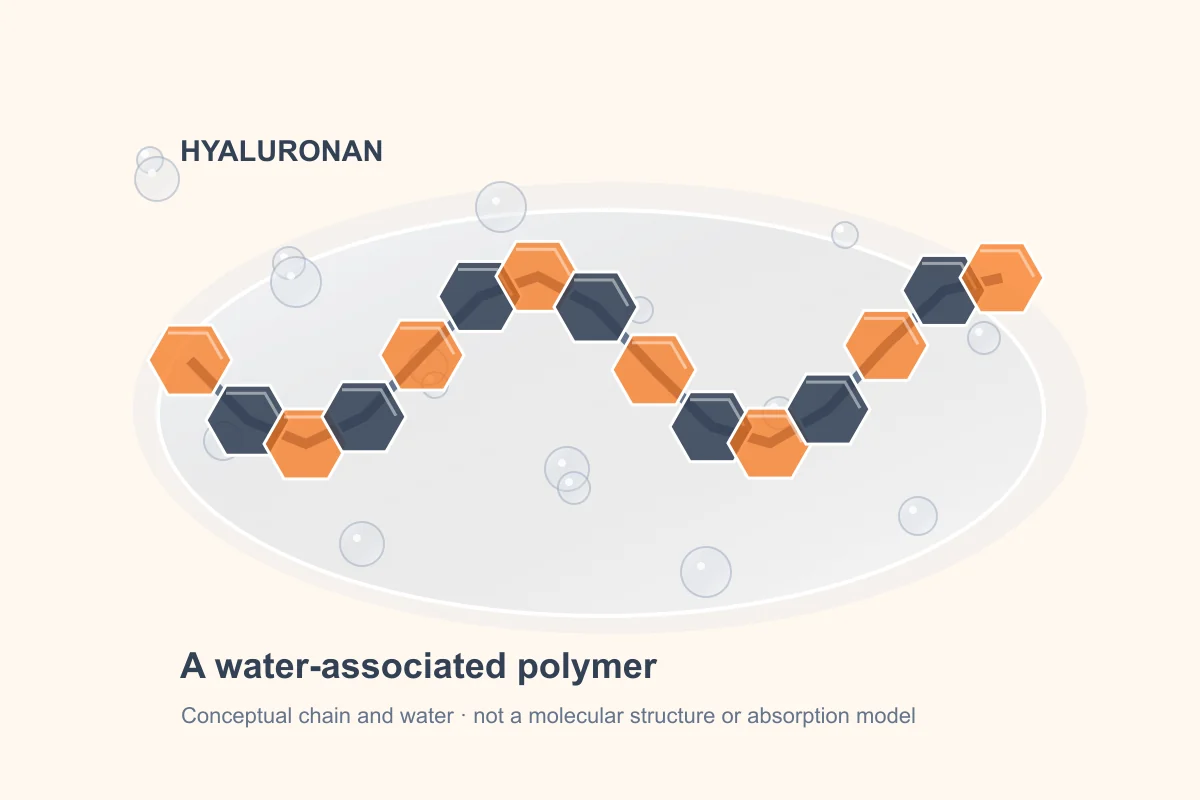
Hyaluronan is a polymer found in tissues including skin and joint fluid. Sodium hyaluronate is a salt form used in oral research.See reference 2
The artwork represents a water-associated polymer, not an exact chemical structure or a model of oral absorption.
A capsule is swallowed. A serum is placed on skin. A dermal filler is injected as a medical procedure with its own uses and risks. Evidence and authorization for an injected product do not establish that an oral supplement produces the same effect.See reference 4
What the skin trials actually tested
- Trial
- 2021 study
- People and exposure
- 40 completers, aged 35–64; 120 mg daily for 12 weeks
- Finding and limit
- Several instrument-measured skin outcomes favored the tested preparation. Small study, selected population and manufacturer-linked authorsSee reference 1
- Trial
- 2025 study
- People and exposure
- 150 randomized healthy adults; 60 mg, 120 mg or placebo daily for 12 weeks
- Finding and limit
- Several objective outcomes favored sodium hyaluronate, particularly 120 mg. One company-funded, single-centre study cannot represent every product or populationSee reference 2
A measured difference is not a guaranteed visible change
The 2025 full results did not establish a significant natural-moisturizing-factor difference or a self-reported hydration advantage. Its abstract sounds stronger on the former.See reference 2
Contipro funded the study and employed most authors. EFSA filing was prospective; ClinicalTrials.gov registration came later. Independent replication remains important.See reference 2
Knee research should not be read as proof of cartilage repair
The 2012 knee trial randomized 60 people to 200 mg oral HA daily or placebo for 12 months, alongside exercises. Only 38 entered the final analysis after exclusions. Both groups improved, with some advantages in an age subgroup at selected visits. Attrition and small subgroup numbers limit confidence.See reference 3
The trial did not establish cartilage regrowth or equivalence to injections. Its result cannot be assumed for every product.See reference 3
Studied amounts describe research, rather than a personal dose
Study amounts describe research, not personal dosing advice; preparation, population and duration limit comparisons.See reference 1,See reference 2,See reference 3
Short-term tolerability has practical limits
The 2021 skin study reported no adverse events attributed to HA. Those short-term observations do not establish lifelong or pregnancy safety.See reference 1
In the 2025 study, mild events occurred across groups without a treatment-related pattern.See reference 2
Some knee-trial participants were excluded after possible side effects, including gastric symptoms with HA; causality was unconfirmed.See reference 3
Keep the complete label available for a clinician or pharmacist, including the ingredient source and any added compounds. Supplement-market rules and ingredient quality checks do not establish effectiveness. This guide does not recommend substituting a capsule for medical care or an appropriate skincare plan.See reference 5
Keep the useful details
- Match the oral preparation to the outcome actually studied.See reference 1,See reference 2,See reference 3
- Separate objective measurements from a promise of visible rejuvenation.See reference 2
- Keep joint research, topical products and injections in their own evidence contexts.See reference 3,See reference 4
Common questions
Are oral hyaluronic acid and injectable fillers equivalent?
No. They have different routes, purposes and evidence. A filler result does not demonstrate a capsule benefit.See reference 4
Does 120 mg daily define the right dose for everyone?
No. It is an amount used in particular skin trials, not an individualized or universally optimal recommendation.See reference 1,See reference 2
Has oral HA been proven to rebuild joint cartilage?
The cited small knee study assessed symptoms and does not establish cartilage regrowth.See reference 3
Get the weekly longevity brief
The week's best longevity research in plain English. Free, every Tuesday.
References
- 1. Oral hyaluronan relieves wrinkles and improves dry skin: a 12-week placebo-controlled study
Hsu and colleagues, Nutrients; 2021Randomized trial
- 2. Oral sodium hyaluronate and skin parameters: randomized trial in 150 healthy adults
Dolečková and colleagues, Scientific Reports; published December 20, 2025Randomized trial
- 3. Oral polymer hyaluronic acid in knee osteoarthritis: a 12-month placebo-controlled study
Tashiro and colleagues, ScientificWorldJournal; 2012Randomized trial
- 4. Dermal fillers: soft-tissue fillers
U.S. Food and Drug AdministrationOfficial guidance
- 5. Questions and answers on dietary supplements
U.S. Food and Drug AdministrationOfficial guidance
Editorial transparency
- Published by
- LongevityMate Editorial
- Review
- Editorial evidence review (AI-assisted)
- Published
- Updated
Medical disclaimer
General education only. AI-assisted editorial evidence review is not a qualified clinical assessment. This guide does not diagnose a condition, interpret a personal result, choose treatment or recommend a supplement dose. Discuss testing, symptoms, medicines and supplements with a qualified health professional.