
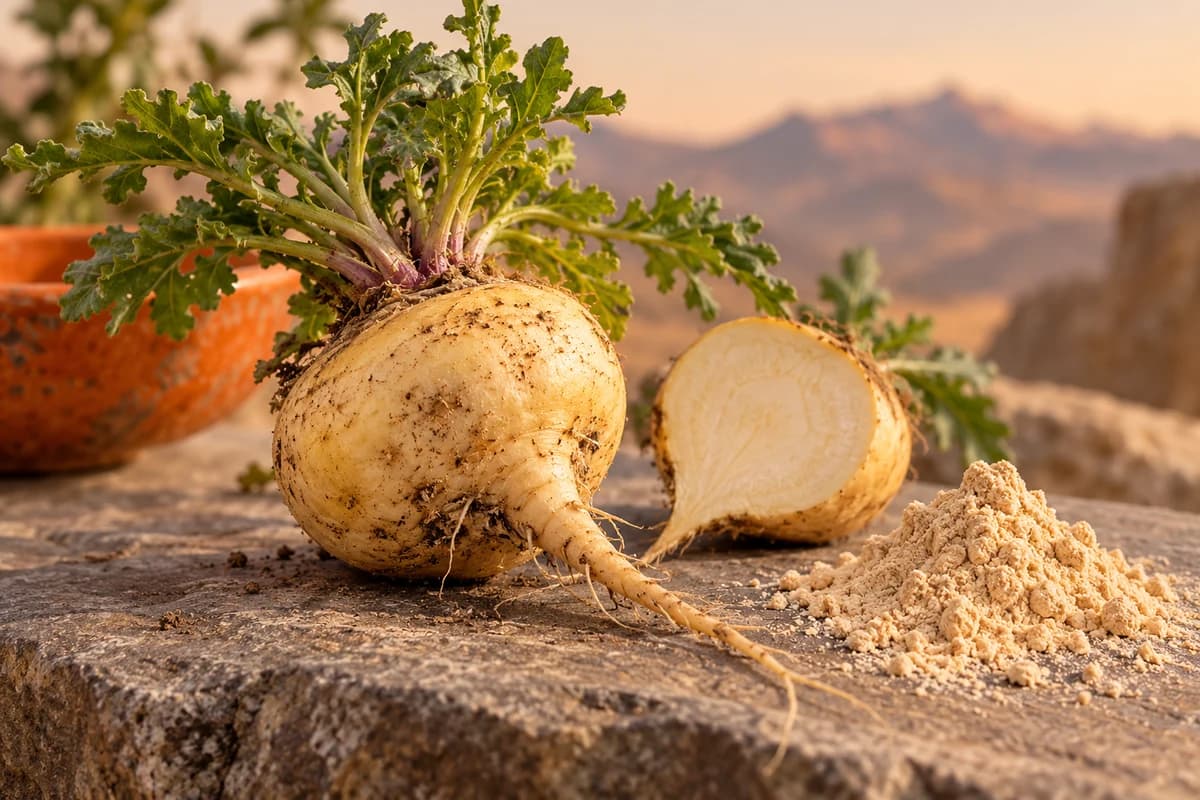
Root powder, processed powder and extracts are different preparations
Maca usually refers to Lepidium meyenii. Root powders, gelatinized preparations and extracts differ. A colour name does not establish a superior benefit.See reference 1
Keep the plant name, preparation and tested amount together when comparing a claim. An extract capsule with a stated root-equivalent amount is not automatically the same material as the powder used in a trial. The illustration depicts a root and powder; it does not certify a commercial product or select a maca colour.
Separate desire, hormones and fertility
- Outcome
- Sexual desire or function
- Human evidence
- A systematic review of four trials found limited evidence of benefit
- What remains uncertain
- Small samples and study quality prevented firm conclusionsSee reference 2
- Outcome
- Testosterone and other reproductive hormones
- Human evidence
- A placebo-controlled trial found no change in the measured hormones
- What remains uncertain
- A report of improved desire does not establish a hormone increaseSee reference 3
- Outcome
- Semen parameters
- Human evidence
- A later review of five trials found mixed and unclear effects
- What remains uncertain
- Changes in a semen measure do not prove more pregnancies or live birthsSee reference 4
- Outcome
- Antidepressant-related sexual symptoms
- Human evidence
- A small 12-week placebo-controlled trial studied selected women
- What remains uncertain
- It does not establish a treatment for every medicine-related symptom or justify changing a prescribed medicineSee reference 5
What the sexual-function reviews support
The 2010 systematic review included four randomized trials in different populations, including healthy men, menopausal women, cyclists and men with erectile dysfunction. Some results were favourable and others were not. The authors judged the evidence limited because the trials were small and methodologically weak.See reference 2
That review is an older evidence snapshot, not the entire later literature. The current MSK evidence summary also describes limited human trials and mixed findings. The practical question remains whether a specific preparation improved a defined endpoint in a population relevant to the claim.See reference 1,See reference 2
A testosterone claim needs a testosterone endpoint
A 12-week randomized, placebo-controlled study examined maca amounts of 1.5 or 3 g/day in healthy adult men. It found no significant effect on testosterone or the other reproductive hormones measured. Those quantities describe the experiment; they are not a recommended personal intake.See reference 3
Desire and hormones are separate endpoints. The trial does not establish treatment for a low testosterone result or every later preparation.See reference 3
Semen measurements do not equal fertility outcomes
The 2022 review included five randomized trials in healthy men or men experiencing infertility. Findings for semen concentration and motility were mixed. Its pooled sperm-concentration result did not show a significant benefit over placebo, and the evidence was too small for firm conclusions.See reference 4
This is why a claim about semen parameters should not be rewritten as a promise of pregnancy, live birth or treatment success. This guide does not choose a fertility intervention or delay an appropriate assessment.See reference 4
A small medicine-related study has a narrow population
A 2015 trial assigned 45 women with antidepressant-associated sexual dysfunction and remitted depression to maca or placebo for 12 weeks. The studied maca amount was 3 g/day. Some remission measures favoured maca, but the analysis involved a small selected population and differing measures.See reference 5
The finding does not tell a reader to stop an antidepressant, reduce its dose or add maca. A medicine-related symptom and the suitability of any proposed intervention require a clinician who can assess the treatment and the person together.
Food use does not settle supplement safety
MSK records possible testosterone-immunoassay interference. That differs from a true hormone increase; disclose supplement use to the testing clinician.See reference 1
Food use cannot clear a concentrated supplement. Pregnancy, breastfeeding, hormone-sensitive conditions and medicine combinations need individual review.See reference 1
Questions worth keeping beside the label
Identify the botanical name and preparation, the actual amount in a serving and any added ingredients. Find the study supporting the specific claim, then check whether it used that preparation, measured that outcome and included a comparable population. A coloured-root story or extract ratio alone does not answer those questions.
For example, a testosterone headline cannot be supported simply by a sexual-desire questionnaire. A fertility headline needs evidence about fertility outcomes. Use the endpoint to decide how far the result can be carried.See reference 3,See reference 4
Keep the useful details
- Keep libido, hormone levels and fertility as separate questions.See reference 2,See reference 3,See reference 4
- Research gram amounts describe experiments, not a personal dose.See reference 3,See reference 5
- A product label should identify the preparation used in the claim.See reference 1
Common questions
Is maca proven to raise testosterone?
No. The cited placebo-controlled study in healthy men found no significant effect on testosterone. Other outcomes cannot substitute for that endpoint.See reference 3
Is maca proven to improve fertility?
The review found mixed, unclear semen-parameter effects. Those measurements do not establish improved pregnancy or live-birth outcomes.See reference 4
Are red, yellow and black maca equally studied?
The evidence depends on the exact preparation and population. A colour name alone does not establish equivalent evidence or superiority.See reference 1
Do the study amounts tell me what to take?
No. They are descriptions of selected research protocols. This page does not choose a product, amount or treatment.
Should supplement use be mentioned before a testosterone test?
Yes. MSK records possible testosterone-immunoassay interference. The clinician and laboratory can assess its relevance to the specific test.See reference 1
Get the weekly longevity brief
The week's best longevity research in plain English. Free, every Tuesday.
References
- 1. Maca: evidence, product differences and safety
Memorial Sloan Kettering Cancer CenterEvidence review
- 2. Maca and sexual function: systematic review
Shin et al., 2010; BMC Complementary and Alternative MedicineSystematic review
- 3. Maca and reproductive hormone levels in healthy men
Gonzales et al., 2003; Journal of EndocrinologyRandomized trial
- 4. Maca and semen parameters: systematic review and meta-analysis
Lee et al., 2022; Frontiers in PharmacologyMeta-analysis
- 5. Placebo-controlled maca trial in women with antidepressant-related sexual symptoms
Dording et al., 2015; Evidence-Based Complementary and Alternative MedicineRandomized trial
Editorial transparency
- Published by
- LongevityMate Editorial
- Published
- Updated
Medical disclaimer
Educational information about published research and product labels. This guide does not diagnose a condition, choose a supplement or dose, change a medicine, or replace advice from a qualified healthcare professional.