
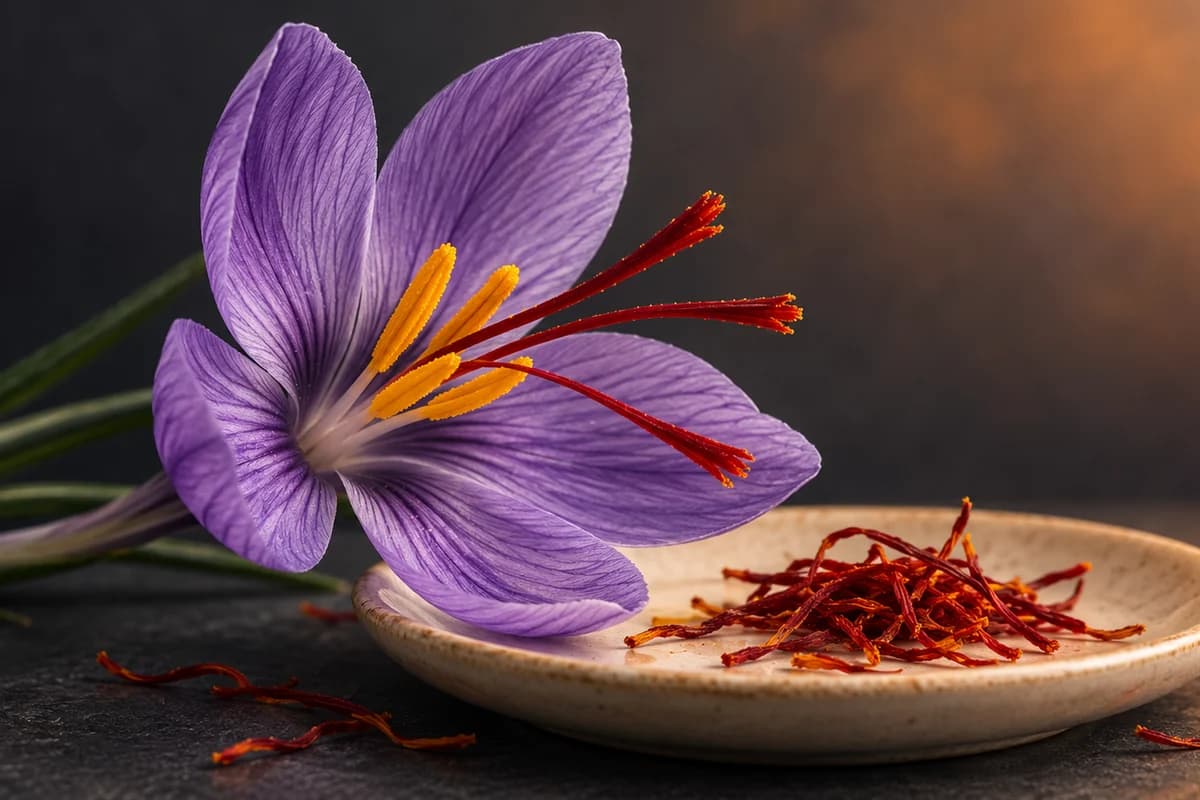
Spice, extract and constituent are different
Saffron is associated with the red stigmas of Crocus sativus. Trials have tested particular capsules or extracts, while other research concerns isolated constituents such as crocin. A kitchen quantity of spice is not an established equivalent of a study product.See reference 2,See reference 5
A supplement sold today may differ from the formulation used in a trial. The complete ingredient list, plant part and preparation are therefore more useful than assuming that every product labelled saffron has the same evidence.See reference 4
Read the result beside its study design
- Research
- 2026 review: 34 randomized trials
- Finding
- Some self-reported symptom scales improved.
- Important limit
- High inconsistency; several other scales did not improve significantly.See reference 1
- Research
- 2005 placebo-controlled pilot
- Finding
- A clinician-rated depression score improved over six weeks.
- Important limit
- Forty adult outpatients, one centre and a specific capsule.See reference 2
- Research
- 2005 fluoxetine comparison
- Finding
- No significant difference between study groups.
- Important limit
- A small pilot is not proof of treatment equivalence.See reference 3
- Research
- 2013 crocin safety study
- Finding
- No major adverse events during one month.
- Important limit
- An isolated constituent, selected healthy adults and a short period.See reference 5
What the 2026 review adds
The review included 34 trials and 1,769 adults. Beck Depression Inventory and Beck Anxiety Inventory scores improved on average, but results differed greatly between studies. The authors rated certainty as moderate and reported no significant effects for the Hamilton depression scale, Hamilton anxiety scale or Profile of Mood States.See reference 1
Self-reported and clinician-rated findings should stay visible together. The review’s abstract does not settle every product, population or long-term question. No unseen full-text assessment of individual trial bias or funding is claimed here.See reference 1
A positive early study does not settle the broader question
The six-week placebo-controlled pilot enrolled 40 adults with mild to moderate major depression and tested a particular saffron capsule. It reported a better Hamilton depression score than placebo. Its small size, single setting and short follow-up limit how far that finding can be applied.See reference 2
A separate six-week pilot in 40 adults compared a stigma extract with fluoxetine and found no statistically significant between-group difference. Absence of a significant difference is not, by itself, proof that two treatments are equivalent. That is a statistical limit, not a personal medicine-switching recommendation.See reference 3
Short-term tolerability is not established long-term safety
The crocin safety study followed 44 healthy volunteers for one month. It found no major adverse events, while some measured laboratory parameters changed. It tested an isolated saffron constituent, not every whole-saffron product or a long-term mood treatment.See reference 5
NCCIH advises checking supplements with a health professional, particularly when taking medicines or during pregnancy or breastfeeding. A natural origin does not ensure safety. The trials discussed here cannot provide an individual safety clearance or rule out interactions.See reference 4
Keep prescribed care in place
NCCIH advises against replacing prescribed medicine with a dietary supplement without discussing it with the treating clinician. This guide offers no dose, treatment plan or instruction to stop an antidepressant. Discuss the exact proposed product and the outcome you hope to improve.See reference 6
Changes in a symptom questionnaire do not establish prevention of suicide, durable recovery, cognitive protection or longer life. Those outcomes are outside the studies summarized here and should not be added to a product claim.See reference 1,See reference 2
Questions that make the claim clearer
- Which extract, plant part or constituent was tested?
- Was the outcome self-reported or clinician-rated?
- How long was follow-up, and who was included?
- Does the claim retain null findings and safety gaps?
Common questions
Can culinary saffron reproduce a trial result?
No established equivalent is supplied by these studies. A study capsule or extract cannot be converted into a kitchen amount from the product name alone.See reference 2,See reference 4
Does no difference from fluoxetine prove equal effectiveness?
No. A small comparison with a non-significant difference does not by itself demonstrate equivalence.See reference 3
Does short-term tolerance mean the supplement is safe for me?
No. Product composition, medicines, personal circumstances and longer-term effects still need consideration.See reference 4,See reference 5
Get the weekly longevity brief
The week's best longevity research in plain English. Free, every Tuesday.
References
- 1. Effect of saffron on depression, anxiety and mood disorder: a GRADE assessed systematic review and meta-analysis of 34 randomized controlled trials
Nutritional NeuroscienceMeta-analysis
- 2. Crocus sativus L. in the treatment of mild to moderate depression: a double-blind, randomized and placebo-controlled trial
Phytotherapy ResearchRandomized trial
- 3. Hydro-alcoholic extract of Crocus sativus L. versus fluoxetine in the treatment of mild to moderate depression: a double-blind, randomized pilot trial
Journal of EthnopharmacologyRandomized trial
- 4. Using Dietary Supplements Wisely
National Center for Complementary and Integrative HealthOfficial guidance
- 5. Safety Evaluation of Crocin (a constituent of saffron) Tablets in Healthy Volunteers
Iranian Journal of Basic Medical SciencesRandomized trial
- 6. Are You Considering a Complementary Health Approach?
National Center for Complementary and Integrative HealthOfficial guidance
Editorial transparency
- Published by
- LongevityMate Editorial
- Published
- Updated
Medical disclaimer
General education only. This guide does not diagnose a condition, interpret your personal result, choose a treatment or recommend a supplement dose. Discuss testing, symptoms, medicines and supplements with a qualified health professional.