
The short answer
Evidence exists, but interactions are a central limitation
St John’s wort, Hypericum perforatum, has evidence of benefit for mild to moderate depression with some studied extracts. That does not establish an effective or safe retail product for an individual. It can weaken important medicines or increase serotonin-related adverse effects, so treatment and interaction decisions require a qualified health professional.See reference 1,See reference 2,See reference 4
A plant name does not identify a trial product
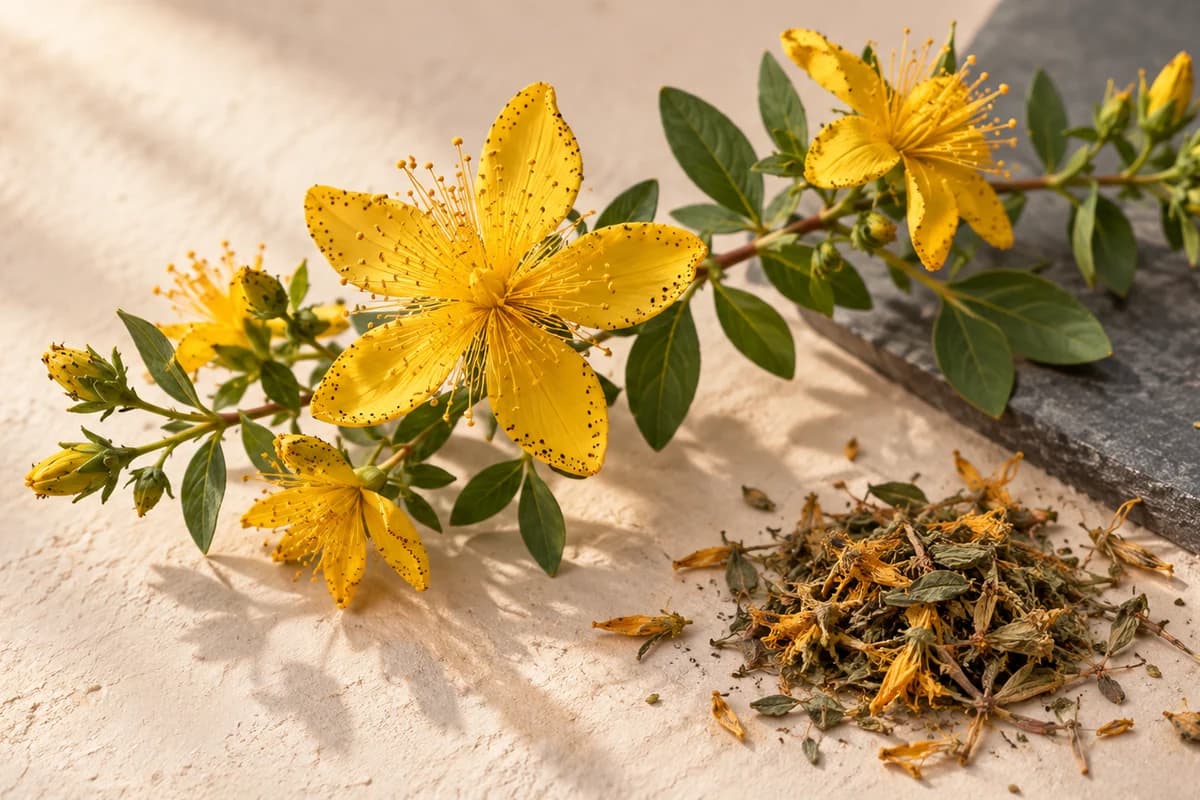
St John’s wort is a yellow-flowered plant. Supplements commonly use preparations of the herb. A study of a defined extract is evidence about that preparation and setting; it should not be read as proof that every tea, tincture or capsule has the same effect.See reference 1,See reference 2
Preparations differ in their constituents, including hypericin and hyperforin. The systematic review found variation across extracts as well as across study results. A label’s milligrams of herb and milligrams of extract are therefore not a ready-made equivalence calculation.See reference 2,See reference 4
What human evidence supports
- Question
- Short-term mild to moderate depression
- Finding
- A 2016 review found better response than placebo and no significant effectiveness difference from antidepressants in the included comparisons.
- Boundary
- Studies and extracts varied; this is not proof that a retail herb is interchangeable with a prescribed medicine.See reference 2
- Question
- Conflicting trial results
- Finding
- A 340-participant placebo-controlled trial found no benefit on its main outcomes in moderately severe major depression.
- Boundary
- A positive average across studies does not make every trial positive.See reference 6
- Question
- Severe depression or sustained use
- Finding
- Current NCCIH guidance says benefit for severe depression or periods beyond 12 weeks is uncertain.
- Boundary
- Short-term symptom improvement does not establish long-term relapse prevention.See reference 1
- Question
- Other promoted uses
- Finding
- Evidence is insufficient for firm conclusions about several other uses.
- Boundary
- Advertising a use is different from demonstrating it in reliable human research.See reference 1
Why the positive and negative findings can coexist
A systematic review combines trials with different participants, extracts and methods. The 2016 review included 35 studies and 6,993 participants, but the studies were not one uniform experiment. Its conclusions were limited by inconsistent results, sparse evidence in severe depression and incomplete assessment of adverse effects.See reference 2
In the 340-participant JAMA trial, neither St John’s wort nor sertraline outperformed placebo on the two primary outcomes. Sertraline did perform better on one secondary measure. This trial cannot establish that antidepressants as a class are ineffective; it illustrates why the product, population and chosen outcome need to stay with the result.See reference 6
For a reader, the practical question is not simply whether a trial exists. Ask whether it studied the same preparation, severity of illness, outcome and duration as the claim being made. A supplement claim that omits these details is harder to assess.
Two different kinds of medicine interaction
St John’s wort can increase the activity of systems that process or transport medicines. For some medicines, this reduces the amount circulating in the body and weakens their effect. The TGA also warns that levels of interacting medicines can rise when St John’s wort is stopped. Starting, stopping or switching preparations can therefore matter.See reference 4
A different interaction involves medicines that affect serotonin. Combining effects can increase serotonin-related adverse reactions. “It lowers drug levels” is not a sufficient explanation for every interaction; some combinations can instead increase harmful effects.See reference 1,See reference 4
Examples that need a medicine review
- Medicine group
- Oral contraceptives
- Potential problem
- Reduced effectiveness, including possible contraceptive failure.
- How to use this information
- Tell the pharmacist or prescriber about the exact supplement.See reference 4
- Medicine group
- Transplant medicines, warfarin and some HIV medicines
- Potential problem
- Reduced exposure or effect can have serious consequences.
- How to use this information
- An online list cannot assess a full prescription regimen.See reference 1,See reference 4
- Medicine group
- Some antidepressants and migraine triptans
- Potential problem
- Increased serotonin-related adverse effects.
- How to use this information
- A clinician or pharmacist needs to check the specific combination.See reference 4
- Medicine group
- Other medicines
- Potential problem
- Many additional interactions are possible.
- How to use this information
- Absence from this short table is not a safety clearance.See reference 1,See reference 4
Other safety limits
Reported adverse effects include digestive upset, dizziness, sleep problems and restlessness. Sun-related skin reactions can occur, particularly with large oral amounts or topical use. Pregnancy may be unsafe, and adverse effects have been reported in breastfed infants.See reference 1
NCCIH also describes reports of worsening symptoms in people with bipolar disorder or schizophrenia. Depression can be a serious illness; an herb should not replace an assessment or delay needed care. This guide does not select a depression treatment or a supplement dose.See reference 3
If St John’s wort is already being used with medicines, contact the prescribing team or pharmacist for an individual plan before making changes. The interaction review needs both the medicines and the supplement history, including recent changes in product.See reference 4
A useful product and evidence checklist
- Record the Latin name, preparation, amount per serving, other ingredients and exact product name.
- Look for a study of the specific extract rather than a general “clinically studied herb” claim.
- Keep a complete medicine and supplement list for a pharmacist’s interaction check.
- A quality seal can address manufacturing or contents; it does not guarantee benefit or safety for you.See reference 5
Common questions
Is St John’s wort a proven treatment for every kind of depression?
No. Findings are strongest for some extracts in short-term mild to moderate depression research. Evidence does not establish benefit across all severities or products.See reference 1,See reference 2
Is a standardised extract automatically safe with medicines?
No. A stated constituent amount does not remove interaction risk, and active-ingredient levels can vary between preparations.See reference 4
Can I use a trial’s dose for any capsule with the same plant name?
The review studied varying extracts, so a plant name alone does not establish product equivalence. This guide does not provide a self-treatment dose.See reference 2
Does fewer side effects in trials mean no serious risk?
No. The systematic review’s adverse-event reporting was limited and the studies were not designed to assess rare events. Medicine interactions remain a separate concern.See reference 2,See reference 4
References
- 1. St. John’s Wort: Usefulness and Safety
National Center for Complementary and Integrative HealthOfficial guidance
- 2. A systematic review of St. John’s wort for major depressive disorder
Apaydin and colleagues, Systematic ReviewsSystematic review
- 3. St. John’s Wort and Depression: In Depth
National Center for Complementary and Integrative HealthOfficial guidance
- 4. St John’s Wort: information sheet for health care professionals
Therapeutic Goods Administration, AustraliaOfficial guidance
- 5. Dietary Supplements: What You Need To Know
NIH Office of Dietary SupplementsOfficial guidance
- 6. Effect of Hypericum perforatum (St John’s Wort) in Major Depressive Disorder: A Randomized Controlled Trial
Hypericum Depression Trial Study Group, JAMARandomized trial
Editorial transparency
- Published by
- LongevityMate Editorial
- Published
- Updated
Medical disclaimer
General education only. This guide does not diagnose a condition, interpret your personal result, choose a treatment or recommend a supplement dose. Discuss testing, symptoms, medicines and supplements with a qualified health professional.