
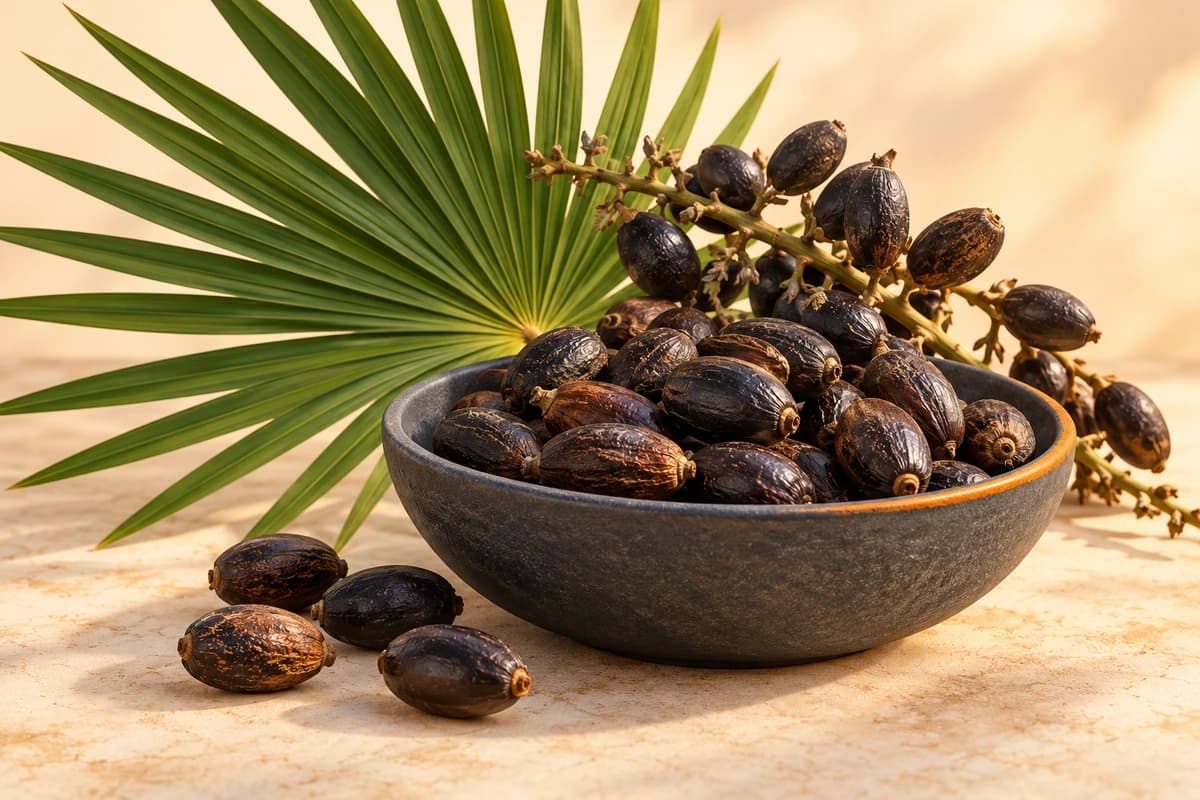
The fruit, extract and final product are not identical
Saw palmetto, Serenoa repens, is a small palm whose berries are used in herbal products.See reference 2
The original artwork depicts fruit and a fan leaf. It is an ingredient illustration, not a verified specimen, tested product or evidence of benefit.
An extract name, extraction process and combination ingredient list describe the product tested. They do not make results from one preparation apply automatically to every bottle.
What the better studies actually tested
- Evidence
- 2006 placebo-controlled trial
- People and preparation
- 225 men over 49; 160 mg extract twice daily for one year
- Result and limit
- No significant benefit for symptom scores or urinary flow; the study amount is not a dose recommendationSee reference 4
- Evidence
- 2011 CAMUS trial
- People and preparation
- 369 men aged 45 or older; 320 mg/day, increasing to two and three times that amount over 72 weeks
- Result and limit
- Increasing the studied amount did not outperform placeboSee reference 3
- Evidence
- 2023 Cochrane review
- People and preparation
- 27 studies, 4,656 men; single and combination products assessed separately
- Result and limit
- Saw palmetto alone: little or no benefit; combinations have greater uncertaintySee reference 1
Improvement during a trial is not necessarily an extract effect
In CAMUS, symptom scores improved in both groups. The average improvement was larger with placebo, and the extract did not show superior secondary outcomes. That comparison explains why feeling better while taking a product does not, by itself, establish that the product caused the improvement.See reference 3
Does a different extraction method change the conclusion?
Cochrane’s findings for single-ingredient saw palmetto were similar at short and longer follow-up. NCCIH also reports that separating hexane-extracted products from other products did not reveal a benefit difference in the review. This does not prove every preparation is equivalent; it limits the claim that extraction alone solves the evidence problem.See reference 1,See reference 2
Urinary evidence cannot become proof for hair growth
NCCIH describes hair-loss research as small and insufficient to establish benefit. A urinary finding does not establish a hair-growth effect.See reference 2
Tolerability does not remove the need for assessment
Reported adverse effects are generally mild and uncommon: digestive symptoms, dizziness and headache. Pregnancy or breastfeeding use may be unsafe. Discuss herbal products when taking medicines; this guide cannot clear a specific combination.See reference 2
Urinary symptoms have several possible causes, including bladder problems, infection and prostatitis. NIDDK advises discussing symptoms with a clinician. Inability to urinate at all needs prompt medical help, rather than a supplement trial.See reference 5
Use product information without confusing it with proof
Keep the ingredient list, preparation and any additional herbs available for a professional review. Supplement regulation and quality evaluation differ from drug approval. A quality check can help identify a product; it does not demonstrate that the product treats urinary symptoms.See reference 6
Keep the useful details
- A negative placebo comparison can be informative, even when both groups improve.See reference 3
- Single-ingredient and combination evidence answer different questions.See reference 1
- Keep urinary assessment separate from a supplement purchase.See reference 5
Common questions
Would taking more be supported by the research?
CAMUS tested increasing amounts without finding better symptom relief than placebo. Those study amounts are not personal instructions.See reference 3
Are combination products proven by the saw-palmetto-only trials?
No. Cochrane evaluated combinations separately and found greater uncertainty.See reference 1
Is there good evidence that it regrows hair?
NCCIH describes the evidence as too limited to reach a conclusion.See reference 2
Get the weekly longevity brief
The week's best longevity research in plain English. Free, every Tuesday.
References
- 1. Serenoa repens for benign prostatic hyperplasia
Franco et al., Cochrane, 2023Systematic review
- 2. Saw palmetto: usefulness and safety
NCCIHOfficial guidance
- 3. Effect of increasing doses of saw palmetto extract on lower urinary tract symptoms
Barry et al., JAMA, 2011Randomized trial
- 4. Saw palmetto for benign prostatic hyperplasia
Bent et al., NEJM, 2006Randomized trial
- 5. Enlarged prostate: benign prostatic hyperplasia
NIDDKOfficial guidance
- 6. Using dietary supplements wisely
NCCIHOfficial guidance
Editorial transparency
- Published by
- LongevityMate Editorial
- Published
- Updated
Medical disclaimer
General education only. This guide does not diagnose a condition, interpret your personal result, choose a treatment or recommend a supplement dose. Discuss testing, symptoms, medicines and supplements with a qualified health professional.