
Whole biomass and a pigment extract are different materials
The food ingredient commonly called spirulina is biomass from cyanobacteria such as Arthrospira. A whole-biomass powder, tablet and isolated blue pigment preparation should not be assumed to contain the same constituents or share the same evidence.See reference 1
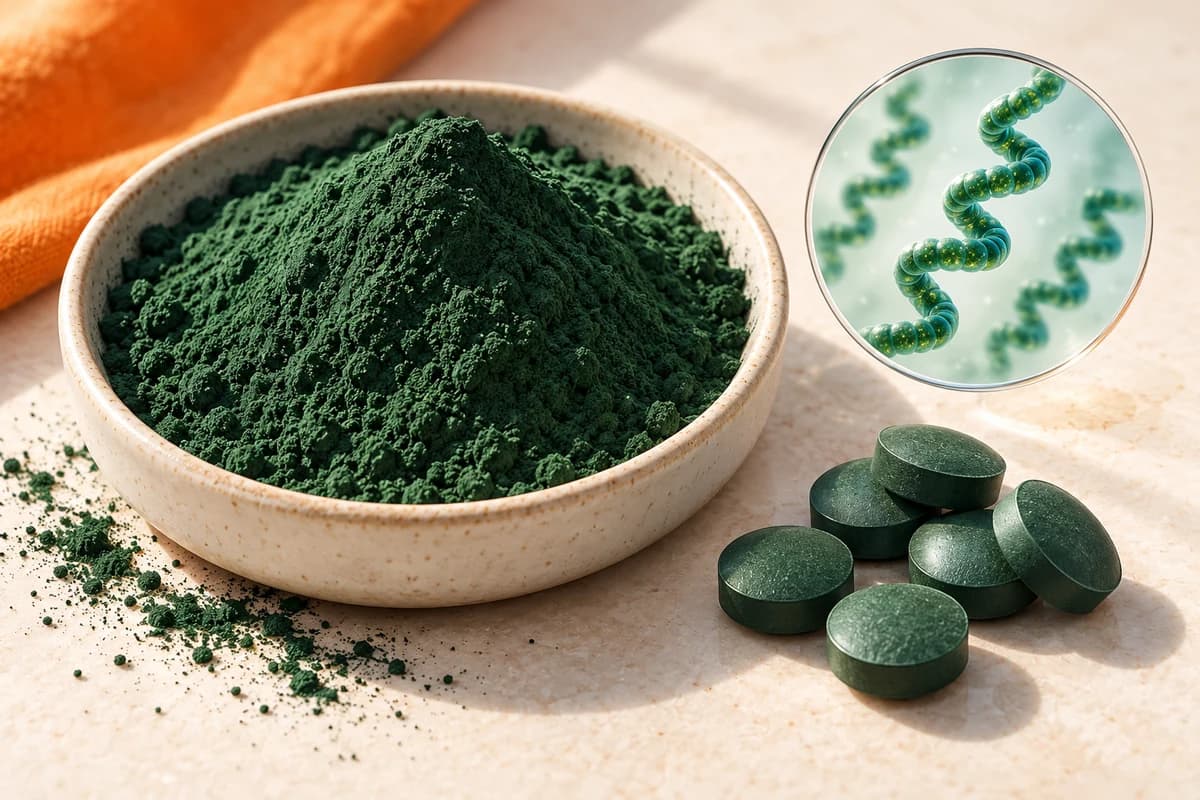
The artwork shows green powder and tablets alongside a conceptual coiled-filament inset. The inset represents the organism’s form; it is not a measured micrograph. It does not show a tested contaminant level or certify a commercial batch.
Keep the endpoint and the product visible
- Question
- Blood lipids
- Evidence observed
- A synthesis of twenty trials reported favourable lipid changes
- Limit
- Measured lipids do not establish fewer clinical cardiovascular eventsSee reference 3
- Question
- Glucose and body measures
- Evidence observed
- A newer broad synthesis found some favourable pooled effects
- Limit
- Certainty differed by endpoint, with low-quality evidence for several metabolic measuresSee reference 4
- Question
- Vitamin B12 adequacy
- Evidence observed
- Food-safety guidance identifies substantial inactive B12 analogues
- Limit
- Spirulina should not be used as a reliable B12 replacementSee reference 2
- Question
- Product safety
- Evidence observed
- Agency guidance identifies possible cyanotoxin, bacterial and metal contamination
- Limit
- A quality judgement needs the actual source and batch, not the ingredient name aloneSee reference 1
Lipid findings are biomarker evidence
The 2023 lipid review combined twenty randomized studies with 1,076 participants and reported improvements in LDL cholesterol, total cholesterol and triglycerides, with an increase in HDL. Populations and protocols varied. The result should be described as a pooled change in measured lipids.See reference 3
That review does not show that the tested products prevented heart attacks or strokes. A favourable laboratory change can be worth further research without becoming a medicine-replacement claim. It also cannot prove that any powder sold under the same ingredient name has the same composition.See reference 3
A newer review still needs endpoint-specific caution
The 2025 broader synthesis included thirty-five trials and assessed multiple cardiometabolic outcomes. Its certainty ratings differed: several lipid or glucose outcomes were supported by low-quality evidence, while some other outcomes received stronger ratings. One positive endpoint does not upgrade all the others.See reference 4
The studies varied in participants, amounts and duration. A claim about cardiovascular prevention needs clinical event evidence beyond these biomarker results. Avoid using the largest number of pooled trials as a substitute for the quality and relevance of the specific finding.See reference 4
The vitamin B12 limitation is practical
ANSES explains that much of the B12-like material in spirulina is an inactive analogue. This makes it an unreliable way to meet vitamin B12 needs, particularly when a diet otherwise lacks a dependable source. A B12-looking analytical number does not settle biological activity.See reference 2
Do not use a spirulina label to discontinue a reliable B12 source or to interpret a low laboratory result. This page does not choose a deficiency-treatment plan. Its related B12 guide explains that separate nutrient question.
Cultivation and batch evidence matter
ANSES highlights contamination by cyanotoxins, bacteria and trace metals as relevant safety concerns. These are possible product-quality problems, not proof that every spirulina product is contaminated. The agency also identifies particular caution for people with phenylketonuria or an allergic predisposition.See reference 1
Ask whether quality documentation identifies the product and lot, reports the relevant tests and comes from an appropriate laboratory. A certificate for a different lot, or a front-of-pack purity slogan, leaves an unanswered question. This checklist does not certify that an unexamined product is safe.
An ingredient monograph does not approve every bottle
The 2011 U.S. Pharmacopeia review assigned a Class A safety rating to the evaluated spirulina ingredients, allowing quality monographs. It reviewed clinical, animal, regulatory and adverse-event information and noted that the classification could be revisited as new information emerged.See reference 5
This supports a standards discussion, not a guarantee of efficacy or of every commercial batch. Keep identity standards, batch contamination checks and benefit studies as separate pieces of evidence. A population-specific medicine or pregnancy question still requires a qualified professional.See reference 5
Keep the useful details
- Do not treat whole biomass and a blue pigment extract as equivalent.
- A lipid change is not proof of fewer cardiovascular events.See reference 3
- Spirulina is not a dependable vitamin B12 replacement.See reference 2
Common questions
Can spirulina supply reliable B12 for a vegan diet?
The agency guidance says it is not a reliable B12 source because of inactive analogues.See reference 2
Do favourable lipid results prove heart-attack prevention?
No. Those measurements and clinical events are different endpoints.
Does a blue spirulina extract share every whole-powder result?
The preparations are different; a transfer needs direct compositional and study support.
Are all spirulina products contaminated?
The cited guidance identifies possible risks, rather than finding contamination in every product.See reference 1
Does a quality monograph guarantee a particular product’s benefit?
No. Quality standards and evidence of clinical efficacy answer different questions.
Get the weekly longevity brief
The week's best longevity research in plain English. Free, every Tuesday.
References
- 1. Risks associated with consumption of spirulina supplements
French Agency for Food, Environmental and Occupational Health & Safety, 2017Official guidance
- 2. Spirulina and vitamin B12: food-safety vigilance summary
ANSES, Vigil’Anses, February 2018Official guidance
- 3. Spirulina supplementation and plasma lipid concentrations: meta-analysis
2023; Pharmacological ResearchMeta-analysis
- 4. Spirulina and cardiometabolic risk factors: systematic review and meta-analysis
Shiri et al., 2025; Complementary Therapies in MedicineMeta-analysis
- 5. U.S. Pharmacopeia safety evaluation of spirulina
Marles et al., 2011; Critical Reviews in Food Science and NutritionEvidence review
Editorial transparency
- Published by
- LongevityMate Editorial
- Published
- Updated
Medical disclaimer
Educational information about published research and product labels. This guide does not diagnose a condition, choose a supplement or dose, change a medicine, or replace advice from a qualified healthcare professional.