
What the human trials actually tested
- Study
- Niv et al., 2016
- Design and participants
- 121 randomized adults with IBS; 108 included in the reported intention-to-treat analysis; 12 weeks
- Finding and limit
- Bloating and combined gas/bloating measures improved. Other symptom measures, overall severity and quality of life did notSee reference 1
- Study
- Edelman et al., 2024
- Design and participants
- 33 healthy adults; three 14-day crossover periods; 3 g PHGG, 6 g PHGG or placebo; low-fiber diet
- Finding and limit
- Some bacterial groups changed. This was not a disease-treatment trialSee reference 2
Read the bloating result alongside the study limits
The 2016 trial studied a specific preparation, mainly at 6 g/day after an initial lower-dose week. Dropout was higher with placebo, and baseline severity differed. ProNatura and Sunwic AB funded the research; the authors declared no competing interests. These details limit how confidently the result applies to another product or person.See reference 1
A microbial shift is not a proven health outcome
The 2024 trial detected changes including increased Akkermansia with both PHGG doses. Its authors noted that a change in microbial composition does not establish a change in microbial function. They reported no adjustment for multiple testing, and the study was supported by Taiyo International; the authors declared no conflict of interest.See reference 2
Its short treatment periods and healthy, low-fiber participants do not establish prevention or treatment of inflammatory gut disease. A taxon is a bacterial group; a higher or lower abundance is not a personal health score or a reason to aim for a particular stool-test number.See reference 2
Do not transfer another fiber’s evidence to PHGG
The 2023 AGA–ACG constipation guideline gives a conditional recommendation for fiber, with low-certainty evidence. Among the fibers it evaluated, only psyllium appeared effective, with limited data for bran and inulin. This is not a PHGG-specific endorsement, and absence from that comparison does not prove PHGG cannot help.See reference 3
The guideline also highlights dietary assessment, hydration and flatulence. Constipation, IBS symptoms and microbial composition are different outcomes. A product saying ‘fiber’ does not establish which outcome was tested or which preparation was used.See reference 3
Match the ingredient before comparing claims
Supplement labels identify the ingredient, quantity per serving and other ingredients. A blend may contain several fibers, sweeteners or added probiotics. Keep the full label: powder weight, fiber grams and named PHGG content are not automatically the same quantity.See reference 5
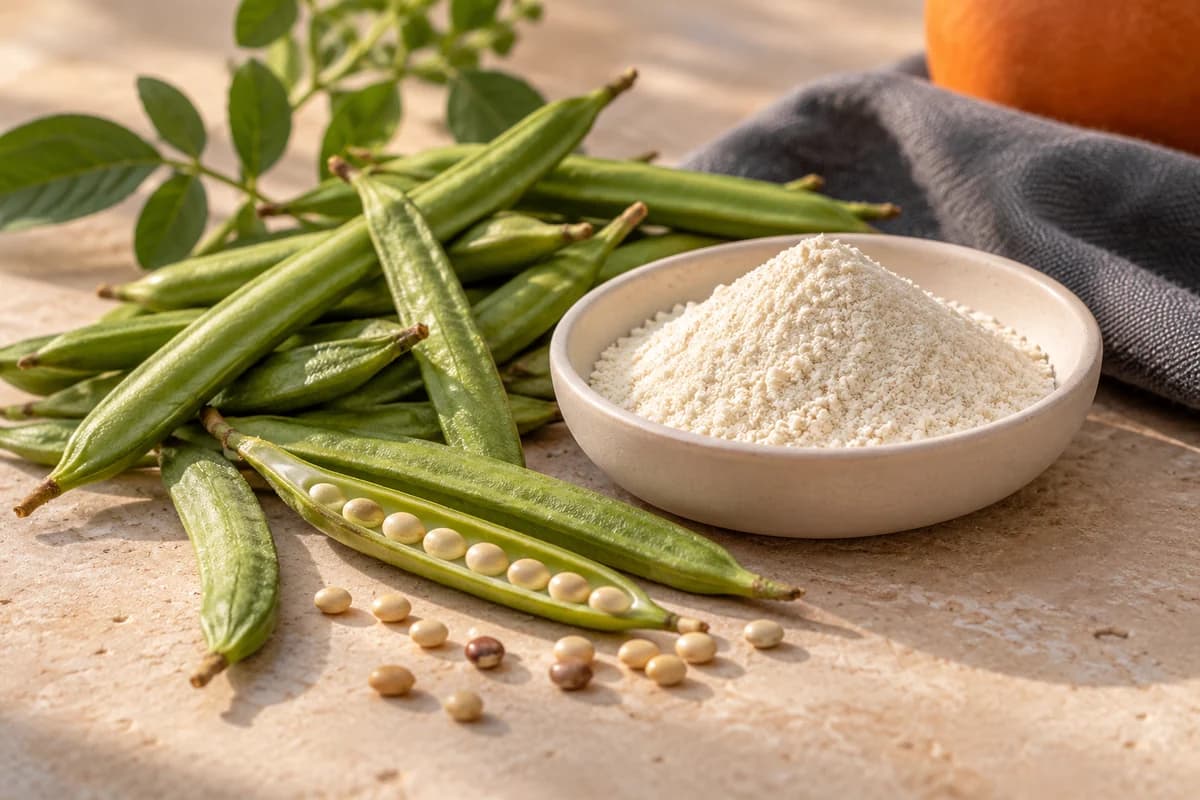
The illustration shows guar pods, seeds and powder as an ingredient-source concept. It cannot show that hydrolysis took place, certify a commercial formulation or prove a bowel benefit. Ordinary guar gum, PHGG, psyllium and inulin are separate ingredients for evidence comparison.
Short adult trials do not settle every safety question
NCCIH advises discussing supplements with the care team, including medicine interactions. Commercial preparations can differ from those studied, and evidence is often limited for pregnancy, breastfeeding and children. The adult trials here should not be used to choose an individual dose or a child’s treatment.See reference 4
No significant side-effect difference was reported in the 2016 trial, but pregnancy and important gastrointestinal conditions were excluded. A limited trial cannot establish safety for excluded groups or detect every rare or long-term problem.See reference 1
Keep the useful details
- Ask whether the claim is about symptoms or microbial measurements.
- Match the exact ingredient and formulation on the label.See reference 5
- Keep clinical treatment decisions with a qualified professional.See reference 4
Common questions
Does more Akkermansia prove better health?
No. The trial’s microbial findings do not establish disease treatment or a personal microbiome target.See reference 2
Can the 6 g study amount be treated as my recommended dose?
No. It describes a trial condition, not an individual recommendation.See reference 1
Is PHGG the same as every product labelled guar gum?
No. Check that the ingredient is explicitly partially hydrolyzed guar gum and read the full formulation.See reference 2
Get the weekly longevity brief
The week's best longevity research in plain English. Free, every Tuesday.
References
- 1. PHGG versus placebo in patients with irritable bowel syndrome
Niv et al., Nutrition & Metabolism, 2016Randomized trial
- 2. Dose response effects of PHGG on gut microbiome of healthy adults
Edelman et al., Applied Microbiology, 2024Randomized trial
- 3. AGA–ACG guideline: pharmacological management of chronic idiopathic constipation
AGA and ACG, 2023Guideline
- 4. Using dietary supplements wisely
NCCIHOfficial guidance
- 5. Dietary supplements: what you need to know
NIH Office of Dietary SupplementsOfficial guidance
Editorial transparency
- Published by
- LongevityMate Editorial
- Published
- Updated
Medical disclaimer
General education only. This guide does not diagnose a condition, interpret your personal result, choose a treatment or recommend a supplement dose. Discuss testing, symptoms, medicines and supplements with a qualified health professional.