
Protein grams are different from scoop weight
The 2015 trial used a particular yellow-pea isolate, not ordinary peas or any powder with pea on its label. A prepared powder includes whatever else the product contains. Compare its stated protein grams, serving weight and ingredient list before relating it to a study preparation.See reference 1
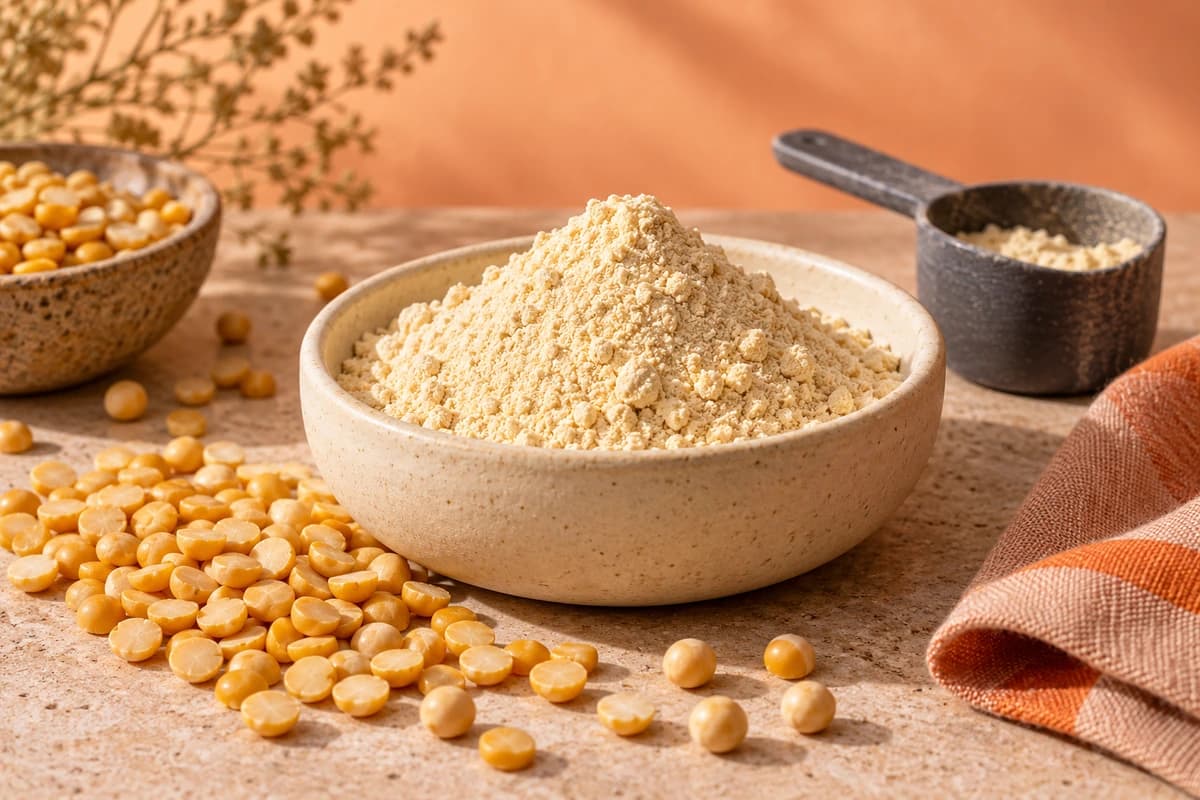
The artwork shows yellow split peas, beige powder and a scoop. It identifies the ingredient source without specifying a brand, dose or measured protein content. A plant ingredient still needs a full ingredient and allergy check.
Two trials, with different training and outcomes
- Study
- 2015: 161 young men, 12 weeks of upper-limb resistance training
- What was found
- Muscle thickness increased over time; the full-sample between-group comparison was a trend, not statistically significant
- What remains uncertain
- A favorable pea-versus-placebo result came from a lower-strength subgroup; strength gains did not differ between groupsSee reference 1
- Study
- 2019 pilot: 15 adults, eight weeks of high-intensity functional training
- What was found
- Squat and deadlift strength improved in both pea and whey groups; no measured outcome differed between groups
- What remains uncertain
- Very small sample, no inactive control and no demonstrated changes in muscle thickness or body compositionSee reference 2
No detected difference does not establish equivalence
The pilot’s absence of a statistically significant pea-versus-whey difference cannot prove equal effects. Fifteen participants leave substantial uncertainty. Improvements while both groups train also cannot isolate the contribution of either supplement from the training itself.See reference 2
The larger trial was funded by Roquette, which made the studied pea ingredient, and several authors were employees. The pilot reported no external funding; one author later became a part owner of the training gym. Read those disclosures beside the design and results.See reference 1,See reference 2
Put the product inside the wider diet and training plan
NIH describes protein quality and total protein supply as part of training and recovery. Food can supply protein; supplements may fill a gap. That wider guidance does not establish pea-specific equivalence or a personal need for a powder.See reference 4
The trial populations and durations do not establish outcomes for all older adults, people with illness or long-term use. If your care team has set dietary limits, discuss the full product before changing intake. A tested preparation can differ from a product sold in a shop.See reference 5
Dairy-free does not mean allergy-free
Health Canada warns that some people with peanut allergy can react to pea protein, although most can eat other legumes. Concentrated pea protein may expose someone to more pea protein than whole peas. Do not treat a dairy-free label or previous tolerance of another legume as allergy clearance.See reference 3
Pea is not a priority allergen under Canadian labeling rules, so it may lack a special allergen warning there even though it appears in the ingredient list. Label rules vary by market. People with relevant food allergy should check the complete label and follow their allergy care plan.See reference 3
Keep the useful details
- Separate the whole-sample findings from the subgroup result.See reference 1
- Keep the pilot’s small sample beside any comparison with whey.See reference 2
- Check the full product ingredients and concentrated-pea allergy concern.See reference 3
Common questions
Is pea protein proven equal to whey?
No. These trials did not establish equivalence. No detected difference, especially in a small pilot, leaves uncertainty.See reference 2
Does a larger muscle measurement prove greater strength?
No. The larger trial measured muscle thickness and strength separately; strength changes did not differ between groups.See reference 1
Can a peanut-allergic person assume pea protein is safe?
No. Some people react to pea protein. The label and individual allergy plan matter.See reference 3
Get the weekly longevity brief
The week's best longevity research in plain English. Free, every Tuesday.
References
- 1. Pea proteins oral supplementation promotes muscle thickness gains during resistance training
Babault et al., 2015Randomized trial
- 2. Effects of whey vs. pea protein on adaptations following eight weeks of high-intensity functional training
Banaszek et al., 2019Randomized trial
- 3. Pea protein and peanut allergy
Health Canada, 2022Official guidance
- 4. Dietary supplements for exercise and athletic performance: protein
NIH Office of Dietary SupplementsOfficial guidance
- 5. Using dietary supplements wisely
NCCIHOfficial guidance
Editorial transparency
- Published by
- LongevityMate Editorial
- Published
- Updated
Medical disclaimer
General education only. This guide does not diagnose a condition, interpret your personal result, choose a treatment or recommend a supplement dose. Discuss testing, symptoms, medicines and supplements with a qualified health professional.