
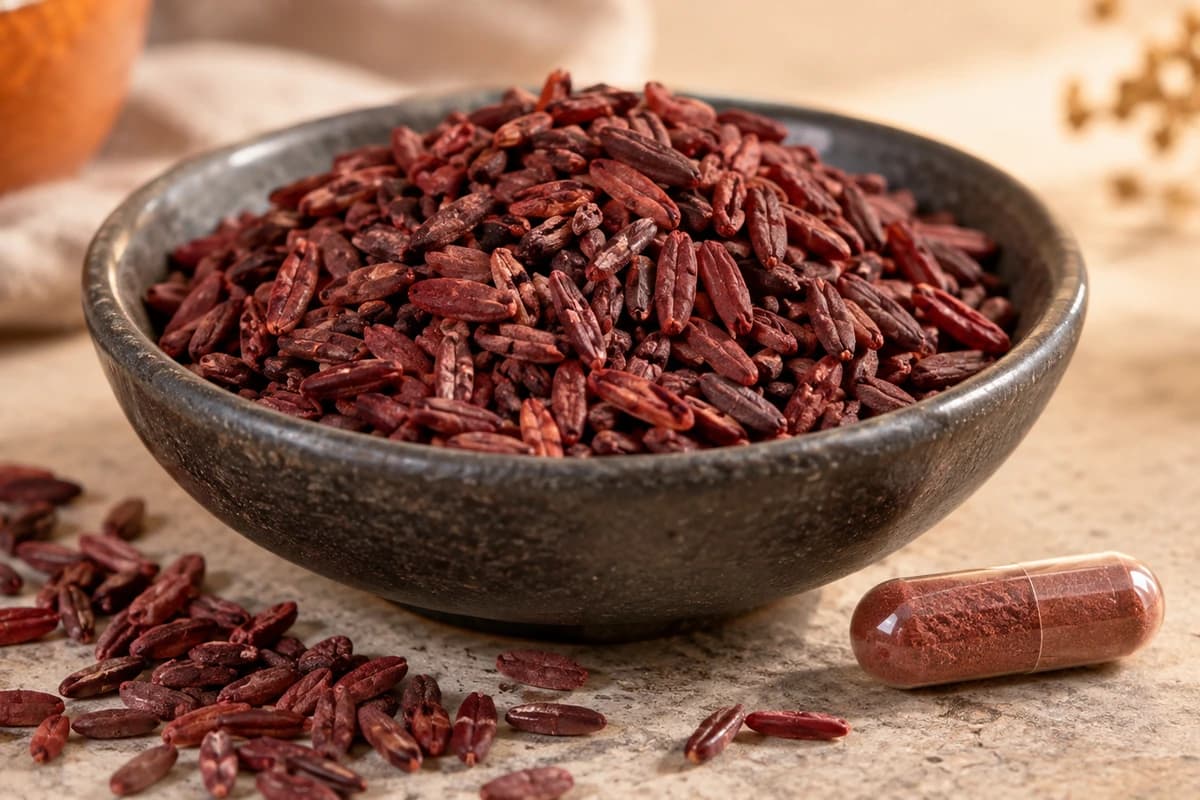
Benefit, product strength and safety are separate questions
- Evidence
- 2015 review of 20 randomized studies
- What it found
- Products with known monacolin content lowered LDL compared with placebo
- Main limit
- Safety assessment was weak in most studies; trial products do not represent every retail capsuleSee reference 4
- Evidence
- 2017 analysis of 28 U.S. retail brands
- What it found
- Monacolin K was undetected in two; among the others, content varied more than 60-fold
- Main limit
- This is a historical sample, not an estimate of every product sold todaySee reference 3
- Evidence
- 2025 EFSA safety review
- What it found
- Additional data did not establish a daily monacolin intake without safety concerns
- Main limit
- A low stated amount is not an established safe dose; this assessment does not prove efficacySee reference 2
Milligrams of rice do not tell you the monacolin amount
The retail analysis compared equal amounts of red yeast rice and found very different monacolin contents. A capsule’s rice weight therefore cannot establish an equivalent lovastatin dose or predict its effect. The study demonstrates a composition problem, rather than providing a shopping list or a conversion formula.See reference 3
What changed in the newer safety assessment
EFSA’s opinion was published in February 2025 and amended for editorial corrections in September. It reaffirmed concerns about serious muscle and liver effects and could not establish safety even below the previously scrutinized low intake level. A regulatory limit or a low-dose marketing claim should not be read as a guarantee of safety.See reference 2
An LDL change is not a complete treatment decision
The older review selected products with known monacolin K content and measured LDL changes. It found low-quality safety assessment in most included studies. A cholesterol response in that evidence does not establish long-term safety, a personal cardiovascular benefit or equivalence between an unknown supplement and a prescribed treatment.See reference 4
Two different risks: active ingredients and contamination
Products with monacolin K can share statin-like muscle, liver and kidney adverse effects and medicine interactions. Separately, some products can contain citrinin, a contaminant that can harm the kidneys. A product without much monacolin is not automatically effective; a contaminant claim alone does not settle the active ingredient’s safety.See reference 1
Pregnancy and breastfeeding are reasons not to use red yeast rice according to NCCIH. Discuss current medicines, previous statin reactions and existing liver or kidney conditions with a qualified clinician or pharmacist. This guide does not select a product, dose or substitute for a prescription.See reference 1,See reference 5
Keep the useful details
- Keep rice weight separate from measured monacolin content.See reference 3
- Assess safety evidence alongside any LDL-lowering claim.See reference 2,See reference 4
- Take the full product label and medicine list to a professional discussion.See reference 5
Common questions
Is red yeast rice a statin-free option?
A product may contain monacolin K, the same molecule as lovastatin. Natural origin does not make that ingredient statin-free.See reference 1
Does a small monacolin amount guarantee safety?
No. EFSA’s 2025 review did not identify an intake without safety concerns, including at low amounts.See reference 2
Can I replace my prescribed cholesterol medicine with it?
This guide cannot authorize that change. Discuss cholesterol management, your complete medicine list and the actual product with the prescribing clinician.See reference 5
Get the weekly longevity brief
The week's best longevity research in plain English. Free, every Tuesday.
References
- 1. Red yeast rice
NCCIHOfficial guidance
- 2. Additional scientific data on the safety of monacolins from red yeast rice: 2025 opinion, amended September 2025
EFSA Panel on Nutrition, Novel Foods and Food AllergensOfficial guidance
- 3. Variability in strength of red yeast rice supplements purchased from mainstream retailers
Cohen, Avula and Khan, European Journal of Preventive Cardiology, 2017Observational study
- 4. Red yeast rice LDL reduction and safety: systematic review and meta-analysis
Gerards et al., Atherosclerosis, 2015Meta-analysis
- 5. Using dietary supplements wisely
NCCIHOfficial guidance
Editorial transparency
- Published by
- LongevityMate Editorial
- Published
- Updated
Medical disclaimer
General education only. This guide does not diagnose a condition, interpret your personal result, choose a treatment or recommend a supplement dose. Discuss testing, symptoms, medicines and supplements with a qualified health professional.