
Why the type and processing matter
- Type
- RS1
- Basis of resistance
- Starch protected within intact plant structures
- Why it matters when reading evidence
- Processing can disrupt the structureSee reference 3
- Type
- RS2
- Basis of resistance
- Resistant starch granules, including high-amylose preparations
- Why it matters when reading evidence
- The named ingredient and treatment conditions matterSee reference 3
- Type
- RS3
- Basis of resistance
- Starch reorganized after cooking and cooling, called retrogradation
- Why it matters when reading evidence
- A description of processing, not a fixed amount in every cooled foodSee reference 3
- Type
- RS4
- Basis of resistance
- Chemically modified starch
- Why it matters when reading evidence
- A different preparation from an unmodified starch powderSee reference 3
Separate short-term markers from a reliable health promise
A 2023 review identified 36 randomized trials in people with type 2 diabetes or prediabetes. Some RS1 and RS2 interventions improved glucose measures, but results varied and evidence for other types was more limited. The pooled findings did not establish a clear HbA1c benefit, a longer-term glucose measure; the authors also flagged bias, inconsistent carbohydrate reporting and uncertain clinical importance.See reference 1
A 2025 review included 23 randomized trials in adults with metabolic-syndrome-related risks, with 19 pooled. Some lipid and body-measure outcomes improved, and the HbA1c change was small. Pooled body weight was not significantly reduced. Insulin-resistance findings varied substantially between studies. These selected adult groups and measured endpoints do not establish that an unspecified powder treats diabetes or reliably causes weight loss.See reference 3
What the much-discussed 2024 weight-loss trial actually tested
A 2024 crossover trial studied 37 adults with overweight or obesity. Eight weeks of high-amylose maize RS2 provided 40 g of resistant starch daily, within a controlled background diet. Compared with the control-starch period, the net average weight change was about −2.8 kg. The study preparation weighed 91.2 g to supply that 40 g of resistant starch, illustrating why powder weight and resistant-starch content differ.See reference 2
The researchers noted the small sample and strict eligibility criteria, and weight returned toward baseline during the washout in one sequence. The result is promising under those conditions, not a forecast or intake recommendation. Human microbiome associations were followed by mechanistic experiments in mice; those experiments do not establish that adding a particular probiotic will reproduce the human effect.See reference 2
Fermentation is not the same as a proven clinical benefit
A 2022 review of 39 adult trials examined tolerability and short-chain fatty acids, compounds produced during gut fermentation. Responses were not uniform and tolerability reporting was incomplete. A change in a bacterial group or a stool metabolite does not itself establish improved symptoms or long-term disease prevention.See reference 4
A September 2026 review considered both glucomannan and resistant starch across mixed study designs: 11 of its 20 included studies were in animals. It described heterogeneous findings and limited direct evidence for benefit from combining the two ingredients. Such mixed mechanistic evidence should not be presented as a proven human weight-loss formula.See reference 5
Identify the starch and the amount actually measured
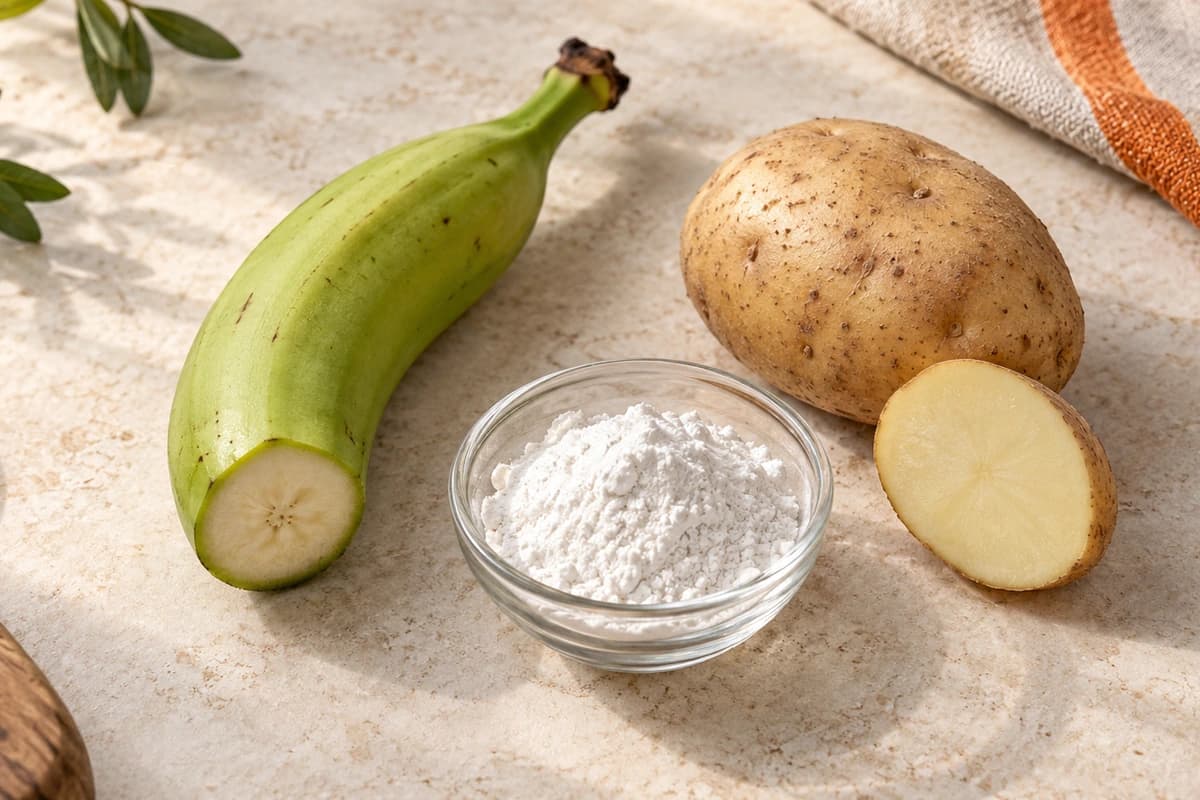
Check the named source and type, whether the ingredient is a prepared extract or ordinary flour, and how the label states resistant-starch content. Processing and preparation are part of the evidence. The picture depicts source ingredients and plain powder; it does not measure their resistant-starch content or recommend eating raw potato.
Cooking and cooling is a scientific explanation for RS3, not a storage or food-safety protocol. Do not infer a resistant-starch amount, a carbohydrate subtraction for insulin dosing, or a safe preparation method from this guide.
Study tolerability does not guarantee personal suitability
Many trials in the tolerability review reported acceptable tolerance, but not all studies measured or reported it consistently. The 2023 review also highlights incomplete side-effect reporting. Gastrointestinal response and suitability remain relevant; evidence from selected adults cannot be extended automatically to children, pregnancy or every digestive condition.See reference 4,See reference 1
NCCIH advises discussing supplements with the care team because products can cause problems in particular medical circumstances or with medicines. This guide does not prescribe an amount, replace diabetes treatment or clear a product for an allergy or digestive condition.See reference 6
Keep the useful details
- Match the type, preparation and population to the study.See reference 1
- Keep the controlled diet and small sample beside the 2024 result.See reference 2
- Distinguish powder grams, resistant-starch grams and fermentation markers.See reference 2,See reference 4
Common questions
Is all starch resistant starch?
No. Resistance describes the fraction that escapes small-intestinal digestion, and it depends on the structure and preparation.See reference 3
Does cooling food make its carbohydrate irrelevant?
No. The RS3 concept does not establish the amount in an individual food or provide an insulin-dosing rule.
Does the 2024 result guarantee weight loss?
No. It tested a specific high-amylose maize preparation in 37 selected adults alongside a controlled diet; broader and lasting effects remain uncertain.See reference 2
Get the weekly longevity brief
The week's best longevity research in plain English. Free, every Tuesday.
References
- 1. A comparison of resistant starch types on glycemic response in type 2 diabetes or prediabetes
Pugh et al., 2023; Frontiers in NutritionMeta-analysis
- 2. Resistant starch intake facilitates weight loss in humans by reshaping the gut microbiota
Li et al., 2024; Nature MetabolismRandomized trial
- 3. Effects of resistant starch on anthropometric and serum parameters in adults with metabolic syndrome-related risks
Lin et al., 2025; Frontiers in NutritionMeta-analysis
- 4. Tolerability and SCFA production after resistant starch supplementation in humans
Sobh et al., 2022; American Journal of Clinical NutritionSystematic review
- 5. Glucomannan and resistant starch in obesity management: systematic review
Kusuma et al., 2026; Food & FunctionSystematic review
- 6. Using dietary supplements wisely
NCCIHOfficial guidance
Editorial transparency
- Published by
- LongevityMate Editorial
- Published
- Updated
Medical disclaimer
General education only. This guide does not diagnose a condition, interpret your personal result, choose a treatment or recommend a supplement dose. Discuss testing, symptoms, medicines and supplements with a qualified health professional.