
Separate amount, protein type and inherited variation
The serum level measures the amount of AAT in blood. Phenotyping examines forms of the protein; genotyping looks for changes in the gene that provides its instructions. These tests answer related questions rather than repeating the same measurement. A level alone does not identify every inherited variant.See reference 1,See reference 3
NHLBI describes AAT deficiency as an inherited condition that can affect the lungs or liver. Having a protein finding does not show the amount of damage to either organ. Lung function tests, liver assessment and other investigations answer those questions separately.See reference 2
Four reports that should not be treated as interchangeable
- Test or finding
- Blood A1AT level
- Question it helps answer
- How much AAT protein is in this sample?
- Limit
- Does not identify every inherited variantSee reference 1,See reference 3
- Test or finding
- AAT phenotype
- Question it helps answer
- Which protein forms were identified?
- Limit
- Needs interpretation alongside the level and other findingsSee reference 1,See reference 3
- Test or finding
- SERPINA1 genotype
- Question it helps answer
- Which gene variants were tested and found?
- Limit
- A panel for common variants is not necessarily a search for every rare variantSee reference 3
- Test or finding
- Fecal AAT clearance
- Question it helps answer
- Is protein being lost through the gut?
- Limit
- A different investigation using stool and serum, not the blood-level question aloneSee reference 4
Inflammation can change the blood level
The adult guideline explains that AAT levels vary with inflammation, pregnancy and age. AAT rises during an inflammatory response, so a reassuring-looking concentration may not settle a suspected inherited deficiency. Interpretation depends on the reason for testing and any confirmatory findings.See reference 3
A higher AAT level during illness is not proof of extra lung protection, and the level is not a wellness score to maximize. If the result and clinical history seem inconsistent, ask the clinician how the testing circumstances affect the interpretation. This page does not decide which follow-up test a person needs.
Check the specimen before comparing results
Mayo Clinic Laboratories lists fecal AAT clearance as an investigation for protein-losing enteropathies, conditions involving protein loss through the digestive tract. That test combines fecal and serum measurements. A report headed ‘fecal,’ ‘stool’ or ‘clearance’ must not be compared with a blood A1AT concentration as though they were the same result.See reference 4
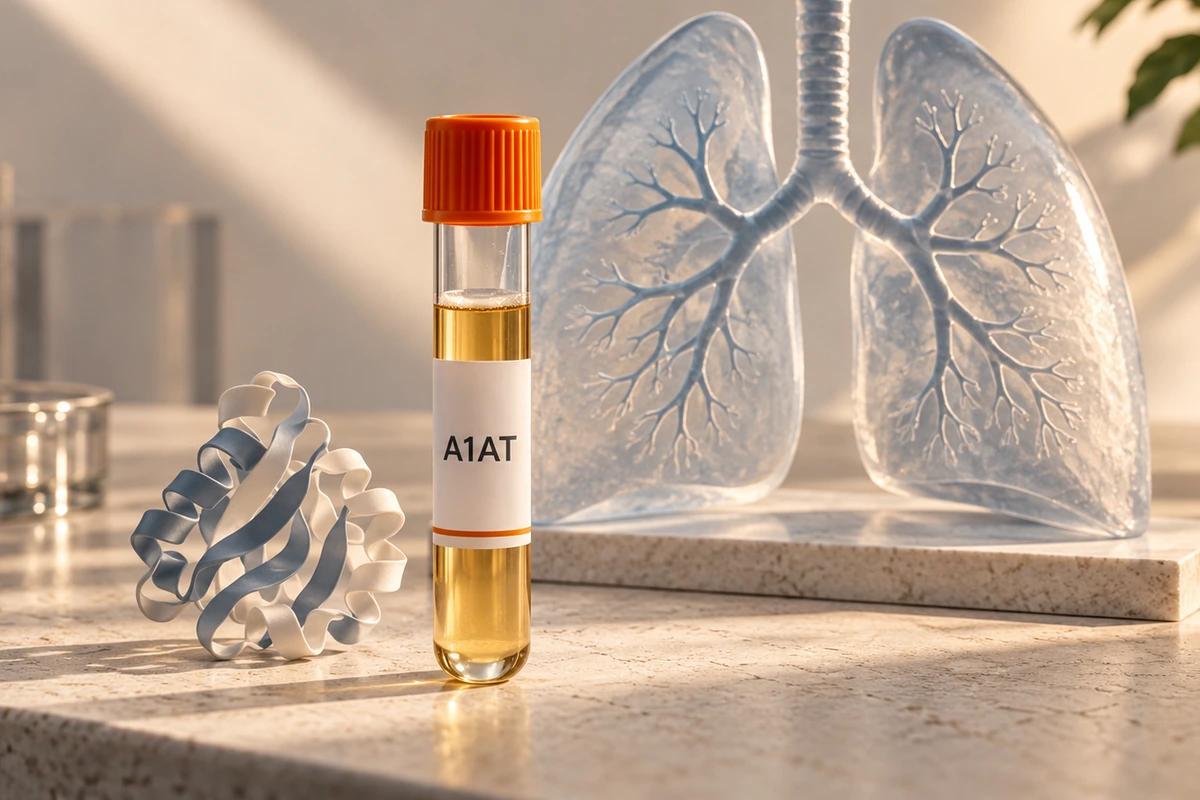
This guide covers the blood-protein test. The image shows a conceptual folded protein, serum tube and lung sculpture. It is not an exact molecular structure, a patient sample, a lung scan or evidence of tissue damage.
Keep the original report and testing context
Retain the value, units, laboratory interval, specimen type and date. Laboratories can use different methods and reference ranges. A result inside an interval does not by itself exclude illness, and a result outside it does not establish the cause.See reference 5
The blood AAT test usually needs no special preparation; other tests drawn together may have instructions. Confirm these with the testing team. Brief discomfort or bruising can follow a blood draw. Bring relevant illness history and previous AAT, protein-type or genetic results.See reference 1
Keep the useful details
- Check that the report is for blood A1AT rather than fecal clearance.See reference 4
- Keep level, phenotype and genotype findings together when available.See reference 1
- Ask how inflammation and the reason for testing affect interpretation.See reference 3
Common questions
Does a low A1AT result prove inherited deficiency?
It can support the investigation, but protein typing or genetic testing may be needed to confirm the explanation.See reference 1
Does a normal level rule out every inherited variant?
No. Levels vary with clinical circumstances and are not sufficient by themselves to identify all inherited variation.See reference 3
Does A1AT measure liver or lung damage?
No. AAT deficiency can affect those organs, but their function and damage are assessed separately.See reference 2
Get the weekly longevity brief
The week's best longevity research in plain English. Free, every Tuesday.
See your blood results in context
If you already have blood test results, the paid LongevityMate app can help you view related markers together. It provides educational context, not a diagnosis or a replacement for your clinician.
Explore blood test analysisReferences
- 1. Alpha-1 antitrypsin testing
MedlinePlusOfficial guidance
- 2. Alpha-1 antitrypsin deficiency
NHLBIOfficial guidance
- 3. The diagnosis and management of alpha-1 antitrypsin deficiency in the adult
Sandhaus et al., 2016; COPD FoundationGuideline
- 4. Alpha-1-antitrypsin clearance, feces and serum
Mayo Clinic LaboratoriesOfficial guidance
- 5. How to understand your lab results
MedlinePlusOfficial guidance
Editorial transparency
- Published by
- LongevityMate Editorial
- Published
- Updated
Medical disclaimer
General education only. This guide does not diagnose a condition, interpret your personal result, choose a treatment or recommend a supplement dose. Discuss testing, symptoms, medicines and supplements with a qualified health professional.