
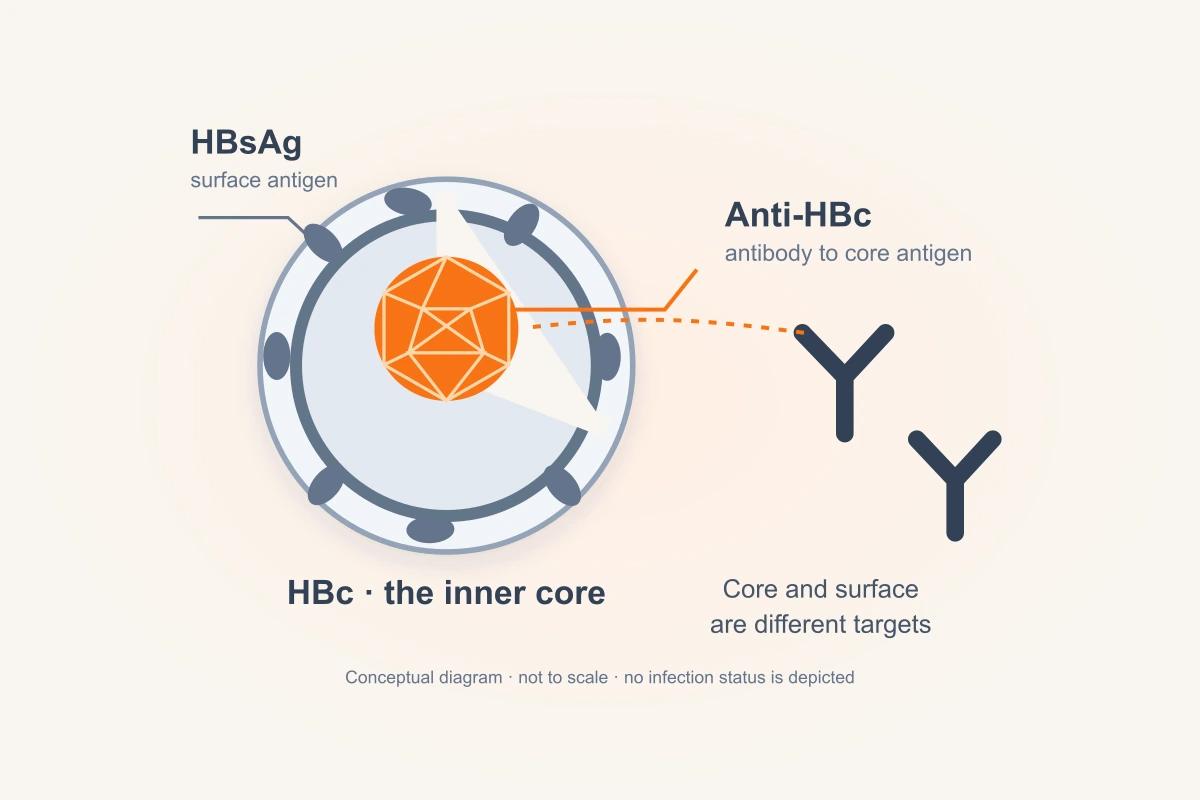
Core, surface and virus amount are different things
- Marker
- Total anti-HBc · HBcAb
- What it describes
- IgM and IgG antibodies to the viral core, measured togetherSee reference 2
- Marker
- IgM anti-HBc
- What it describes
- One antibody class associated with recent infection; it can also be positive during severe flares or reactivationSee reference 1
- Marker
- HBsAg
- What it describes
- A hepatitis B surface antigen; it is not an antibodySee reference 1
- Marker
- Anti-HBs · HBsAb
- What it describes
- An antibody to the surface antigen, distinct from core antibodySee reference 1
- Marker
- HBV DNA
- What it describes
- Measures viral genetic material and can provide information on viral loadSee reference 2
Vaccination and previous infection leave different antibody patterns
Vaccination alone does not produce anti-HBc in a person who has never had HBV infection. Total anti-HBc commonly persists after infection, while anti-HBs can develop after either infection or successful vaccination. That is why a surface-antibody result and a core-antibody result should not be swapped in a record.See reference 1
The original illustration separates the virus’s surface from its core and labels the antibody target. It is a simplified explanatory diagram, not an image of a patient’s virus or a result interpretation.
A total result cannot tell you when exposure happened
Total anti-HBc detects IgM and IgG together and does not by itself date infection. An IgM-specific result is a separate measurement. CDC notes that IgM can also appear with severe chronic-infection flares or reactivation, so the shorthand IgM equals a new infection is incomplete.See reference 1
Why an isolated core antibody has several explanations
- What the term means
- Total anti-HBc positive; HBsAg and anti-HBs negative
- Possible explanation, not a diagnosis
- Previous infection with surface antibodies that have wanedSee reference 3
- What the term means
- The same reported pattern
- Possible explanation, not a diagnosis
- A false-positive or assay-interference resultSee reference 3
- What the term means
- The same reported pattern
- Possible explanation, not a diagnosis
- Occult infection or a surface-antigen variant not detected by an assaySee reference 3
- What the term means
- The same reported pattern
- Possible explanation, not a diagnosis
- A window in the course of recent infectionSee reference 3
- What the term means
- In an infant, the same pattern needs age-specific context
- Possible explanation, not a diagnosis
- Passively transferred antibody from a gestational parentSee reference 3
The complete history helps resolve the uncertainty
CDC’s isolated-core document says immune status, risk history and where a person was born can affect interpretation. Clinicians may use additional testing to distinguish the possibilities. The table above is an explanation of uncertainty, not a home diagnostic algorithm or a vaccination plan.See reference 3
Past infection remains relevant before treatment that suppresses the immune system because reactivation can occur. Tell the team managing that treatment about previous hepatitis B results. This page does not choose antiviral prevention or tell you to delay, start or stop another treatment.See reference 2
Keep the method and wording attached to the result
Save the exact total or IgM test name, the reactive/nonreactive wording, the laboratory’s interpretation and the other hepatitis B results. Keep core antibody separate from the viral-load result: HBV DNA and anti-HBc measure different things. Laboratory methods and reference information can differ.See reference 2,See reference 4
Keep the useful details
- Core antibody is different from surface antibody and surface antigen.See reference 1
- Total anti-HBc and IgM anti-HBc are different test requests.See reference 2
- An isolated result needs context rather than one assumed explanation.See reference 3
Common questions
Can vaccination alone make core antibody positive?
Vaccination alone does not create anti-HBc in someone never infected with HBV. Anti-HBs is the surface-antibody marker associated with vaccination.See reference 2
Does positive total anti-HBc prove current infection?
No. Previous infection and false positivity are among the possible explanations; other markers and clinical context are required.See reference 3
Does a core-antibody number measure virus amount?
No. HBV DNA testing provides viral-load information; anti-HBc is an antibody test.See reference 2
Get the weekly longevity brief
The week's best longevity research in plain English. Free, every Tuesday.
See your blood results in context
If you already have blood test results, the paid LongevityMate app can help you view related markers together. It provides educational context, not a diagnosis or a replacement for your clinician.
Explore blood test analysisReferences
- 1. Clinical testing and diagnosis for hepatitis B
Centers for Disease Control and Prevention; reviewed August 14, 2026Official guidance
- 2. Screening and testing for hepatitis B virus infection: CDC recommendations, 2023
Conners et al., CDC MMWR; March 10, 2023Guideline
- 3. Interpretation and differentiation of isolated positive hepatitis B core antibody
Centers for Disease Control and Prevention; 2025 documentOfficial guidance
- 4. How to understand your lab results
MedlinePlusOfficial guidance
Editorial transparency
- Published by
- LongevityMate Editorial
- Published
- Updated
Medical disclaimer
General education only. This guide does not diagnose a condition, interpret your personal result, choose a treatment or recommend a supplement dose. Discuss testing, symptoms, medicines and supplements with a qualified health professional.