
IGF-1 and growth hormone are related, not interchangeable
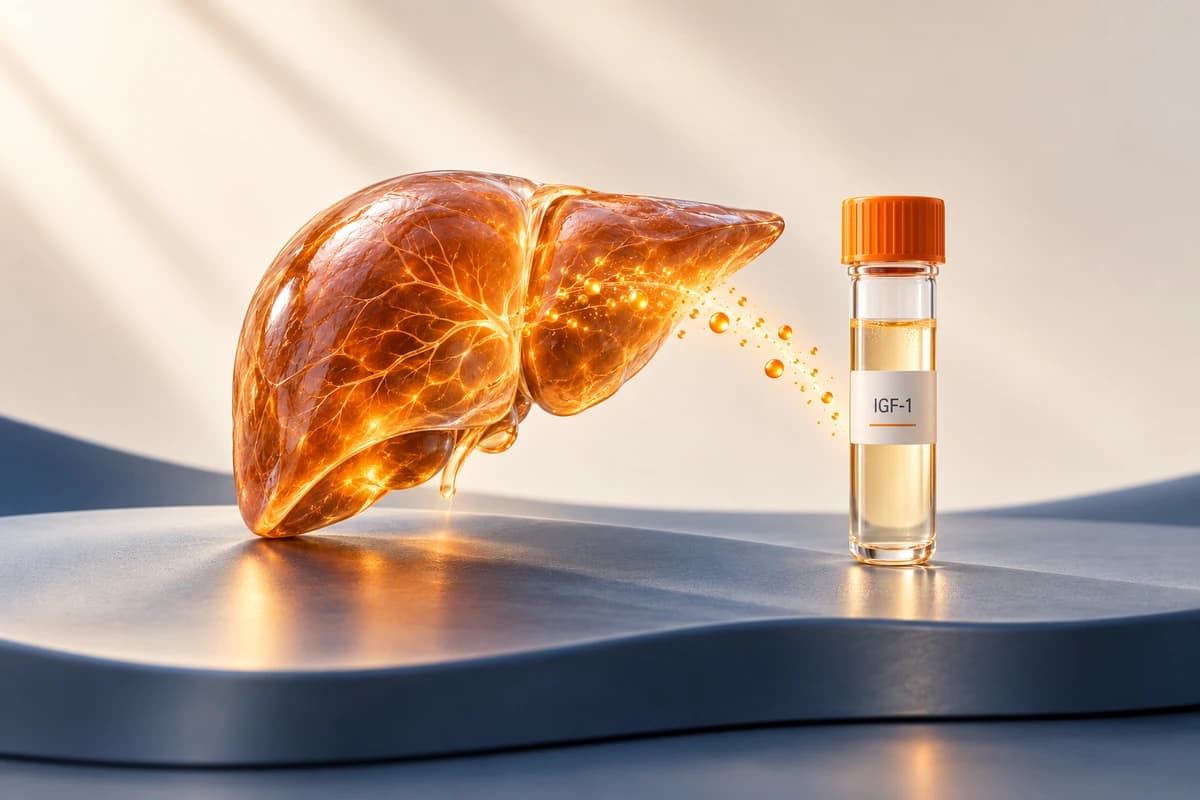
Growth hormone is produced in the pituitary gland. Cells in the liver respond by producing IGF-1, which helps mediate growth. The liver-and-serum artwork illustrates this relationship; it does not show an exact organ structure or a measured hormone result.See reference 2
Growth hormone secretion varies during the day, whereas IGF-1 is comparatively steadier. MedlinePlus describes IGF-1 rising toward puberty and declining during adulthood. A value suitable for one age cannot simply become another person's reference point.See reference 1
Read the report before comparing the number
- Report detail
- Age and reference interval
- Why it matters
- Age-stratified intervals belong to the validated laboratory methodSee reference 3
- Report detail
- Concentration unit
- Why it matters
- The Mayo replacement assay reports ng/mL; keep the original unit attachedSee reference 5
- Report detail
- Method and test date
- Why it matters
- A method change can alter the comparison with earlier resultsSee reference 4,See reference 5
- Report detail
- Reason for testing
- Why it matters
- Clinical signs and other findings determine what the measurement can establishSee reference 6
There is no universal normal range
A 2024 assay review describes substantial differences between methods and laboratories, as well as week-to-week variation within an individual. Updated reference populations can also change the upper reference limit. A chart copied from another test or an older report may therefore mislead.See reference 4
Mayo's April 2026 notice replaced its IGFMS mass-spectrometry test with an IGF1S chemiluminescence immunoassay. It supplies age-specific, sex-specific and puberty-stage intervals. This is a concrete example of why the exact assay matters, not a recommendation to order that laboratory's test.See reference 5
Higher and lower results need different kinds of context
A high IGF-1 result can be part of investigating acromegaly, a condition involving excess growth hormone. NIDDK describes diagnosis using the clinical picture and blood testing, with further testing when appropriate. The result does not identify a pituitary tumour's size or prove a diagnosis independently.See reference 6
A low result may accompany an age-related change or a growth-hormone disorder, but it is not specific to one cause. The acromegaly consensus also notes that nutrition, metabolic conditions and liver-related factors can affect IGF-1. Those influences need professional interpretation rather than a supplement or hormone response chosen from a number.See reference 1,See reference 3
Preparation is specific to the test being performed
MedlinePlus says no special preparation is needed for an IGF-1 blood test.See reference 1
However, Mayo's replacement-test notice gives an assay-specific precaution about biotin supplements. Confirm the instructions for your actual laboratory and disclose supplements. This guide does not tell you to stop a prescribed medicine.See reference 5
A useful trend keeps the method and clinical question attached
For equivocal results in an acromegaly assessment, the 2024 consensus discusses repeating IGF-1 with the same validated assay. That recommendation belongs to a clinical assessment, not a self-directed screening schedule. Keep the method, reference interval and testing reason beside any trend.See reference 3
The 2024 variability review focuses on people being assessed for acromegaly. It cannot establish an optimal IGF-1 for healthy ageing. This guide gives no longevity score, growth-hormone dose or bodybuilding clearance.See reference 4
Keep the useful details
- Keep the original unit, age context and laboratory interval together.See reference 7
- A changing method may matter as much as a changing number.See reference 4
- Use the result to inform the clinical question, not to create a hormone target.See reference 6
Common questions
Is IGF-1 the same as a growth-hormone test?
No. It measures a related hormone that is comparatively steadier; growth hormone itself changes throughout the day.See reference 1
Does a low result establish growth-hormone deficiency?
No. Age and other causes matter, and additional clinical assessment may be needed.See reference 1
Can I compare results from different laboratories?
Keep each method and reference interval. Assay differences and biological variation can affect comparisons.See reference 4
Get the weekly longevity brief
The week's best longevity research in plain English. Free, every Tuesday.
See your blood results in context
If you already have blood test results, the paid LongevityMate app can help you view related markers together. It provides educational context, not a diagnosis or a replacement for your clinician.
Explore blood test analysisReferences
- 1. IGF-1 (insulin-like growth factor 1) test
MedlinePlusOfficial guidance
- 2. GH1 gene
MedlinePlus GeneticsOfficial guidance
- 3. Consensus on criteria for acromegaly diagnosis and remission
Giustina et al., 2024; PituitaryGuideline
- 4. IGF-I assay methods and biologic variability
Clemmons and Bidlingmaier, 2024; European Journal of EndocrinologyEvidence review
- 5. IGFMS obsolescence and IGF1S replacement test notice, April 2026
Mayo Clinic LaboratoriesOfficial guidance
- 6. Acromegaly
NIDDKOfficial guidance
- 7. How to understand your lab results
MedlinePlusOfficial guidance
Editorial transparency
- Published by
- LongevityMate Editorial
- Published
- Updated
Medical disclaimer
General education only. This guide does not diagnose a condition, interpret your personal result, choose a treatment or recommend a supplement dose. Discuss testing, symptoms, medicines and supplements with a qualified health professional.