
Active and total B12 answer related questions
- Test
- Active B12 / holotranscobalamin
- What it measures
- B12 attached to transcobalamin
- Practical limit
- One laboratory marker within a deficiency assessmentSee reference 1,See reference 3
- Test
- Total B12 / serum cobalamin
- What it measures
- B12 carried by both active and inactive binding proteins
- Practical limit
- A different quantity, not a number interchangeable with active B12See reference 3
- Test
- Methylmalonic acid (MMA)
- What it measures
- A different marker considered in some uncertain assessments
- Practical limit
- Its use and interpretation depend on the clinical circumstancesSee reference 2
The name “active” does not make it a perfect test
NICE accepts total or active B12 as the initial test for many adults with suspected deficiency. Its rationale identifies no gold-standard diagnostic test and limited comparative evidence. Active B12 is useful, but neither test settles every case.See reference 2,See reference 3
NICE specifies different testing approaches during pregnancy or when recreational nitrous oxide is suspected. The guideline covers people over 16. Local laboratory access and methods matter; individual test selection needs clinical guidance.See reference 2
Supplements can change a blood result
NICE warns that B12 supplements may raise total or active B12 concentrations without fully treating a deficiency. Tell the care team which supplements or replacement treatments you use and when testing occurred. A raised result after supplementation is not, on its own, evidence that the original cause or symptoms have been resolved.See reference 2
Do not stop a prescribed treatment or delay necessary care to obtain a supposedly cleaner baseline. Testing and treatment timing belong to the treating clinician. The original pre-treatment result, if available, can provide useful context alongside later measurements.
A normal-looking result can miss a different problem
NICE explains that nitrous oxide can inactivate B12 even when total or active concentrations remain in the usual range. This is one example of why the amount measured in blood and the vitamin’s function are not identical questions. Tell a clinician about relevant exposure when discussing symptoms and test results.See reference 3
MMA or homocysteine may be considered in some assessments. They are separate tests; a total-B12 unit converter cannot produce an active B12 result.See reference 2
Use the test name, units and laboratory interval together
Keep the full test name, value, units, laboratory range and sample date. Laboratory methods and reference ranges differ. Comparing only the numbers from an active and total B12 report can be misleading, even when both happen to use similar unit names.See reference 4
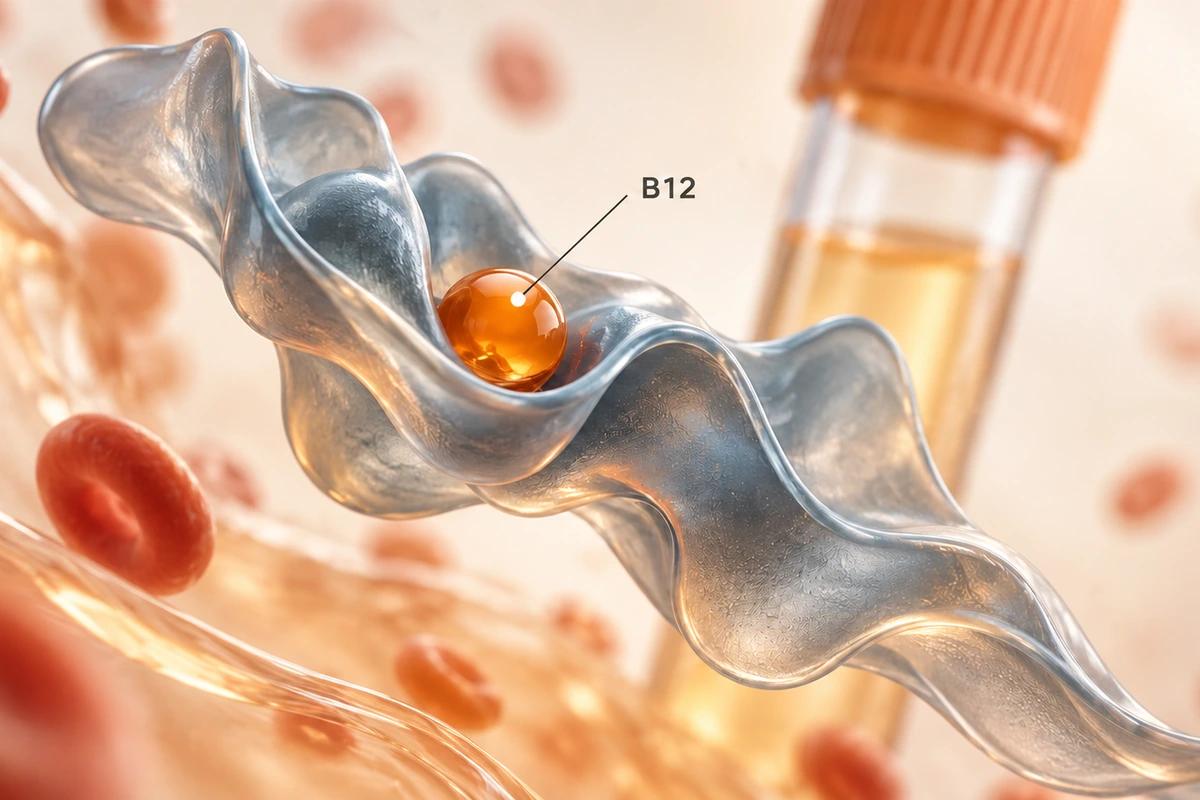
Ask which question remains uncertain: the presence of deficiency, its cause, or the explanation for symptoms. The illustration uses an orange B12 symbol held by a conceptual protein ribbon. It depicts transport, not an exact molecule, the amount in someone’s blood or a test result.
Keep the useful details
- Check whether the report says active or total B12.See reference 1,See reference 3
- Bring the supplement and treatment history with the report.See reference 2
- Keep symptoms and testing circumstances in the discussion.See reference 2
Common questions
Is active B12 the same as total B12?
No. Active B12 is the transcobalamin-bound fraction; total B12 includes B12 attached to other binding proteins.See reference 1,See reference 3
Can I calculate active B12 from total B12?
No fixed conversion between these different measured quantities is supplied by this guide. They are separate tests.
Does a higher result after a supplement prove the problem is fixed?
No. NICE cautions that supplements can raise blood concentrations without fully treating deficiency.See reference 2
Get the weekly longevity brief
The week's best longevity research in plain English. Free, every Tuesday.
See your blood results in context
If you already have blood test results, the paid LongevityMate app can help you view related markers together. It provides educational context, not a diagnosis or a replacement for your clinician.
Explore blood test analysisReferences
- 1. Active B12 (holotranscobalamin)
Gloucestershire Hospitals NHS Foundation TrustOfficial guidance
- 2. Vitamin B12 deficiency in over 16s: recommendations
NICE NG239, 2024Guideline
- 3. Vitamin B12 deficiency in over 16s: rationale and impact
NICE NG239, 2024Guideline
- 4. How to understand your lab results
MedlinePlusOfficial guidance
Editorial transparency
- Published by
- LongevityMate Editorial
- Published
- Updated
Medical disclaimer
General education only. This guide does not diagnose a condition, interpret your personal result, choose a treatment or recommend a supplement dose. Discuss testing, symptoms, medicines and supplements with a qualified health professional.