
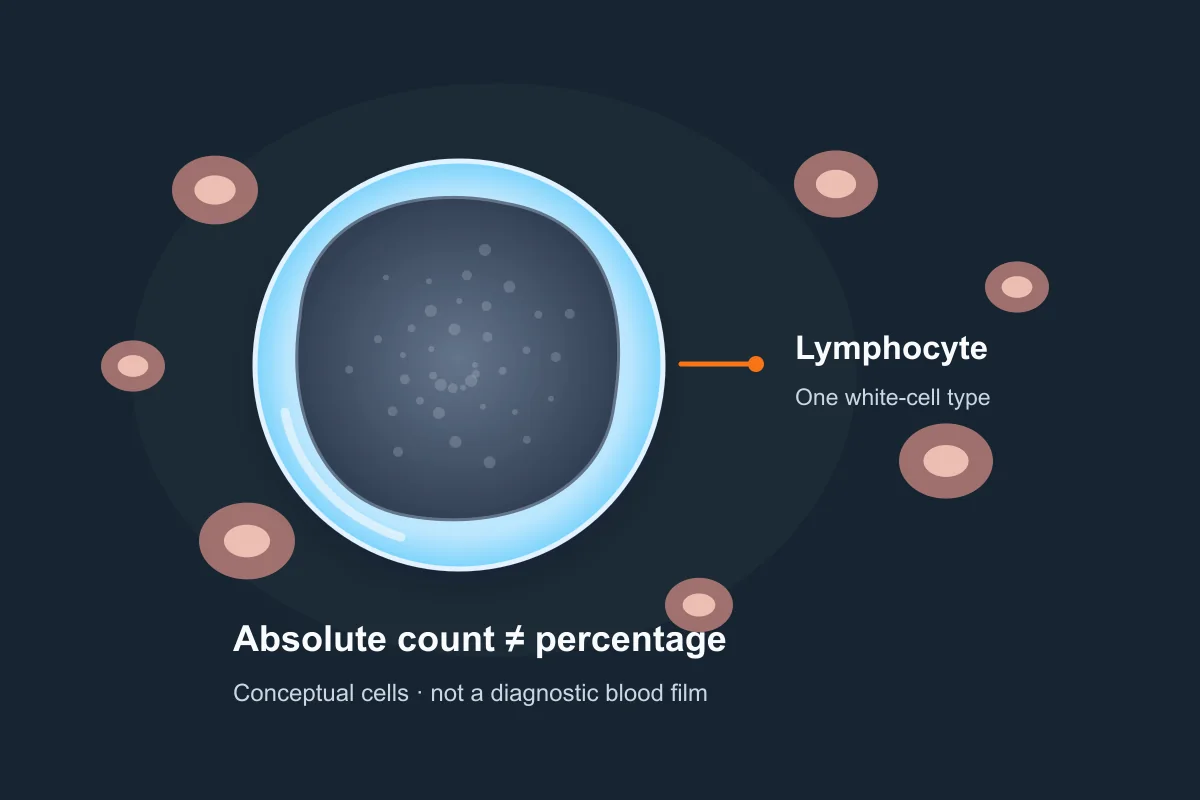
Four report entries answer different questions
- Entry
- Total WBC
- Meaning
- All counted white blood cells togetherSee reference 1
- Entry
- Lymphocytes %
- Meaning
- The proportion classified as lymphocytesSee reference 2
- Entry
- Lymphocytes absolute
- Meaning
- The number in the report’s stated volume unitSee reference 6
- Entry
- CD4 count
- Meaning
- A separate count of a particular T-cell subsetSee reference 5
Why a percentage can mislead when read alone
An increase in another white-cell type can lower the lymphocyte percentage even without a comparable fall in lymphocytes. A differential therefore needs its denominator: the total white-cell count. A percentage flag and an absolute-count flag are not interchangeable.See reference 2
A hypothetical arithmetic example: WBC 5.0 × 10⁹/L with 30% lymphocytes gives an ALC of 1.5 × 10⁹/L. The same 30% with WBC 10.0 × 10⁹/L gives 3.0 × 10⁹/L. These examples explain the calculation, not whether either result is normal for a person.See reference 1,See reference 2
Keep the volume unit attached
Labcorp reports its absolute lymphocyte result in thousands per microlitre, written x10E3/uL. Other reports use × 10⁹/L. Those two scales have the same numerical value: 1.5 on either scale is 1,500 cells/µL. A value written in cells/µL must not be compared as if it were already in thousands.See reference 6
Use the reference interval printed on the actual report, including any age-specific information. This guide does not set a universal threshold, define an optimal count or use an adult referral pathway to classify a child’s result.See reference 3,See reference 4,See reference 6
A raised count has reactive and persistent explanations
Adult NHS guidance describes temporary lymphocytosis with infections, including viral illnesses, as well as associations with smoking and other causes. Persistent elevations can have a different significance, including a blood-cell disorder. The count itself cannot distinguish those explanations.See reference 3
Clinicians may consider the previous counts, symptoms, examination, other blood-cell lines and blood-film findings. The cited pathway is for adults in one health service; its repeat-testing and referral rules are not a global self-management schedule.See reference 3
A low count also needs the wider picture
The adult lymphopenia pathway describes possible effects of acute infection, recent surgery, steroids and other immunosuppressants. It also makes an important distinction between an isolated incidental finding and a result accompanied by symptoms or other abnormalities.See reference 4
That distinction cannot be made from a number alone. Discuss the result and medicine list with the requesting clinician. Do not stop a prescribed medicine or start an “immune booster” to change the count using this page.See reference 4
ALC does not reveal which lymphocyte subset changed
A CD4 count measures helper T cells and has specific clinical uses, especially in HIV care. A total lymphocyte count does not identify the CD4 number or the balance of lymphocyte subsets. It cannot replace a requested CD4 test or establish HIV status.See reference 5
The collection is usually straightforward
A blood differential usually needs a standard blood sample without special preparation. Other tests in the same visit can have different instructions. Interpretation combines the result with symptoms, history and other blood tests rather than relying only on the high or low flag.See reference 1
Keep the useful details
- Read the absolute count and percentage as different measurements.See reference 1,See reference 2
- Preserve the original volume unit and report interval.See reference 6
- Keep temporary changes, persistent changes and cell-subset tests in context.See reference 3,See reference 4,See reference 5
Common questions
Can the lymphocyte percentage be high while the absolute count is not?
Yes. The percentage depends on the total and on the other white-cell types. Use the full differential rather than the percentage alone.See reference 2
Is ALC the same as CD4 count?
No. CD4 is a particular T-cell subset measured by a different test.See reference 5
Does one raised ALC diagnose leukaemia?
No. Adult NHS guidance includes reactive causes and evaluates persistent changes with other findings.See reference 3
Get the weekly longevity brief
The week's best longevity research in plain English. Free, every Tuesday.
See your blood results in context
If you already have blood test results, the paid LongevityMate app can help you view related markers together. It provides educational context, not a diagnosis or a replacement for your clinician.
Explore blood test analysisReferences
- 1. Blood differential
MedlinePlus, U.S. National Library of MedicineOfficial guidance
- 2. Blood differential test
MedlinePlus Medical EncyclopediaOfficial guidance
- 3. Lymphocytosis: adult clinical referral guidance
Cornwall NHS Referral Management Service; reviewed July 2025Official guidance
- 4. Lymphopenia: adult clinical referral guidance
Cornwall NHS Referral Management Service; reviewed May 2025Official guidance
- 5. CD4 lymphocyte count
MedlinePlus, U.S. National Library of MedicineOfficial guidance
- 6. Complete blood count with differential: result units
Labcorp test catalogueOfficial guidance
Editorial transparency
- Published by
- LongevityMate Editorial
- Review
- Editorial evidence review (AI-assisted)
- Published
- Updated
Medical disclaimer
General education only. AI-assisted editorial evidence review is not a qualified clinical assessment. This guide does not diagnose a condition, interpret a personal result, choose treatment or recommend a supplement dose. Discuss testing, symptoms, medicines and supplements with a qualified health professional.