
The same test can answer different questions
- Purpose
- Screening without symptoms
- Why the context changes
- Looks for a possible cancer signal; it cannot diagnose cancerSee reference 2
- Purpose
- Investigation of prostate symptoms
- Why the context changes
- A result is considered with the history, examination and other testsSee reference 2
- Purpose
- Monitoring known cancer or its treatment
- Why the context changes
- Trends are interpreted within that person’s treatment planSee reference 4
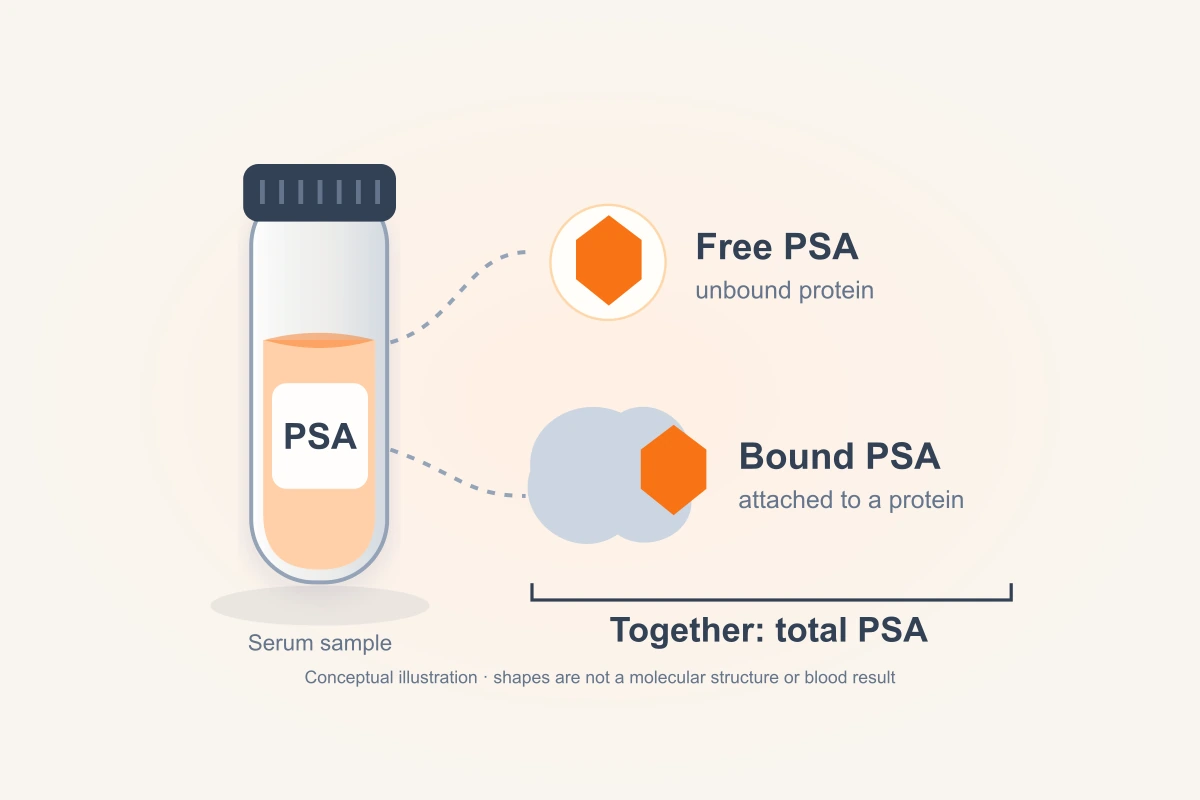
Total PSA and percent-free PSA are different measurements
Some PSA circulates unattached; some is bound to other blood proteins. Total PSA includes both. Percent-free PSA compares the free portion with the total, so a concentration and a percentage must not be read as the same result. The artwork is a conceptual illustration of this distinction, not a molecular structure or patient result.See reference 4
Free PSA, PSA density and multi-marker scores can add information in selected clinical assessments. They do not turn one laboratory result into a cancer diagnosis or a self-selected biopsy rule.See reference 3
Why there is no universal safe or dangerous number
NCI explains that no single PSA threshold cleanly separates people with and without prostate cancer. PSA generally rises with age, and some medicines change how a concentration is interpreted. Keep the original unit, often ng/mL, attached to the value rather than comparing it with an unrelated chart.See reference 1
A reference interval describes a laboratory’s comparison group. It is not a guarantee of health or a personal treatment target. Ask what question the result is meant to answer and which previous results are comparable.See reference 5
Details worth keeping with the report
- Detail
- Recent prostate inflammation, infection or procedure
- Why it matters
- Can raise PSA temporarilySee reference 1
- Detail
- Recent ejaculation or vigorous cycling
- Why it matters
- May affect the collection contextSee reference 1
- Detail
- Finasteride or dutasteride
- Why it matters
- Can lower PSA; the interpreting clinician needs the medicine historySee reference 3
- Detail
- Testosterone, other hormones and supplements
- Why it matters
- Some products can change PSA or its interpretationSee reference 3
Follow the collection instructions instead of inventing a washout
Tell the clinical team about medicines and supplements, and follow the testing centre’s preparation instructions. Published guidance gives different preparation details; this guide does not select a universal waiting time or tell you to stop a prescribed medicine.See reference 2,See reference 4
Screening involves benefits and harms
Screening may find an important cancer earlier, but it can also lead to false alarms, biopsies and detection of cancers that would never have caused a problem. Unnecessary treatment can affect urinary and sexual function. The decision belongs in a discussion of personal risk, health and preferences, rather than a routine longevity checklist.See reference 2
A change after prostate-cancer treatment is a different question from an initial screening result. NCI describes looking at trends and other findings; one elevated measurement alone does not establish that cancer has returned.See reference 1
Useful questions for the appointment
Is this screening, symptom investigation or treatment monitoring? Is the result total PSA or percent-free PSA? Could the collection circumstances or a medicine matter? What further assessment, if any, is appropriate for this particular history? Bring the complete report and medicine list so those questions can be answered together.
Keep the useful details
- Keep the testing purpose, full test name, unit and previous reports together.See reference 5
- Separate a laboratory signal from a cancer diagnosis.See reference 2
- Keep hormone and supplement information available for interpretation.See reference 3
Common questions
Does an elevated PSA mean cancer?
No. Several noncancerous prostate conditions can raise PSA, and further assessment is needed to identify the cause.See reference 2
Is free PSA the same as total PSA?
No. Free PSA is the unattached portion; total PSA includes free and protein-bound PSA. Percent-free PSA is a ratio.See reference 4
Should I change a medicine to lower the number?
This guide does not support that decision. Medicines can affect interpretation, so discuss them with the prescribing and testing team.See reference 3
Get the weekly longevity brief
The week's best longevity research in plain English. Free, every Tuesday.
See your blood results in context
If you already have blood test results, the paid LongevityMate app can help you view related markers together. It provides educational context, not a diagnosis or a replacement for your clinician.
Explore blood test analysisReferences
- 1. Prostate-Specific Antigen (PSA) Test
National Cancer Institute; updated January 31, 2025Official guidance
- 2. Prostate-specific antigen (PSA) test
MedlinePlusOfficial guidance
- 3. Screening tests for prostate cancer
American Cancer Society; revised November 22, 2023Official guidance
- 4. Prostate-specific antigen (PSA) test
Canadian Cancer Society; medical review April 2026Official guidance
- 5. How to understand your lab results
MedlinePlusOfficial guidance
Editorial transparency
- Published by
- LongevityMate Editorial
- Published
- Updated
Medical disclaimer
General education only. This guide does not diagnose a condition, interpret your personal result, choose a treatment or recommend a supplement dose. Discuss testing, symptoms, medicines and supplements with a qualified health professional.