
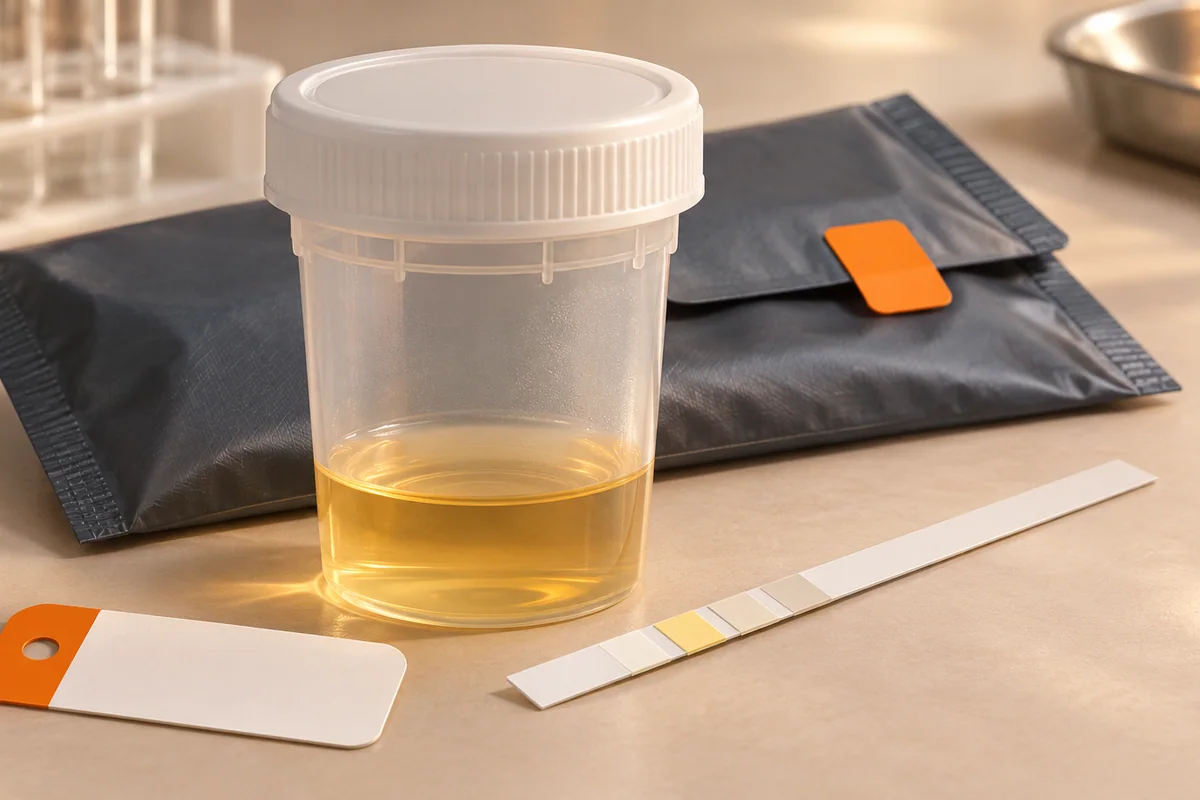
Urine and blood bilirubin answer different questions
A urine bilirubin test is also called a urine direct or conjugated bilirubin test. Blood tests can measure bilirubin separately. The sample type matters: a urine strip is not a substitute for a blood bilirubin measurement or a liver panel.See reference 1,See reference 2
The RCPA notes that some causes of predominantly unconjugated bilirubin in blood can have a negative urine bilirubin result. This is one reason that “negative” on a urine strip is not a complete assessment of jaundice or liver health.See reference 4
Read the finding before looking for a cause
- Report detail
- Negative
- What it tells you
- No bilirubin signal detected at that method’s sensitivity.
- What it does not establish
- That every liver or bile-duct condition is absent.See reference 3,See reference 4
- Report detail
- Positive or a graded strip category
- What it tells you
- The method detected a reaction requiring clinical context.
- What it does not establish
- The cause, severity or treatment of a condition.See reference 1,See reference 3
- Report detail
- A blood bilirubin value
- What it tells you
- A separate measurement in a blood specimen.
- What it does not establish
- A number interchangeable with a urine strip category.See reference 1,See reference 2
A positive result is a reason to investigate, not a diagnosis
Bilirubin in urine can occur with liver disease or impaired bile flow. The laboratory result cannot distinguish the cause by itself. A clinician may consider a liver panel and other findings instead of treating the strip as a stand-alone answer.See reference 1,See reference 2
The strip has a detection limit
A negative pad means no reaction was detected above the test’s limit; it is not proof of an exact zero concentration. The cited manufacturer instructions specifically warn that very small amounts may fall below the strip’s sensitivity. Colour categories also represent bands rather than a precise continuous measurement.See reference 3
Use the performing laboratory’s wording, units and reference information. Do not assign a blood-test cutoff to a urine result or compare a phone photograph with a colour chart from another product.See reference 2,See reference 3
Sample handling and medicines can affect the result
Bilirubin can break down with light exposure. Return the specimen as instructed and tell the collection team about delays or uncertain storage. A sample cannot be made reliable by interpreting its colour more confidently.See reference 2,See reference 3
The cited Siemens instructions identify coloured compounds and etodolac metabolites as possible sources of interference or atypical reactions. This is a method-specific example, not a complete list for every strip. Tell the clinician about medicines and supplements; do not stop them on your own to repeat a test.See reference 1,See reference 3
Useful questions to take to the appointment
Bring the complete report. Ask whether the result was a strip category or another method, whether sample handling or a medicine could matter, and which blood results or symptoms change the interpretation. If symptoms continue, an isolated negative strip should not end the discussion.See reference 1,See reference 3
Common questions
Is bilirubin the same as urobilinogen?
No. They are different chemical findings on a urine report. A result for one cannot be read as the result for the other.See reference 1,See reference 3
Does dark urine prove that bilirubin is present?
No. Urine colour is not the chemical test. Coloured substances can also make a strip harder to read, so the measured result and its limitations matter.See reference 3
Get the weekly longevity brief
The week's best longevity research in plain English. Free, every Tuesday.
See your blood results in context
If you already have blood test results, the paid LongevityMate app can help you view related markers together. It provides educational context, not a diagnosis or a replacement for your clinician.
Explore blood test analysisReferences
- 1. Bilirubin in Urine
MedlinePlus, U.S. National Library of MedicineOfficial guidance
- 2. Bilirubin - urine
MedlinePlus Medical EncyclopediaOfficial guidance
- 3. Reagent strips for urinalysis: performance and limitations
Siemens Healthcare DiagnosticsOfficial guidance
- 4. Urine dipstick
Royal College of Pathologists of AustralasiaOfficial guidance
Editorial transparency
- Published by
- LongevityMate Editorial
- Review
- Editorial evidence review (AI-assisted)
- Published
- Updated
Medical disclaimer
General education only. AI-assisted editorial evidence review is not a qualified clinical assessment. This guide does not diagnose a condition, interpret a personal result, choose treatment or recommend a supplement dose. Discuss results, symptoms, medicines and supplements with a qualified health professional.