
Know which herb and which preparation
Black cohosh is Actaea racemosa, also called Cimicifuga racemosa. Preparations use its roots and rhizomes, the underground stems. Whole-herb powders and different extracts are not automatically interchangeable. ODS notes that formulations differ chemically and that the relevant active ingredients remain uncertain.See reference 2
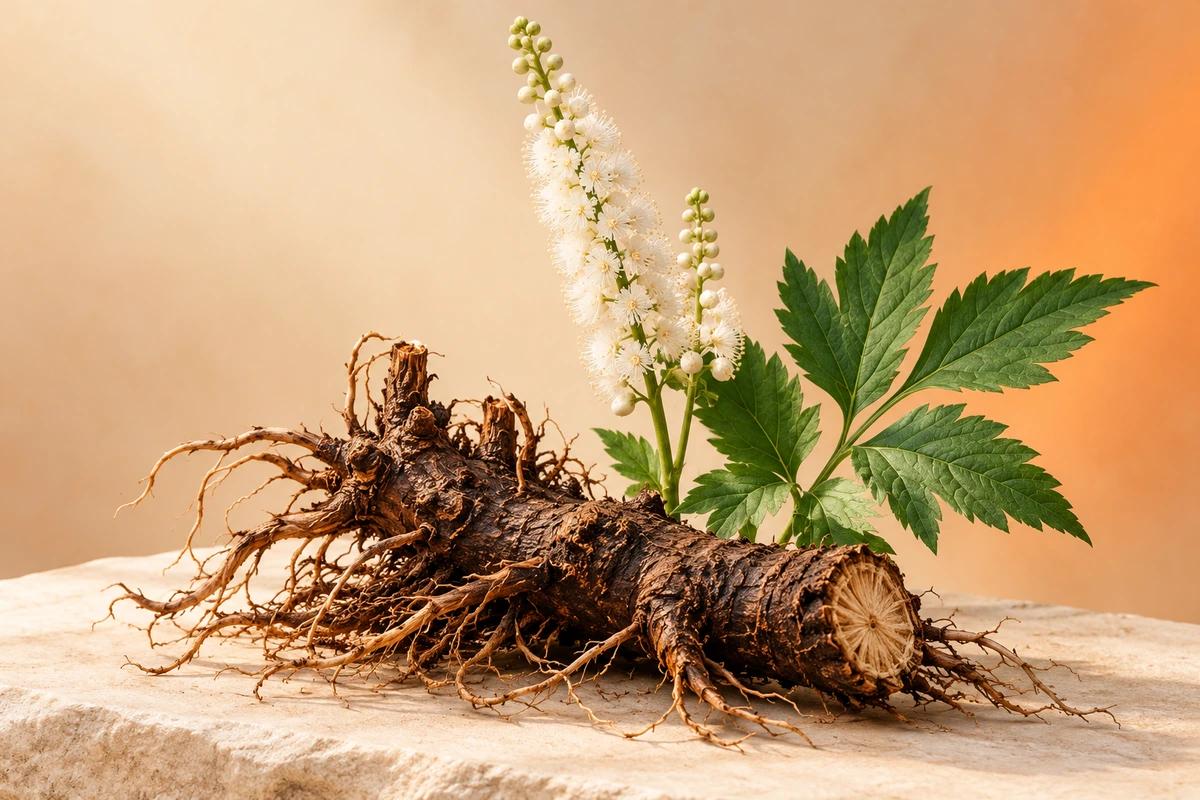
Black cohosh and blue cohosh are different plants. Their common names are not evidence that they share uses or safety. The original illustration depicts a black-cohosh rhizome and pale racemes; it is not a botanical identification or purity test.See reference 1
Why two evidence summaries can sound different
- Source
- 2023 meta-analysis
- What was assessed
- 22 articles covering 2,310 menopausal women; extracts alone or with other active ingredients
- Finding and limit
- Improvement in overall symptoms and hot flashes; no significant anxiety or depressive-symptom benefitSee reference 3
- Source
- 2023 menopause-society statement
- What was assessed
- Evidence for nonhormone management of hot flashes and night sweats
- Finding and limit
- Insufficient evidence for black cohosh; not recommended for those symptomsSee reference 4
- Source
- ODS background review
- What was assessed
- Different extracts, trial methods and outcomes
- Finding and limit
- Formulation variation makes a universal product claim difficultSee reference 2
A pooled benefit is not a guarantee for every product
The 2023 meta-analysis included single-ingredient and combination regimens. Its positive pooled findings do not establish that each commercial preparation works or that another ingredient in a combination contributed nothing. A similar dropout rate to placebo is also not proof that rare or long-term harms cannot occur.See reference 3
The society statement considered consistent evidence for clinical recommendations; it also discussed an earlier review with inconclusive safety data. These documents asked different questions. Neither disagreement nor a positive pooled result establishes the right treatment for an individual reader.See reference 4
Studied amounts are descriptions, not a personal dose
The 2012 review summarized in the society statement used a median 40 mg daily amount and mean treatment duration of 23 weeks. That describes the included preparations. Milligrams of extract, whole root and root-equivalent content do not identify the same formulation by themselves; a label number should not be copied as a treatment plan.See reference 2,See reference 4
Keep the liver-safety uncertainty visible
NCCIH describes rare reports of serious liver damage in people taking products labelled black cohosh. Causation is uncertain, and some products have contained different herbs or unlisted mixtures. Those uncertainties do not make the reports safe to ignore. Dark urine or unusual fatigue during use warrants medical advice.See reference 1
Research follow-up cannot establish unlimited safety. ODS’s 2020 fact sheet notes that most studies were short, commonly six months or less, and that long-term human safety had not been established in its review. An absence of frequent trial side effects is a narrower finding.See reference 2
Medicines and hormone-sensitive conditions need professional context
NCCIH says safety is uncertain after hormone-sensitive conditions such as breast or uterine cancer, and that black cohosh may be unsafe during pregnancy or breastfeeding. Discuss medicines and supplements with the treating professional. This guide does not establish that an herbal product is suitable after cancer treatment or safe in a specific medicine combination.See reference 1
Product identity and effectiveness are separate checks
For a professional review, keep the species, plant part, extract description and complete ingredient list. Quality evaluation can help check what a bottle contains. It cannot turn inconsistent efficacy findings into evidence for that bottle or establish a personal benefit-risk balance.See reference 5
Keep the useful details
- Keep the preparation and outcome attached to a study finding.See reference 2
- Potential pooled benefit and guideline endorsement are different conclusions.See reference 3,See reference 4
- Discuss safety questions and treatment alternatives with a qualified clinician.See reference 1
Common questions
Is black cohosh simply plant estrogen?
Its active ingredients and mechanism are uncertain. Treating it as interchangeable with prescribed estrogen would go beyond the evidence.See reference 2
Does it reliably help anxiety or depression?
The 2023 analysis did not find significant benefits for those specific symptoms, despite some positive menopause outcomes.See reference 3
Are black and blue cohosh the same herb?
No. They are different plants and should not be substituted for one another.See reference 1
Get the weekly longevity brief
The week's best longevity research in plain English. Free, every Tuesday.
References
- 1. Black cohosh: usefulness and safety
NCCIHOfficial guidance
- 2. Black cohosh: health professional fact sheet
NIH Office of Dietary SupplementsOfficial guidance
- 3. Black cohosh extracts in women with menopausal symptoms: updated pairwise meta-analysis
Sadahiro et al., Menopause, 2023Meta-analysis
- 4. 2023 nonhormone therapy position statement
The North American Menopause SocietyGuideline
- 5. Using dietary supplements wisely
NCCIHOfficial guidance
Editorial transparency
- Published by
- LongevityMate Editorial
- Published
- Updated
Medical disclaimer
General education only. This guide does not diagnose a condition, interpret your personal result, choose a treatment or recommend a supplement dose. Discuss testing, symptoms, medicines and supplements with a qualified health professional.