
The short answer
Panax ginseng evidence depends on the outcome
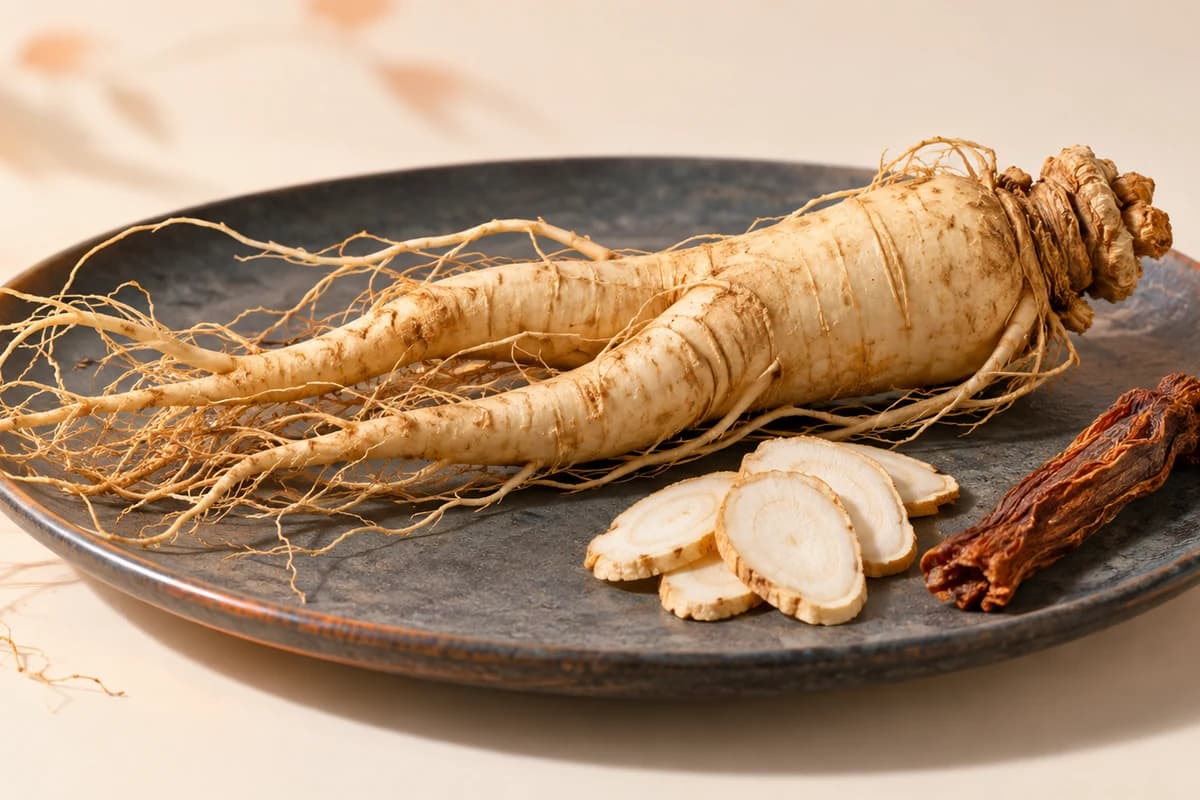
Panax ginseng, also called Asian or Korean ginseng, has been studied for fatigue and several other outcomes. Results are mixed and often come from small, short studies. Neither the plant name nor the word “adaptogen” establishes a broad energy, cognition or longevity benefit. Preparation, species and safety context matter.See reference 1,See reference 2,See reference 3
Names and forms are not interchangeable
- Name
- Asian or Korean ginseng
- What it identifies
- Panax ginseng.
- What to check
- The Latin name and exact preparation.See reference 1,See reference 2
- Name
- Red or white ginseng
- What it identifies
- Different preparations of Asian ginseng root.
- What to check
- Processing and extract details, not just the colour word.See reference 1
- Name
- American ginseng
- What it identifies
- Panax quinquefolius, a different species.
- What to check
- Whether the cited study used that species.See reference 2
- Name
- Siberian ginseng
- What it identifies
- Eleutherococcus senticosus, a different plant.
- What to check
- It is not a substitute name for Panax ginseng.See reference 2
Why a root and an extract cannot be compared by weight alone
Ginsenosides are among the constituents considered relevant to ginseng’s effects. Root preparations and extracts can differ in composition. A milligram amount is not a complete description of what was studied; a root powder, defined extract and multi-herb formula may represent different interventions.See reference 1,See reference 2
Record the species, plant part, processing, extract description, listed constituents and other ingredients before looking for a matching trial. If those details are missing, treat a claim of “the same ginseng used in research” as unconfirmed.
Human evidence by question
- Question
- Fatigue
- Current finding
- A 2023 review found no clear reduction in fatigue in its overall pooled analysis; some subgroup results were positive.
- Useful limit
- Different fatigue conditions and multi-herb formulas were included.See reference 3
- Question
- Cognition
- Current finding
- Some small studies suggest possible benefits on selected cognitive tasks.
- Useful limit
- A task result is not proof of dementia prevention or a reliable everyday memory benefit.See reference 1
- Question
- Exercise performance
- Current finding
- Most research reviewed by NCCIH does not show improved athletic performance.
- Useful limit
- Laboratory mechanisms do not establish performance gains in people.See reference 1
- Question
- Erectile function
- Current finding
- Cochrane found little or trivial change on validated questionnaires, with mostly low-certainty evidence.
- Useful limit
- Simple self-reports looked more favourable than the structured scores.See reference 4
- Question
- Blood glucose
- Current finding
- Research findings are inconsistent.
- Useful limit
- This is not evidence for replacing diabetes care or adjusting medicine.See reference 1
Why “helps fatigue” is too broad
The 2023 review included 19 randomised trials across different kinds of fatigue and ginseng preparations. The overall fatigue result was not statistically clear. Smaller effects appeared in some subgroup analyses, including general fatigue and ginseng-containing herbal formulas. The review called for more rigorous trials.See reference 3
A positive result for a multi-herb formula cannot identify ginseng as the ingredient responsible. A result in one fatigue condition also cannot be assumed to apply to another. These are limits of the study comparison, not proof that all possible products have no effect.See reference 3
Before accepting an energy claim, ask what “fatigue” meant in the trial, who was included, what product they took and how improvement was measured. That makes a product claim more useful to assess than a list of traditional uses.
An example of measurement changing the conclusion
The 2021 Cochrane review included nine studies with 587 men and follow-up of 12 weeks or less. Validated erectile-function questionnaires suggested a trivial effect. Answers to a simpler question about perceived improvement looked more positive. Most outcomes had low certainty, and the review found no trial comparisons with usual erectile-dysfunction medicines.See reference 4
A favourable answer to “did it improve?” and a clinically meaningful change on a validated questionnaire are different results. Neither supports treating ginseng as equivalent to a prescribed medicine.See reference 4
Safety is not established by traditional use
Insomnia is a common reported adverse effect. Asian ginseng may affect blood clotting, lower blood glucose or worsen autoimmune disorders, and it can interact with medicines. Long-term safety remains uncertain. NCCIH identifies pregnancy concerns and limited knowledge about breastfeeding.See reference 1
The medicine review should use the exact product and a complete list of prescriptions and other supplements. Blood-glucose effects matter particularly when glucose-lowering medicines are used. An online interaction list cannot assess that combination for an individual.See reference 1,See reference 2
Evidence from an adult trial does not establish safety for children, pregnancy or breastfeeding. This guide does not choose a dose, prescribe a course of use or recommend a product.See reference 1
A better way to assess a ginseng claim
- Match the Latin species and preparation to the trial.
- Identify the exact outcome, comparison group and length of follow-up.
- Keep single-herb evidence separate from multi-herb formula evidence.
- Treat quality seals as information about contents or production, not proof of benefit.See reference 5
- Bring the product label to a pharmacist or clinician when checking medicine compatibility.
Common questions
Is red ginseng a separate species?
Red and white describe different Asian-ginseng root preparations. The Latin name and preparation details still matter.See reference 1
Does a fatigue study prove Panax ginseng will boost my energy?
No. The review combined different fatigue settings and preparations, and the overall result was uncertain. A finding in one subgroup is not a personal prediction.See reference 3
Are American and Siberian ginseng the same as Panax ginseng?
No. American ginseng is Panax quinquefolius; Siberian ginseng is Eleutherococcus senticosus. Evidence should stay attached to the plant that was studied.See reference 2
Has ginseng been shown to extend human life?
The evidence sources reviewed here do not establish that claim. Short-term fatigue, cognition or metabolic measurements cannot demonstrate an extension of human lifespan.See reference 1,See reference 3,See reference 4
References
- 1. Asian Ginseng: Usefulness and Safety
National Center for Complementary and Integrative HealthOfficial guidance
- 2. Ginseng (Asian)
Memorial Sloan Kettering Cancer CenterEvidence review
- 3. Ginseng and Ginseng Herbal Formulas for Symptomatic Management of Fatigue: A Systematic Review and Meta-Analysis
Li and colleagues, Journal of Integrative and Complementary MedicineSystematic review
- 4. Ginseng for improving erectile function
CochraneSystematic review
- 5. Dietary Supplements: What You Need To Know
NIH Office of Dietary SupplementsOfficial guidance
Editorial transparency
- Published by
- LongevityMate Editorial
- Published
- Updated
Medical disclaimer
General education only. This guide does not diagnose a condition, interpret your personal result, choose a treatment or recommend a supplement dose. Discuss testing, symptoms, medicines and supplements with a qualified health professional.