
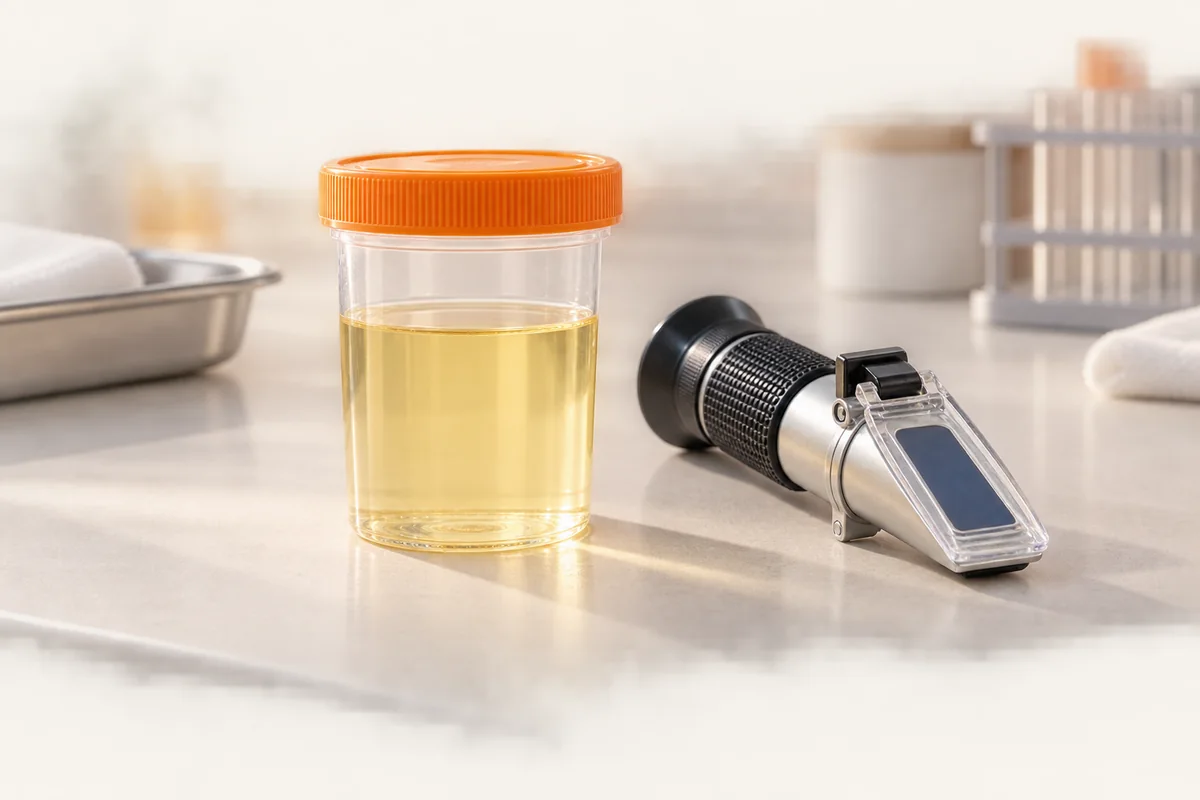
The short answer
What urine specific gravity means
Urine specific gravity compares the density of urine with water and is used as a clue to how concentrated that sample is. It is influenced by water and by substances dissolved in urine. A single value cannot diagnose dehydration, kidney disease or a need to change fluid intake.See reference 1,See reference 2
Concentration is more than a hydration score
A urinalysis can report several independent findings from one specimen. Specific gravity addresses concentration, whereas protein, glucose and other markers answer different questions. Read the full report rather than treating specific gravity as a summary of kidney health.See reference 1,See reference 2
Urine osmolality directly measures dissolved particles and is a different laboratory test. In a comparison study, specific gravity and osmolality were related but did not agree closely enough in every type of sample to use one as an exact substitute for the other.See reference 2
Check how the result was obtained
- On the report or label
- Dipstick specific gravity
- What it can and cannot tell you
- A convenient screening estimate. Comparisons with refractometry and osmolality found meaningful scatter, so a borderline result should not be treated as laboratory precision.See reference 2,See reference 3
- On the report or label
- Refractometer specific gravity
- What it can and cannot tell you
- An estimate based on refractive index. It can be useful, but unusual dissolved substances can still change its relationship with osmolality.See reference 2,See reference 3
- On the report or label
- Urine osmolality
- What it can and cannot tell you
- A separate measurement of particle concentration. A clinician may use it when a more direct concentration measure is needed.See reference 2
Why a value may be higher or lower
A more concentrated sample may follow a period with less fluid intake, while a more dilute sample may follow more drinking. The same person can produce different samples at different times. The study of specific gravity and osmolality also found that glucose, protein and other abnormal constituents can affect how the measurements relate.See reference 2
The interval printed by your laboratory and the method used matter. This guide does not apply a universal high or low cutoff, and it cannot decide whether an unexpected result is a normal short-term change or a medical issue.See reference 1,See reference 2
A practical way to read your report
Keep the collection date and time, test method if shown, laboratory interval and the other urinalysis findings together. If the result is important to a clinical question, ask whether a repeat specimen or another measurement is needed rather than comparing a dipstick with a different method as if they were identical.See reference 1,See reference 2,See reference 3
Do not restrict fluids or stop medicines to chase a target value from this page. Preparation and follow-up depend on why the test was ordered and should be agreed with your care team.See reference 1,See reference 2
What to take into the next conversation
- The actual result, laboratory interval and collection timing.See reference 1,See reference 2
- Whether the report used a dipstick, refractometer or another method.See reference 2,See reference 3
- The rest of the urinalysis, recent fluid context and reason for testing.See reference 1,See reference 2
Common questions
Does high specific gravity prove dehydration?
No. A concentrated sample has several possible explanations, and dissolved substances and the method can affect the number. Interpretation needs the wider picture.See reference 1,See reference 2
Is specific gravity the same as osmolality?
No. They are related measures with different methods and can diverge, especially in an unusual sample.See reference 2
Can I compare a home dipstick with a lab result?
Only cautiously. Dipstick estimates can differ from laboratory methods; check the method and discuss a meaningful discrepancy with the care team.See reference 2,See reference 3
References
- 1. Urinalysis
MedlinePlus, U.S. National Library of MedicineOfficial guidance
- 2. Is specific gravity a good estimate of urine osmolality?
Journal of Clinical Laboratory AnalysisObservational study
- 3. Dipstick measurements of urine specific gravity are unreliable
Archives of Disease in ChildhoodObservational study
Editorial transparency
- Published by
- LongevityMate Editorial
- Published
- Updated
Medical disclaimer
General education only. This guide does not diagnose a condition, choose treatment or recommend a supplement dose. Discuss your own result, symptoms, medicines or product use with a qualified health professional.