
Six points that prevent most ALP mistakes
- Use the reporting laboratory's interval. Current adult examples range from 30–130 U/L to sex-specific 35–104 or 40–129 U/L, so one internet range is not universal.See reference 2,See reference 3,See reference 5
- Total ALP does not identify its tissue source. A liver pattern, bone pattern, isoenzyme profile and symptoms answer different parts of the question.See reference 1,See reference 2,See reference 4,See reference 5
- Children and adolescents often have higher ALP during growth, and pregnancy can raise placental ALP. Adult ranges and this page's tool do not apply to those settings.See reference 1,See reference 2,See reference 3,See reference 5
- Preparation depends on the order: one standard total-ALP service requires no special preparation, while companion panels or an isoenzyme profile may require fasting.See reference 1,See reference 2,See reference 5
- A repeated low ALP plus stress fractures, premature tooth loss or bone/dental symptoms deserves qualified assessment for secondary causes and, when appropriate, hypophosphatasia—not a diagnosis from one value.See reference 6,See reference 7,See reference 8,See reference 9
- New jaundice or severe upper-abdominal pain with fever, shivering, vomiting or confusion needs urgent assessment regardless of the ALP number.See reference 12,See reference 13
What ALP measures—and what it does not
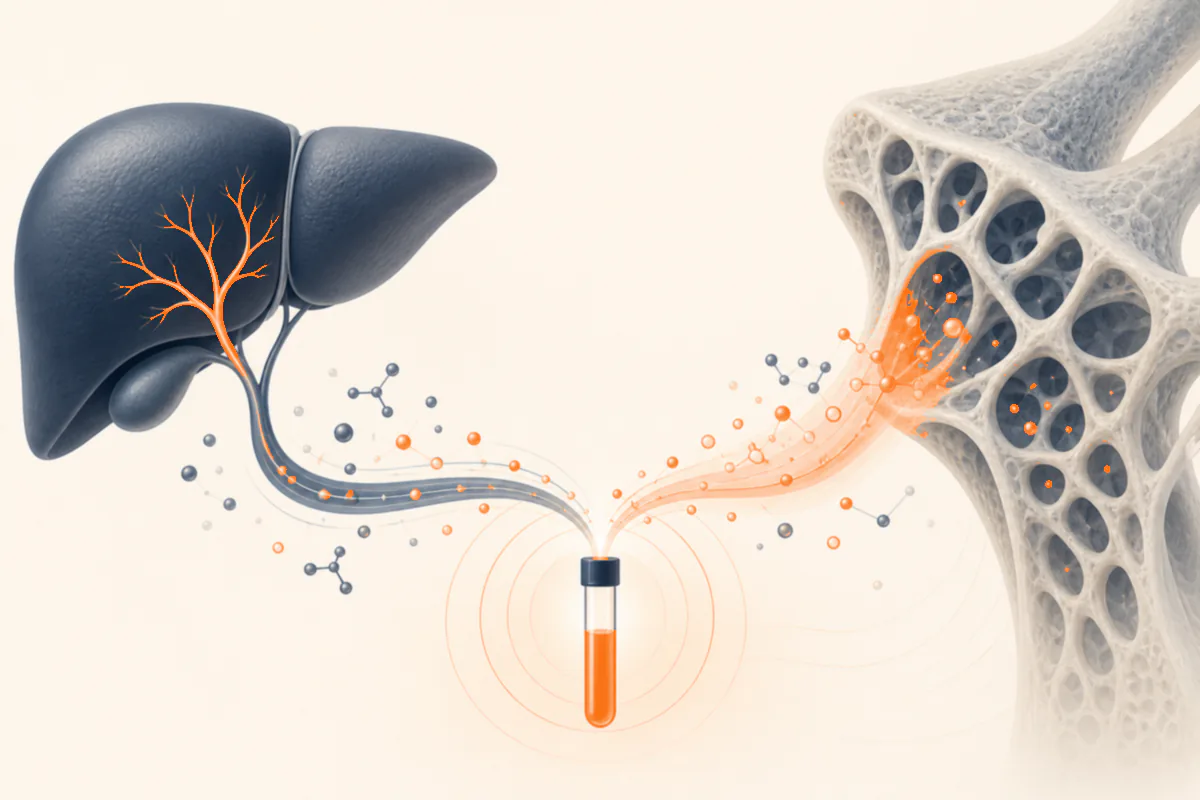
Alkaline phosphatases are enzymes that remove phosphate groups from molecules. Routine blood testing reports their combined catalytic activity, usually in units per litre. In adults, most circulating activity comes from tissue-nonspecific ALP expressed in liver and bone; intestine and placenta can also contribute.See reference 1,See reference 2,See reference 10,See reference 11
ALP is commonly included in a comprehensive metabolic or liver chemistry panel, but it is not a direct measurement of liver function. It is an indirect marker that can rise with impaired bile flow or increased bone-forming activity, among other settings.See reference 1,See reference 2,See reference 4
The routine total result is different from bone-specific ALP and from an ALP isoenzyme profile. Those tests try to separate sources, but even a fraction must be interpreted with the method, age, symptoms and other findings rather than treated as a stand-alone diagnosis.See reference 1,See reference 2,See reference 5
Why reputable laboratories publish different adult ALP ranges
- Source and example
- Mayo current catalog: males age 19+, 40–129 U/L
- Responsible use
- Example for Mayo's current method and population
- Important boundary
- Not a universal male target and not transferable to another assay without its own interval.See reference 2
- Source and example
- Mayo current catalog: females age 17+, 35–104 U/L
- Responsible use
- Example showing that age and sex can alter a laboratory interval
- Important boundary
- Do not infer disease because another laboratory uses a higher upper limit.See reference 2
- Source and example
- Gloucestershire NHS: adults over 18, 30–130 U/L
- Responsible use
- Example from a different current laboratory service
- Important boundary
- Its standard assay has its own method, preparation and population context.See reference 5
- Source and example
- MedlinePlus educational example: 40–129 U/L
- Responsible use
- Useful for explaining laboratory variation, not replacing the interval on a report
- Important boundary
- This guide excludes the page's non-equivalent paired SI display and uses the exact 60× conversion only.See reference 3
Total ALP, GGT and isoenzymes answer different questions
- Test or pattern
- Total ALP
- What it can add
- Confirms the combined enzyme activity measured by that laboratory
- What it cannot prove
- Cannot locate the source or diagnose obstruction, liver disease, bone disease or HPP.See reference 1,See reference 2,See reference 4
- Test or pattern
- ALP elevation with GGT elevation
- What it can add
- Supports a hepatic or biliary source and is recommended by ACG as a clarifying test
- What it cannot prove
- GGT is nonspecific and is not a stand-alone liver screening or diagnosis test.See reference 4,See reference 5
- Test or pattern
- ALP elevation with bone/mineral context and no convincing hepatic pattern
- What it can add
- Makes increased bone-forming or remodeling activity more relevant
- What it cannot prove
- A normal GGT does not by itself name the bone condition or exclude every liver cause.See reference 1,See reference 2,See reference 5
- Test or pattern
- ALP isoenzyme profile or bone-specific ALP
- What it can add
- May separate liver, bone and intestinal fractions when the source remains uncertain
- What it cannot prove
- Availability, method and reference values differ; a fraction still needs clinical interpretation.See reference 1,See reference 2
Units, preparation, timing and specimen issues
ALP activity is commonly reported in U/L or µkat/L. Divide U/L by 60 to get µkat/L; multiply µkat/L by 60 to return. For example, 129 U/L is exactly 2.15 µkat/L and 40 U/L is 0.6667 µkat/L. Because some published paired displays do not reconcile with this exact formula, classification must stay in the original unit against the same report's limits.See reference 3
Preparation is order-specific. Gloucestershire's standard total ALP assay requires no special preparation, MedlinePlus notes that companion blood tests often require several hours of fasting, and Mayo's total-plus-isoenzyme profile requires fasting and warns that a fatty meal can raise intestinal ALP about two hours later. Follow the actual order rather than a generic web rule.See reference 1,See reference 2,See reference 5
Tell the ordering team about medicines, supplements, pregnancy and recent fractures or illness; do not stop a medicine unless instructed. Mayo's current profile uses serum and notes method-specific inhibition by substances such as phosphate, oxalate, citrate and excess glycine, which is one reason laboratory method and specimen comments matter.See reference 1,See reference 2,See reference 5
Children, adolescents and pregnancy need different boundaries
- Context
- Child or adolescent
- Why ALP can differ
- Bone growth can make total ALP much higher than adult values; current pediatric intervals change substantially by age and sex.
- Safe interpretation
- Use the child's reporting laboratory and pediatric assessment. Never apply this adult tool or an adult internet range.See reference 1,See reference 2,See reference 3,See reference 5
- Context
- Young child with a very large temporary rise
- Why ALP can differ
- Mayo describes transient hyperphosphatasemia under age five, with no detected liver or bone disease and normalization over weeks or months.
- Safe interpretation
- That is a clinician-made exclusion diagnosis, not a label to place on an unassessed result.See reference 2
- Context
- Pregnancy
- Why ALP can differ
- Placental ALP can increase and adult nonpregnant ranges may not apply.
- Safe interpretation
- Use pregnancy-specific laboratory and obstetric context; new itching, jaundice, pain or feeling unwell needs prompt assessment.See reference 1,See reference 2,See reference 3,See reference 5
Why total ALP can be high
- Broad source
- Liver or bile-duct source
- Examples
- Cholestasis, bile-duct obstruction or stricture, cholestatic liver disease, medicine-related injury and infiltrative disease among many possibilities
- What adds useful context
- GGT, bilirubin, ALT/AST, symptoms, medicines and clinician-directed imaging or serology.See reference 1,See reference 2,See reference 4
- Broad source
- Bone-forming or remodeling source
- Examples
- Growth, healing fracture, vitamin-D-related osteomalacia/rickets, Paget disease and some bone tumors
- What adds useful context
- Age, fracture history, bone pain, calcium, phosphate, vitamin D, PTH, imaging and bone-specific ALP when appropriate.See reference 1,See reference 2,See reference 3,See reference 5
- Broad source
- Placental, intestinal or temporary source
- Examples
- Pregnancy, post-meal intestinal ALP and transient hyperphosphatasemia in young children
- What adds useful context
- Life stage, fasting status, age-specific interval, trend and isoenzymes where needed.See reference 1,See reference 2,See reference 3,See reference 5
When the pattern points more toward liver or bile ducts
ACG defines a cholestatic chemistry pattern as ALP rising disproportionately to ALT and AST. When ALP is elevated, accompanying GGT elevation supports hepatic origin, but GGT is nonspecific and should not be used alone to screen for or name liver disease.See reference 4
Once qualified care confirms a hepatic pattern, symptoms, bilirubin, medicines and history guide the next step. The ACG pathway includes right-upper-quadrant ultrasound and, in the appropriate context, testing for primary biliary cholangitis or primary sclerosing cholangitis. Those are clinician workflows—not conclusions produced by an ALP number.See reference 4
A normal ALT, AST or bilirubin does not automatically make an elevated ALP harmless, and a normal ALP does not rule out every liver or bile-duct disorder. Trend and the whole clinical picture remain essential.See reference 1,See reference 4,See reference 5
When the pattern points more toward bone
Bone ALP reflects osteoblast activity—the work of bone-forming cells. It can rise normally during growth or fracture repair and abnormally with disorders that increase bone formation or remodeling, including rickets, osteomalacia and Paget disease.See reference 1,See reference 2,See reference 3,See reference 5
A non-hepatic pattern can lead qualified care to review calcium, phosphate, 25-hydroxyvitamin D, parathyroid hormone, kidney context, symptoms, fractures and imaging. Bone-specific ALP or isoenzymes can add source information when needed; total ALP alone cannot choose among those causes.See reference 1,See reference 2,See reference 5
Do not self-treat a high ALP with vitamin D, calcium, zinc or another supplement without confirming a deficiency and checking safety. The same high value can arise from very different conditions, and excessive supplementation can create its own harm.See reference 1,See reference 2,See reference 4,See reference 5
A low ALP result needs confirmation before a cause label
- Possibility
- Temporary or contextual low result
- Relevant context
- Severe acute illness, specimen/method context or ordinary biological variation can contribute
- Responsible next step
- Confirm the correct interval, collection context and trend rather than diagnosing from one value.See reference 2,See reference 8
- Possibility
- Nutrition, mineral or endocrine context
- Relevant context
- Protein-energy malnutrition, zinc or magnesium deficiency, thyroid disease and pernicious anemia are among reported associations
- Responsible next step
- Test and treat a confirmed cause; a low ALP value alone does not identify which nutrient or dose.See reference 1,See reference 3,See reference 8,See reference 11
- Possibility
- Medicine effect
- Relevant context
- Some medicines, including antiresorptive treatments, can lower ALP
- Responsible next step
- Review timing and indication with the prescriber; never stop treatment from this page.See reference 1,See reference 8
- Possibility
- Hypophosphatasia possibility
- Relevant context
- Persistently low age- and sex-adjusted ALP plus compatible fracture, bone, joint or dental features
- Responsible next step
- Qualified assessment may use history, imaging, PLP/PEA and ALPL genetics; one low result is not diagnostic.See reference 6,See reference 7,See reference 8,See reference 9
The important persistent-low-ALP boundary: hypophosphatasia
Hypophosphatasia is a rare inherited disorder caused by reduced tissue-nonspecific ALP activity. In adults it can involve stress or poorly healing fractures, musculoskeletal pain, chondrocalcinosis and dental history; severity varies widely.See reference 6,See reference 7,See reference 8,See reference 9
Current expert frameworks require persistently low ALP for age and sex after secondary causes are excluded, combined with clinical and sometimes biochemical, imaging or genetic evidence. They do not support diagnosing HPP from one low value or from an adult cutoff applied to a child.See reference 6,See reference 7,See reference 8,See reference 9
If persistently low ALP sits beside stress fractures, recurrent poorly healing fractures, premature loss of adult teeth or a strong family history, raise that pattern with qualified care—especially before assuming ordinary osteoporosis treatment is appropriate. Do not stop an existing antiresorptive or other medicine without the prescriber.See reference 6,See reference 7,See reference 8
Factors that can shift or complicate ALP
- Factor
- Recent fatty meal
- Possible effect
- Can increase the intestinal ALP fraction, particularly in some people with blood group O or B
- Responsible response
- Follow the actual fasting instructions and record meal timing; do not diagnose an intestinal source yourself.See reference 1,See reference 2,See reference 4
- Factor
- Growth, pregnancy or healing fracture
- Possible effect
- Can raise ALP through bone or placental activity without representing the same adult liver mechanism
- Responsible response
- Use age/life-stage context and the correct interval; symptoms and trend still matter.See reference 1,See reference 2,See reference 3,See reference 5
- Factor
- Prescription, over-the-counter and supplement exposure
- Possible effect
- May raise or lower ALP, contribute to liver injury or alter bone turnover
- Responsible response
- Provide a full list and timing; do not stop or add products from the result alone.See reference 1,See reference 4,See reference 5,See reference 8
- Factor
- Assay and specimen differences
- Possible effect
- Activity depends on method conditions; inhibitors or specimen problems can alter measurement
- Responsible response
- Use the same report's interval and clarify a surprising change or specimen comment with the laboratory/clinician.See reference 2,See reference 3,See reference 10
What may change ALP—and what not to infer
- Situation
- Confirmed liver or bile-flow cause
- Evidence-based action
- Cause-specific assessment and treatment may include medicine review, blood tests, imaging and specialist care
- What not to infer
- A generic detox, fasting plan or supplement cannot safely treat all hepatic ALP elevations.See reference 1,See reference 4,See reference 12
- Situation
- Confirmed bone/mineral cause
- Evidence-based action
- Treat the demonstrated disorder or deficiency and follow the clinically relevant markers
- What not to infer
- The ALP number does not identify a nutrient or justify a high-dose supplement.See reference 1,See reference 2,See reference 5
- Situation
- Physiologic or healing context
- Evidence-based action
- Interpret the expected life-stage or healing trend with the appropriate care team
- What not to infer
- A higher value is not automatically liver damage and should not be forced into an adult target.See reference 1,See reference 2,See reference 3,See reference 5
- Situation
- Confirmed persistent low ALP
- Evidence-based action
- Identify secondary causes and investigate HPP only when the wider pattern supports it
- What not to infer
- Do not self-diagnose, self-supplement or change osteoporosis treatment from ALP alone.See reference 6,See reference 7,See reference 8,See reference 9
Symptoms outrank the ALP calculator
Seek prompt assessment for new jaundice, dark urine with pale stool, persistent itching, or new significant bone pain or fracture. Use urgent or emergency local care for sudden severe or persistent upper-abdominal pain; pain spreading to the back with vomiting; fever or shivering with abdominal pain or jaundice; new confusion or difficulty waking; fainting; vomiting blood; black stool with weakness; or uncontrolled bleeding. Do not wait for an ALP threshold, repeat test or online interpretation.See reference 1,See reference 12,See reference 13
Common ALP misconceptions
- Claim
- High ALP always means liver damage
- What the evidence supports
- Liver/bile ducts and bone are major sources; placenta and intestine can contribute.
- Safer conclusion
- Use GGT, companion tests, life stage, symptoms and sometimes isoenzymes.See reference 1,See reference 2,See reference 4,See reference 5
- Claim
- Normal ALP rules out liver or bone disease
- What the evidence supports
- ALP is one indirect marker with limited sensitivity and specificity.
- Safer conclusion
- Interpret the whole clinical picture and other relevant tests.See reference 1,See reference 4,See reference 5
- Claim
- Normal GGT proves a bone source
- What the evidence supports
- GGT can support hepatic origin when elevated but is nonspecific.
- Safer conclusion
- A normal GGT can shift probability; it does not identify the source by itself.See reference 4,See reference 5
- Claim
- One low ALP proves hypophosphatasia
- What the evidence supports
- HPP requires persistent age/sex-adjusted low ALP plus compatible clinical and supporting evidence after other causes are excluded.
- Safer conclusion
- Confirm the trend and use qualified assessment.See reference 6,See reference 7,See reference 8,See reference 9
- Claim
- There is one optimal longevity ALP value
- What the evidence supports
- Laboratory intervals differ and the same activity can arise from different tissues and life stages.
- Safer conclusion
- No evidence-backed universal longevity target or self-treatment goal is established.See reference 1,See reference 2,See reference 3,See reference 4,See reference 5
A calm next-step checklist
- Confirm the test is total ALP, then preserve the unrounded value, original unit, laboratory interval and date.See reference 1,See reference 2,See reference 3
- Check age, sex, pregnancy, fasting instructions, recent meal, fracture/healing, symptoms, illness and every medicine or supplement.See reference 1,See reference 2,See reference 5,See reference 8
- If high, review GGT, bilirubin, ALT/AST and bone/mineral context; source tests are selected from the full pattern, not the ALP number alone.See reference 1,See reference 2,See reference 4,See reference 5
- If low, confirm it with the correct age/sex interval and trend before testing for nutrients, endocrine causes or HPP.See reference 6,See reference 7,See reference 8,See reference 9
- Use symptom-led urgent care when warning signs are present; do not wait for a repeat result.See reference 12,See reference 13
What this evidence still cannot decide
- Limit
- Reference intervals vary by assay, laboratory, age, sex and life stage
- Why it matters
- One web range can misclassify a real result
- How the page handles it
- Examples are labelled and the tool uses only the reader-entered interval.See reference 2,See reference 3,See reference 5
- Limit
- Total ALP, GGT and isoenzymes are not perfectly source-specific
- Why it matters
- An apparently neat pattern can still have overlap or more than one cause
- How the page handles it
- No automated liver/bone diagnosis is generated.See reference 1,See reference 2,See reference 4,See reference 5
- Limit
- ACG's ALP evaluation recommendations use very-low-quality evidence
- Why it matters
- The workflow is clinically useful but not a proven universal sequence for every person
- How the page handles it
- It is presented as clinician-led guidance, not self-ordering or certainty.See reference 4
- Limit
- HPP criteria are proposed and require clinical integration
- Why it matters
- A screening value cannot establish disease or treatment
- How the page handles it
- Persistent low ALP is a signal for assessment, never an online diagnosis.See reference 6,See reference 7,See reference 8,See reference 9
Put ALP in the context of the whole report
Upload a laboratory report to LongevityMate to organize ALP beside GGT, bilirubin, ALT, AST, albumin, calcium, phosphate, vitamin D, kidney markers and prior results. You receive structured educational context for discussion—not a liver-versus-bone diagnosis, fasting instruction, emergency decision or treatment prescription.
Understand your lab resultsAlkaline phosphatase questions people ask most
What is a normal alkaline phosphatase range?
Use the interval on the same report. Current examples include 40–129 U/L for Mayo adult males, 35–104 U/L for Mayo adult females and 30–130 U/L for adults at Gloucestershire NHS. These are method- and population-specific examples, not one universal optimal range.See reference 2,See reference 3,See reference 5
What causes high alkaline phosphatase?
Broad sources include liver or bile-duct cholestasis, increased bone formation or remodeling, growth, pregnancy and intestinal ALP after a meal. Total ALP alone cannot identify which source or cause applies.See reference 1,See reference 2,See reference 4,See reference 5
How can you tell whether high ALP is from liver or bone?
GGT, bilirubin and ALT/AST can support a hepatic pattern; age, bone symptoms, fracture history, calcium-phosphate-vitamin-D context and bone-specific ALP can support a bone pattern. Isoenzymes may help when uncertainty remains, but no single companion test proves the source.See reference 1,See reference 2,See reference 4,See reference 5
Does a normal GGT mean high ALP is from bone?
Not necessarily. ACG recommends GGT to help confirm hepatic origin of an ALP elevation, but GGT is nonspecific. A normal GGT can make a hepatic source less supported; it does not prove a bone diagnosis or exclude every liver cause.See reference 4,See reference 5
What causes low alkaline phosphatase?
Reported possibilities include acute severe illness, malnutrition or protein/mineral deficiency, thyroid disease, pernicious anemia, medicines and hypophosphatasia. Confirm persistence with the correct age/sex interval before choosing tests or treatment.See reference 1,See reference 3,See reference 8,See reference 11
Does low ALP mean hypophosphatasia?
One low result does not. HPP becomes more relevant when ALP remains low for age and sex after other causes are excluded and compatible fracture, bone, joint, dental, biochemical or genetic evidence is present.See reference 6,See reference 7,See reference 8,See reference 9
Can pregnancy raise ALP?
Yes. Placental ALP can raise the total result, and ordinary adult nonpregnant intervals may not apply. Use the obstetric laboratory and care team, especially with itching, jaundice, pain or feeling unwell.See reference 1,See reference 2,See reference 3,See reference 5
Why is alkaline phosphatase high in children?
Active bone growth commonly raises ALP, and current pediatric ranges can be far higher than adult ranges. Illness still matters, so use the child's age- and sex-specific report and pediatric assessment rather than an adult calculator.See reference 1,See reference 2,See reference 3,See reference 5
Do I need to fast for an ALP test?
Follow the actual order. Some standard total-ALP services require no special preparation, companion panels may require fasting, and Mayo's ALP isoenzyme profile requires fasting because a fatty meal can raise intestinal ALP.See reference 1,See reference 2,See reference 5
Can vitamin D deficiency raise ALP?
It can when vitamin-D deficiency contributes to osteomalacia or rickets and increased bone remodeling. A high ALP does not prove vitamin-D deficiency or justify high-dose treatment; test and interpret vitamin D with the wider mineral and clinical context.See reference 1,See reference 2,See reference 3,See reference 5
How do I convert ALP from U/L to µkat/L?
Divide U/L by 60; multiply µkat/L by 60 to return. Convert the result and both limits together only for display. Preserve the original unit and do not use a rounded converted value to switch category near a range boundary.See reference 3
Should I take supplements or stop medicine for abnormal ALP?
No. Medicines can affect liver chemistry or bone turnover, and supplements are appropriate only for a confirmed need with safe dosing. Provide the full list to qualified care and do not stop prescribed treatment or change osteoporosis therapy from this page.See reference 1,See reference 4,See reference 6,See reference 8
Get the weekly longevity brief
The week's best longevity research in plain English. Free, every Tuesday.
References
- 1. Alkaline Phosphatase — Last Updated November 5, 2024
MedlinePlus Medical Tests, U.S. National Library of MedicineOfficial guidance
- 2. Alkaline Phosphatase, Total and Isoenzymes, Serum — Current Catalog; Accessed 2026-08-10
Mayo Clinic LaboratoriesOfficial guidance
- 3. ALP Blood Test
MedlinePlus Medical Encyclopedia, U.S. National Library of MedicineOfficial guidance
- 4. ACG Clinical Guideline: Evaluation of Abnormal Liver Chemistries
American College of GastroenterologyGuideline
- 5. Alkaline Phosphatase — Page Updated and Reviewed 9 April 2026
Gloucestershire Hospitals NHS Foundation TrustOfficial guidance
- 6. Hypophosphatasia
GeneReviews, NCBI BookshelfEvidence review
- 7. Hypophosphatasia Diagnosis: Current State of the Art and Proposed Diagnostic Criteria for Children and Adults
Osteoporosis InternationalEvidence review
- 8. Diagnostic Approach to Patients with Low Serum Alkaline Phosphatase
Calcified Tissue InternationalEvidence review
- 9. Diagnosis and Treatment of Hypophosphatasia
Calcified Tissue InternationalEvidence review
- 10. Alkaline Phosphatase: An Overview
Indian Journal of Clinical BiochemistryEvidence review
- 11. Serum Alkaline Phosphatase: Clinical and Laboratory Perspectives
StatPearls, NCBI BookshelfEvidence review
- 12. Gallstones
NHSOfficial guidance
- 13. Recognizing Medical Emergencies
MedlinePlus Medical Encyclopedia, U.S. National Library of MedicineOfficial guidance
Editorial transparency
- Published by
- LongevityMate Editorial
- Editorial review by
- Lukas Dvorsky, Founder — editorial review
- Published
- Updated
Medical disclaimer
Educational information only, not a diagnosis of liver, bile-duct, bone, nutrient, endocrine or genetic disease; not a child, pregnancy, medicine, supplement, osteoporosis-treatment or emergency decision. Use the original laboratory report and qualified clinical care for individual decisions.