
Six points that prevent most bilirubin mistakes
- Use the reporting laboratory's interval. Published adult examples differ at the lower endpoint and are not treatment targets.See reference 1,See reference 2,See reference 7
- If total bilirubin is high, the direct and indirect fractions usually provide more useful direction than the total value alone.See reference 3,See reference 4,See reference 8
- A mild, repeated, isolated unconjugated pattern can fit Gilbert syndrome, but one result does not diagnose it and hemolysis or liver disease must not be assumed away.See reference 4,See reference 5,See reference 6,See reference 9
- Fasting, illness, dehydration, exercise, medicines, specimen light and hemolysis can change or distort a result.See reference 1,See reference 2,See reference 5,See reference 6,See reference 7,See reference 10
- Adult ranges and this tool must never be used for newborn jaundice; pregnancy also needs pregnancy-specific context.See reference 7,See reference 11
- New jaundice or jaundice with fever, chills, severe pain, confusion or bleeding needs prompt or emergency assessment regardless of the bilirubin number.See reference 5,See reference 12,See reference 13
What total bilirubin measures—and what it does not
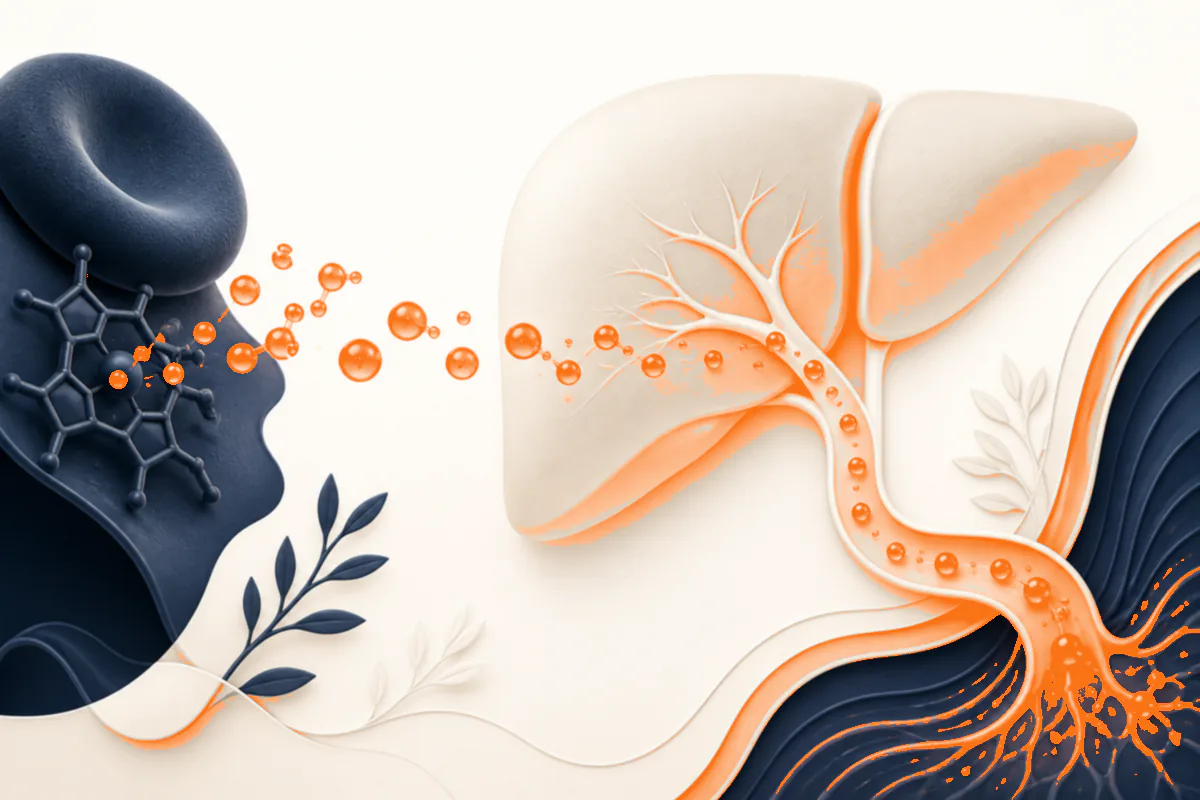
Bilirubin is a yellow pigment produced mainly while the body recycles heme from aging red blood cells. The liver takes up unconjugated bilirubin, attaches glucuronic acid to make it water-soluble, and excretes the conjugated form into bile. A routine total bilirubin test measures the combined circulating amount produced across this pathway.See reference 1,See reference 4,See reference 7,See reference 8
Total bilirubin is neither a stand-alone 'liver health score' nor a pure measure of liver-cell injury. It can rise before the liver, within liver processing, or after conjugation when bile cannot flow normally. It may also stay normal in important liver disease.See reference 2,See reference 3,See reference 4,See reference 8
The test is also different from urine bilirubin. Unconjugated bilirubin is albumin-bound and does not normally pass into urine; urine bilirubin generally reflects water-soluble conjugated pigment. Blood total, blood fractions and urine bilirubin therefore answer related but different questions.See reference 4,See reference 8
Three number systems people often mix up
- Number
- The interval printed by the reporting laboratory
- Responsible use
- Primary comparison for that result, method and population
- Important boundary
- It does not identify the cause, severity, treatment or urgency by itself.See reference 1,See reference 2,See reference 7
- Number
- Adult educational examples
- Responsible use
- MedlinePlus lists 0.1–1.2 mg/dL (1.71–20.5 µmol/L); Mayo's current adult catalog lists 0.0–1.2 mg/dL.
- Important boundary
- Different lower endpoints prove these are not a universal optimal range. Paired SI values are rounded displays.See reference 1,See reference 7
- Number
- Newborn age-in-hours and gestation rules
- Responsible use
- Used by pediatric teams for neonatal jaundice decisions
- Important boundary
- Do not apply adult intervals, this page's tool or an adult symptom rule to a newborn.See reference 2,See reference 7
Total, direct and indirect bilirubin are related—not interchangeable
- Report label
- Total bilirubin
- What it usually represents
- The combined bilirubin signal measured before fraction-led interpretation
- Limitation
- It cannot distinguish production, uptake, conjugation, liver-cell or bile-flow mechanisms by itself.See reference 3,See reference 4,See reference 8
- Report label
- Direct bilirubin (often called conjugated)
- What it usually represents
- The fraction reacting directly in the assay; it commonly rises when conjugated bilirubin accumulates
- Limitation
- It is an operational assay fraction and can include delta bilirubin; it is not chemically pure conjugated bilirubin.See reference 3,See reference 8
- Report label
- Indirect bilirubin (often called unconjugated)
- What it usually represents
- Frequently calculated as total minus direct and often reflects the non-direct-reacting fraction
- Limitation
- Subtraction carries the uncertainty of both measurements. Tiny discrepancies do not create a diagnosis.See reference 4,See reference 8
Units, preparation and specimen handling
Bilirubin is commonly reported in mg/dL or µmol/L. The conventional conversion is µmol/L = mg/dL × 17.1; divide by 17.1 in the other direction. For example, 1.2 mg/dL is 20.52 µmol/L, usually displayed as 20.5. Preserve the original value and compare before display rounding.See reference 1,See reference 9
Preparation depends on why the test was ordered and what else is in the panel. A clinician or laboratory may request fasting, but do not deliberately fast as a home diagnostic challenge. Tell the ordering team about medicines and supplements, and do not stop anything unless instructed.See reference 1,See reference 2,See reference 9,See reference 10
Bilirubin is light-sensitive. Current Mayo laboratory instructions protect serum from light and reject grossly hemolyzed samples because hemoglobin can inhibit its diazo method and falsely lower the result. A specimen comment or an implausible change can justify clarification or repeat collection.See reference 7,See reference 8
Interpret the pattern before naming a cause
- Pattern
- Predominantly indirect/unconjugated elevation with otherwise normal liver chemistries
- Mechanisms it can fit
- Increased bilirubin production, impaired uptake or impaired conjugation; Gilbert syndrome is common when the pattern is mild and repeated
- What adds context
- CBC, blood film, reticulocytes, LDH, haptoglobin, history, trend and clinician-directed fractionation.See reference 3,See reference 4,See reference 6,See reference 8,See reference 9
- Pattern
- Direct/conjugated or mixed elevation
- Mechanisms it can fit
- Liver-cell dysfunction, impaired secretion or impaired bile flow/obstruction among the possibilities
- What adds context
- ALT, AST, ALP, GGT, symptoms, medicines, imaging and the wider clinical setting.See reference 3,See reference 4,See reference 7,See reference 8
- Pattern
- Below the reporting interval
- Mechanisms it can fit
- Often no clinically important disorder; medicines or analytical context may contribute
- What adds context
- Usually no bilirubin-directed treatment. Review only if the broader clinical picture gives a reason.See reference 2,See reference 7,See reference 14
When an isolated high result can fit Gilbert syndrome
Gilbert syndrome is an inherited reduction in bilirubin conjugation. It commonly causes mild, intermittent, predominantly unconjugated hyperbilirubinemia and may become more visible during illness, dehydration, fasting, menstruation or overexertion. It does not usually damage the liver or require treatment.See reference 4,See reference 5,See reference 6,See reference 9
The responsible pattern is repeated unconjugated elevation with no evidence of liver disease or hemolysis—not one high total value. Normal aminotransferases and ALP, plus a reassuring CBC, blood film and reticulocyte context, can support a presumptive diagnosis. Genetic testing is rarely needed but can help when uncertainty would change management.See reference 4,See reference 6,See reference 9
Do not label new jaundice, dark urine, pale stool, itching, anemia, abnormal liver enzymes or a changing symptom pattern as 'just Gilbert.' Those findings deserve fresh assessment even if Gilbert syndrome was diagnosed before.See reference 5,See reference 6,See reference 12
Why total bilirubin can be high
- Mechanism
- More bilirubin production
- Examples
- Hemolysis, ineffective red-cell production, breakdown of a large hematoma
- Useful distinction
- Often indirect-predominant; anemia, reticulocytes, LDH and haptoglobin help, but total bilirubin alone cannot prove hemolysis.See reference 1,See reference 2,See reference 4,See reference 7,See reference 8
- Mechanism
- Reduced uptake or conjugation
- Examples
- Gilbert syndrome, rarer inherited disorders and some medicine effects
- Useful distinction
- Often indirect-predominant. Severity, age, other tests and medication history separate very different situations.See reference 4,See reference 5,See reference 6,See reference 7,See reference 8
- Mechanism
- Liver-cell disease
- Examples
- Viral, immune, metabolic, alcohol-associated or medicine-related injury among many possibilities
- Useful distinction
- Fractions can be mixed; ALT/AST, INR, albumin, symptoms and cause-specific testing matter.See reference 1,See reference 2,See reference 3,See reference 4,See reference 8
- Mechanism
- Impaired bile formation or flow
- Examples
- Gallstones, strictures, inflammation, cholestatic disease or external obstruction
- Useful distinction
- Direct/conjugated bilirubin, ALP/GGT, dark urine, pale stool, itching, pain and imaging provide context.See reference 1,See reference 2,See reference 3,See reference 4,See reference 8,See reference 12
Companion results that change the interpretation
- Result
- Direct and indirect bilirubin
- Why it helps
- Separates a broad production/conjugation pattern from liver-cell/bile-flow patterns
- What it cannot do alone
- Assay fractions overlap and do not name the disease.See reference 3,See reference 4,See reference 8
- Result
- ALT, AST, ALP and GGT
- Why it helps
- Shows whether hepatocellular, cholestatic or mixed chemistry abnormalities accompany bilirubin
- What it cannot do alone
- Normal enzymes do not rule out every liver or bile-duct disorder.See reference 3,See reference 4,See reference 6,See reference 8
- Result
- CBC, reticulocytes, blood film, LDH and haptoglobin
- Why it helps
- Adds evidence for or against increased red-cell destruction
- What it cannot do alone
- No one item proves the cause; transfusion and other conditions can complicate the pattern.See reference 4,See reference 6,See reference 9
- Result
- Albumin and PT/INR
- Why it helps
- Can add context about liver synthetic function in the right setting
- What it cannot do alone
- Albumin has many non-liver influences, and INR also has non-liver causes.See reference 4,See reference 8
Factors that can shift or distort the result
- Factor
- Prolonged fasting or calorie restriction
- Possible effect
- Can raise total and indirect bilirubin, especially in susceptible people
- Responsible response
- Follow the test instructions; do not intentionally fast to prove Gilbert syndrome.See reference 5,See reference 6,See reference 9,See reference 10
- Factor
- Illness, dehydration, menstruation or heavy exertion
- Possible effect
- Can trigger intermittent elevation in Gilbert syndrome; strenuous exercise can affect results more broadly
- Responsible response
- Record the context and symptoms. Do not dismiss a new pattern without assessment.See reference 2,See reference 5,See reference 6
- Factor
- Prescription medicines, over-the-counter products and supplements
- Possible effect
- May change bilirubin processing, cause analytical effects or contribute to liver injury
- Responsible response
- Provide a complete list and timing; never stop a prescribed medicine from this page.See reference 1,See reference 2,See reference 5,See reference 7
- Factor
- Light exposure, gross hemolysis or method interference
- Possible effect
- Can lower or distort the measured result depending on the assay
- Responsible response
- Check specimen comments and clarify a surprising result with the laboratory or clinician.See reference 7,See reference 8
Pregnancy, newborns and children need different boundaries
- Context
- Pregnancy
- What changes
- Published pregnancy-specific bilirubin examples are generally lower than nonpregnant examples; pregnancy-related and coincidental liver disorders also matter
- Safe boundary
- Use the obstetric laboratory and care team. New jaundice, itching, pain, vomiting or feeling unwell needs pregnancy-specific assessment.See reference 11
- Context
- Newborn or young infant
- What changes
- Interpretation depends on postnatal age in hours, gestation, rate of rise and other risk factors
- Safe boundary
- This adult guide and tool do not apply. Use pediatric care promptly for visible jaundice or an abnormal infant result.See reference 1,See reference 2,See reference 7
- Context
- Older child or adolescent
- What changes
- Age-specific laboratory intervals and pediatric causes still apply
- Safe boundary
- Do not substitute the adult example interval for the child's report or pediatric assessment.See reference 2,See reference 7
New jaundice and warning symptoms outrank the calculator
Seek prompt medical assessment for new yellowing of the eyes or skin, even if the bilirubin rise looks modest. Use urgent or emergency local care for jaundice with high temperature, chills or right-upper abdominal pain; severe unrelenting abdominal pain; new confusion or difficulty waking; vomiting blood; black stool with weakness; fainting; or uncontrolled bleeding. Do not wait for a repeat test or a bilirubin cutoff. Newborn jaundice requires pediatric assessment, not this adult tool.See reference 5,See reference 12,See reference 13
What may change bilirubin—and what the evidence supports
- Situation
- Confirmed Gilbert syndrome
- Evidence-based action
- Usually no treatment is needed. Ordinary hydration, regular eating and avoiding personal triggers may reduce episodes for some people.
- What not to infer
- There is no need to force the value into a universal range or repeat-fasten to test yourself.See reference 5,See reference 6,See reference 9
- Situation
- Increased red-cell breakdown
- Evidence-based action
- Treatment depends on the cause, severity and clinical setting after appropriate evaluation.
- What not to infer
- Hydration, supplements or a bilirubin number alone do not treat or diagnose hemolysis.See reference 1,See reference 2,See reference 4
- Situation
- Liver-cell or bile-flow disease
- Evidence-based action
- Cause-specific assessment may include medicine review, targeted blood tests and imaging; obstruction or infection can need urgent treatment.
- What not to infer
- A generic detox, diet or supplement cannot safely substitute for diagnosis and may add liver or interaction risk.See reference 2,See reference 3,See reference 4,See reference 12
- Situation
- Low bilirubin
- Evidence-based action
- Usually no bilirubin-directed treatment is needed; review the wider context only when clinically relevant.
- What not to infer
- Research associations do not create a target to raise bilirubin.See reference 2,See reference 14
Fasting can move the number, but it is not a home diagnostic test
In a randomized open crossover study of 37 healthy volunteers, a 24-hour fast more than doubled total bilirubin from baseline in both the normal and consistently elevated groups; a difference was apparent after 12 hours. The study is small, old and limited to healthy volunteers, so it cannot predict an individual's response.See reference 10
This is why fasting status belongs in the context of a result. It is not a reason to skip meals, dehydrate yourself or repeat a test without instructions. Modern evaluation relies on the repeated pattern and exclusion of liver disease or hemolysis; provocative fasting tests are not recommended as a self-diagnostic strategy.See reference 1,See reference 6,See reference 9,See reference 10
When a repeat test helps—and when waiting does not
A repeat under known, appropriate preparation can confirm a surprising or isolated abnormality, especially when fasting status, illness, hydration, exertion or specimen quality differed. Clinician-directed fractionation can then separate direct and indirect patterns. Keep the original values, units, intervals and dates.See reference 1,See reference 3,See reference 4,See reference 6,See reference 7
Simply waiting for another routine test is not appropriate when jaundice is new, symptoms are concerning, the broader liver panel is markedly abnormal, synthetic function may be impaired or hemolysis is possible. The cause and clinical setting—not the decimal alone—set the timing.See reference 3,See reference 4,See reference 5,See reference 12,See reference 13
Low bilirubin is not a longevity deficiency
MedlinePlus states that low bilirubin is not usually a cause for concern. Some medicines and analytical factors can lower the measurement, but routine care does not define a universal bilirubin deficiency syndrome or replacement treatment.See reference 2,See reference 7
Bilirubin has antioxidant and signaling biology, and population studies report associations between lower or mildly higher concentrations and health outcomes. These observations do not prove that deliberately raising bilirubin improves health. Fasting, supplements or accepting jaundice to chase a longevity target is unsupported and can be unsafe.See reference 14
Common bilirubin misconceptions
- Claim
- One isolated high result proves Gilbert syndrome
- What the evidence supports
- Gilbert fits a mild, repeated, unconjugated pattern after liver disease and hemolysis are not apparent.
- Safer conclusion
- Use fractions, related tests, history and qualified review.See reference 4,See reference 5,See reference 6,See reference 9
- Claim
- Any high bilirubin means a blocked bile duct
- What the evidence supports
- Obstruction is one cause; red-cell production, uptake, conjugation and liver-cell mechanisms also raise bilirubin.
- Safer conclusion
- The fraction and companion-test pattern matter.See reference 1,See reference 2,See reference 3,See reference 4,See reference 8
- Claim
- Normal total bilirubin rules out liver disease
- What the evidence supports
- Bilirubin is one test with limited sensitivity and specificity; important disease can exist with a normal result.
- Safer conclusion
- Interpret symptoms, risks and the whole panel.See reference 2,See reference 4,See reference 8
- Claim
- Direct equals chemically pure conjugated bilirubin
- What the evidence supports
- Direct is an assay reaction fraction and may include delta bilirubin; indirect is often calculated.
- Safer conclusion
- Use the report labels and method-aware clinical interpretation.See reference 8
- Claim
- A liver detox or supplement lowers bilirubin safely
- What the evidence supports
- Treatment depends on the cause; no generic supplement has a role across Gilbert syndrome, hemolysis, hepatitis and obstruction.
- Safer conclusion
- Do not delay evaluation or add a potential liver/interaction risk.See reference 2,See reference 3,See reference 4,See reference 5
A calm next-step checklist
- Confirm that the report says total bilirubin, then preserve the original value, unit, interval and date.See reference 1,See reference 2,See reference 7
- Note symptoms, fasting instructions, illness, hydration, exertion, pregnancy and every medicine or supplement.See reference 1,See reference 2,See reference 5,See reference 6,See reference 11
- If high, review direct/indirect fractions and companion liver or blood results when a clinician has ordered them.See reference 3,See reference 4,See reference 6,See reference 8
- Do not diagnose Gilbert syndrome, hemolysis or obstruction from the total value or calculator.See reference 3,See reference 4,See reference 6,See reference 9
- Use prompt or emergency local care for new jaundice or the warning symptoms above; do not wait for a threshold.See reference 5,See reference 12,See reference 13
What this evidence still cannot decide
- Limit
- Reference intervals vary by method, laboratory, age, sex and pregnancy context
- Why it matters
- One web range can misclassify a real report
- How the page handles it
- The page labels examples and the tool uses only the reader-entered interval.See reference 1,See reference 2,See reference 7,See reference 11
- Limit
- Direct and indirect assays are operational measurements
- Why it matters
- A percentage can look more precise than the chemistry allows
- How the page handles it
- No diagnostic fraction cutoff or automated cause label is used.See reference 8
- Limit
- No universal bilirubin-only adult emergency threshold exists
- Why it matters
- The same value can represent very different mechanisms and clinical states
- How the page handles it
- Escalation is symptom- and context-led.See reference 3,See reference 4,See reference 5,See reference 12,See reference 13
- Limit
- Fasting effect evidence is small and old
- Why it matters
- It cannot predict an individual or establish a diagnosis
- How the page handles it
- The effect is presented as a confounder, never an instruction.See reference 9,See reference 10
- Limit
- Antioxidant and outcome evidence is mainly mechanistic or associative
- Why it matters
- Association does not prove benefit from changing bilirubin
- How the page handles it
- No optimal longevity target, supplement or raising strategy is claimed.See reference 14
Put bilirubin in the context of the whole report
Upload a laboratory report to LongevityMate to organize total bilirubin beside direct/indirect fractions, ALT, AST, ALP, GGT, albumin, blood-count markers and prior results. You receive structured educational context for discussion—not a diagnosis, fasting instruction, emergency decision or treatment prescription.
Understand your lab resultsTotal bilirubin questions people ask most
What is a normal total bilirubin range?
Use the interval on the same report. MedlinePlus gives an adult educational example of 0.1–1.2 mg/dL (1.71–20.5 µmol/L), while Mayo's current adult catalog starts at 0.0 mg/dL and ends at 1.2 mg/dL. These are laboratory examples, not a universal optimal range.See reference 1,See reference 2,See reference 7
Is 1.2 mg/dL bilirubin high?
Compare the unrounded result with your own report. Some adult examples use 1.2 mg/dL as the upper endpoint, so exactly 1.2 is within those intervals, but another laboratory may differ. The number alone cannot diagnose a cause or decide urgency.See reference 1,See reference 2,See reference 7
What causes high total bilirubin?
Broad mechanisms are increased bilirubin production such as hemolysis; impaired uptake or conjugation such as Gilbert syndrome; liver-cell disease; and impaired bile flow or obstruction. Direct/indirect fractions, related tests, symptoms and history help separate them.See reference 1,See reference 2,See reference 3,See reference 4,See reference 8
Can fasting raise bilirubin?
Yes. A small randomized crossover study found that 24 hours of fasting more than doubled total bilirubin in 37 healthy volunteers. Gilbert syndrome may also flare with fasting. Do not perform a fasting challenge yourself; follow the test instructions.See reference 5,See reference 6,See reference 9,See reference 10
Does isolated high bilirubin mean Gilbert syndrome?
It can fit Gilbert syndrome when the elevation is mild, repeated and predominantly unconjugated, with no apparent hemolysis or liver disease and otherwise reassuring liver and blood tests. One total value is not enough, and genetic testing is only sometimes needed.See reference 4,See reference 5,See reference 6,See reference 9
What is the difference between direct and indirect bilirubin?
Direct is the assay fraction that reacts without an accelerator and commonly tracks conjugated plus delta bilirubin; indirect is often total minus direct and commonly tracks the non-direct-reacting fraction. They guide a pattern, but they are not chemically exact synonyms or diagnoses.See reference 3,See reference 4,See reference 8
Can dehydration raise bilirubin?
Dehydration is a recognized trigger for intermittent bilirubin elevation in Gilbert syndrome. Record the context, but do not assume dehydration explains a new high result or force fluids if you have a fluid restriction or another reason they may be unsafe.See reference 5,See reference 6
Is low bilirubin dangerous?
Low bilirubin is not usually a cause for concern and generally has no bilirubin-specific treatment. Medicines and analytical context can contribute. Research associations do not establish a deficiency syndrome or a reason to raise the value.See reference 2,See reference 7,See reference 14
At what bilirubin level does jaundice appear?
Jaundice often becomes visible around 2–3 mg/dL (about 34–51 µmol/L), but visibility varies with lighting, skin tone, fraction, trend and observer. Any new yellowing of the eyes or skin needs prompt assessment regardless of the number.See reference 1,See reference 5,See reference 8
Can a normal bilirubin rule out liver disease?
No. Bilirubin is one part of the liver and bile picture and has limited sensitivity and specificity. Symptoms, risk factors, ALT, AST, ALP, GGT, albumin, INR, imaging and other tests may matter even when total bilirubin is within range.See reference 2,See reference 3,See reference 4,See reference 8
How do I convert bilirubin from mg/dL to µmol/L?
Multiply mg/dL by 17.1; divide µmol/L by 17.1 to return. Thus 1.0 mg/dL is 17.1 µmol/L and 1.2 mg/dL is 20.52 µmol/L. Convert the result and both range limits together, and classify against the original unrounded values.See reference 1,See reference 9
Should I stop a medicine or take a liver detox for high bilirubin?
No. Medicines and supplements can affect bilirubin or the liver, but stopping a prescribed treatment or adding a detox without guidance can cause harm. Provide a complete product list and let qualified care identify the pattern and cause.See reference 1,See reference 2,See reference 3,See reference 5,See reference 7
Get the weekly longevity brief
The week's best longevity research in plain English. Free, every Tuesday.
References
- 1. Bilirubin Blood Test
MedlinePlus Medical Encyclopedia, U.S. National Library of MedicineOfficial guidance
- 2. Bilirubin Blood Test — Evidence References Accessed 2024-07-22
MedlinePlus Medical Tests, U.S. National Library of MedicineOfficial guidance
- 3. ACG Clinical Guideline: Evaluation of Abnormal Liver Chemistries
American College of GastroenterologyGuideline
- 4. Guidelines on the Management of Abnormal Liver Blood Tests
British Society of Gastroenterology and GutGuideline
- 5. Gilbert's Syndrome
NHSOfficial guidance
- 6. Presentation: Patient with Elevated Unconjugated Hyperbilirubinaemia
NHS England Genomics Education ProgrammeOfficial guidance
- 7. Bilirubin, Total, Serum (BILIT) — Current Test Catalog; Accessed 2026-08-10
Mayo Clinic LaboratoriesOfficial guidance
- 8. Measurement and Clinical Usefulness of Bilirubin in Liver Disease
Advances in Laboratory MedicineEvidence review
- 9. Evaluating Elevated Bilirubin Levels in Asymptomatic Adults
JAMAEvidence review
- 10. The Effect of Fasting on Total Serum Bilirubin Concentrations
British Journal of Clinical PharmacologyRandomized trial
- 11. FIGO Guideline on Liver Disease and Pregnancy
International Federation of Gynecology and ObstetricsGuideline
- 12. Making a Decision About Gallstones
NHS EnglandOfficial guidance
- 13. Recognizing Medical Emergencies
MedlinePlus Medical Encyclopedia, U.S. National Library of MedicineOfficial guidance
- 14. Bilirubin — New Insights into an Old Molecule
Biochemia MedicaEvidence review
Editorial transparency
- Published by
- LongevityMate Editorial
- Editorial review by
- Lukas Dvorsky, Founder — editorial review
- Published
- Updated
Medical disclaimer
Educational information only, not a diagnosis of Gilbert syndrome, hemolysis, hepatitis, bile-duct obstruction or another condition; not a newborn-jaundice tool; and not a medicine, fasting, supplement, treatment or emergency decision. Use the original laboratory report and qualified clinical care for individual decisions.