
The 10 rules to remember
- For diabetes, ketone testing is a safety action linked to a written sick-day plan.See reference 1
- Blood BHB is preferred to urine acetoacetate for DKA diagnosis and can support monitoring.See reference 2
- A BHB result must be interpreted with symptoms, glucose, acid-base status and clinical context.See reference 3
- Blood testing during sick days can improve adherence and reduce emergency use versus urine testing in one trial.See reference 4
- Many home meters are aids to diabetes monitoring, not stand-alone diagnostic devices.See reference 5
- Capillary and venous BHB can differ, especially in the lower nutritional-ketosis range.See reference 6
- Meters may lose linear accuracy at high concentrations where clinical stakes are greatest.See reference 7
- Severe dehydration, shock, hematocrit and environmental limits can make readings unreliable.See reference 8
- Nutritional ketosis does not prove fat loss, metabolic health or safety.See reference 9
- Use only compatible, in-date, correctly stored strips and never share the lancing device.See reference 10
First principles: what this tool can actually change
Low insulin availability and increased fatty-acid delivery drive liver ketone production. BHB rises in both physiological fasting or ketogenic diets and pathological insulin deficiency; the number alone does not reveal which state is present.See reference 1,See reference 2
DKA is defined by ketosis plus metabolic acidosis in a person with diabetes or hyperglycemia. SGLT2 inhibitors and pregnancy can produce dangerous ketoacidosis without extreme glucose, so a reassuring glucose value cannot rule it out.See reference 3,See reference 4
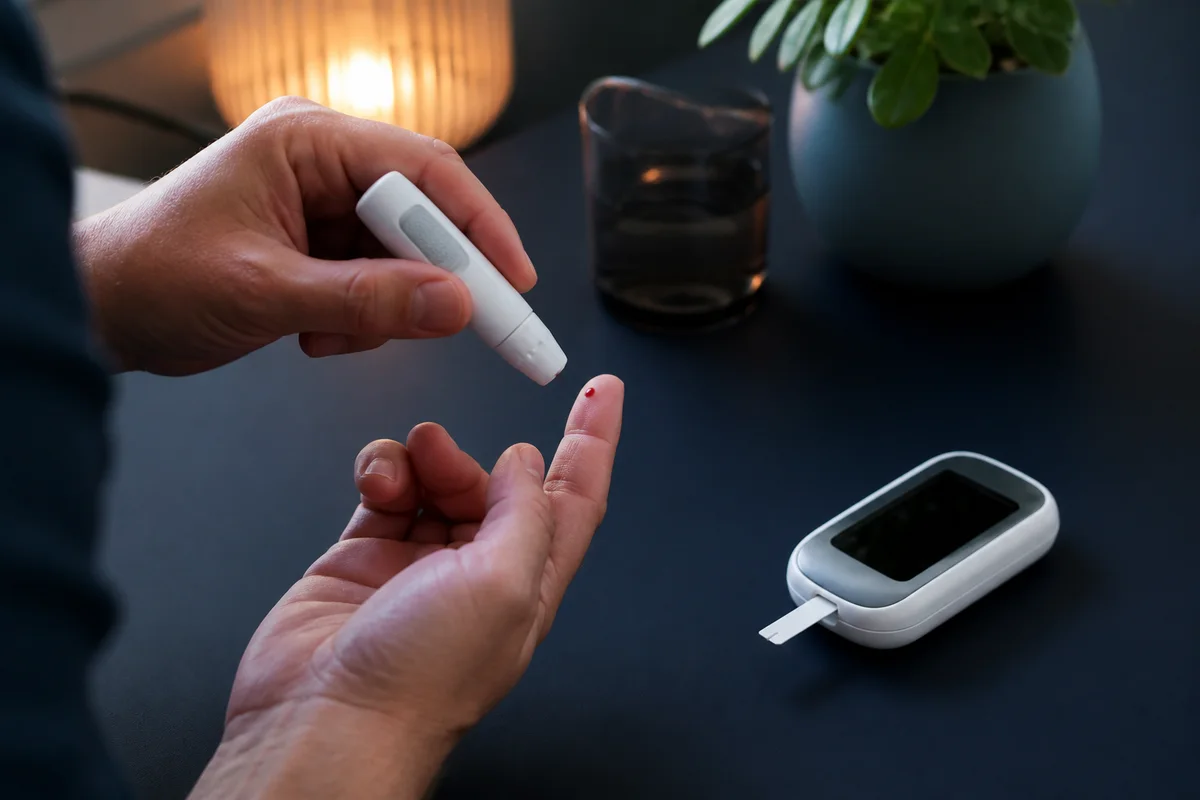
A meter is an electrochemical estimate from a tiny whole-blood sample. Its clinical value comes from acting early on a validated threshold and symptom pattern, not maximizing ketones as a performance score.See reference 5,See reference 6
A practical protocol
- Stage
- Prepare
- What to do
- Wash and fully dry hands; check strip, expiry and meter
- Why it matters
- Contamination and wrong strips create errorSee reference 1
- Stage
- Sample
- What to do
- Use a fresh lancet and free-flowing fingertip drop
- Why it matters
- Reduces tissue-fluid dilutionSee reference 2
- Stage
- Interpret
- What to do
- Use the personal sick-day or nutrition context
- Why it matters
- The same number can have different meaningsSee reference 3
- Stage
- Act
- What to do
- Repeat unexpected readings and follow urgent thresholds
- Why it matters
- Prevents delayed DKA careSee reference 4
Timing and frequency
- When
- Diabetes sick days
- Action
- Test with illness, vomiting, missed insulin, DKA symptoms or plan-defined high glucoseSee reference 5
- When
- SGLT2 inhibitor use
- Action
- Test if unwell even when glucose is not very high, according to clinical adviceSee reference 6
- When
- Nutrition tracking
- Action
- Use the same relation to meals, exercise and wakingSee reference 7
- When
- Unexpected result
- Action
- Repeat immediately with a new strip and act on symptomsSee reference 8
What to measure
- Signal
- BHB
- How
- mmol/L from capillary whole blood
- Interpretation
- Direct meter output; device range and bias matterSee reference 7
- Signal
- Glucose
- How
- Separate validated meter or CGM confirmation
- Interpretation
- Does not rule DKA in or out aloneSee reference 8
- Signal
- Symptoms
- How
- Nausea, vomiting, pain, deep breathing, dehydration, confusion
- Interpretation
- Can make a lower number urgentSee reference 9
- Signal
- Trend
- How
- Same meter over short intervals when instructed
- Interpretation
- Failure to fall can indicate escalationSee reference 10
What the evidence supports
Guidelines support blood BHB for DKA assessment, and blood testing responds faster to changing ketosis than urine acetoacetate.See reference 1,See reference 3
A randomized sick-day study in young people with type 1 diabetes found more frequent testing and fewer emergency or hospital assessments with blood versus urine ketone monitoring.See reference 2,See reference 4
For ketogenic diets, meters can show relative changes, but measurement agreement and the absence of outcome-based targets limit claims about an ideal nutritional level.See reference 5,See reference 6
Evidence strength by claim
- Claim
- Supports sick-day management and early DKA detection
- Confidence
- Strong when plan-directed
- Important boundary
- Not a substitute for symptoms or acid-base assessmentSee reference 1,See reference 2
- Claim
- Blood BHB is more clinically useful than urine ketones for DKA
- Confidence
- Moderate to strong
- Important boundary
- Device performance still mattersSee reference 3,See reference 4
- Claim
- A specific nutritional BHB target improves health
- Confidence
- Not established
- Important boundary
- No universal outcome-based optimumSee reference 5,See reference 6
- Claim
- Higher ketones mean greater longevity
- Confidence
- Not established
- Important boundary
- A biomarker is not proof of benefitSee reference 7,See reference 8,See reference 9,See reference 10
Limitations and common overclaims
Consumer meters have device-specific measuring ranges, hematocrit limits and bias; high BHB values can be particularly imprecise and should not be managed by repeatedly testing at home.See reference 3,See reference 7
Capillary values, venous whole blood, plasma BHB and total ketones are different measurements. Cutoffs and trends should not be transferred casually between methods.See reference 5,See reference 8
Food, fasting, alcohol, exercise, illness, hydration and medicines all change ketones. A nutrition experiment without standardized conditions produces noisy interpretation.See reference 9,See reference 10
How to make it stick
People at DKA risk should keep meter, compatible strips, glucose supplies, hydration plan and emergency contacts together and check expiry monthly.See reference 1,See reference 2
Write the action thresholds from the treating team on the kit. Do not rely on remembering internet ranges during illness.See reference 3,See reference 4
For optional nutrition tracking, limit testing to the smallest schedule that answers the question—often one consistent time on selected days.See reference 5,See reference 6
Troubleshooting
- Problem
- Error or no reading
- Likely issue
- Too little blood, wrong strip or temperature issue
- Better next step
- Repeat with a fresh compatible strip after checking instructionsSee reference 2,See reference 3
- Problem
- High reading without symptoms
- Likely issue
- True ketosis or meter error
- Better next step
- Repeat once, then follow the clinical plan rather than dismissing itSee reference 4,See reference 5
- Problem
- Symptoms with a low reading
- Likely issue
- Early DKA, another emergency or device limitation
- Better next step
- Seek clinical advice based on symptomsSee reference 6,See reference 7
- Problem
- Numbers vary during diet tracking
- Likely issue
- Timing, meals, exercise and capillary variation
- Better next step
- Standardize conditions and stop chasing precisionSee reference 8,See reference 9,See reference 10
Safety and when to stop
DKA can be life-threatening. Seek urgent medical care for vomiting, abdominal pain, deep or rapid breathing, severe dehydration, confusion, marked drowsiness, inability to keep fluids down, or ketones that remain high or rise despite following the sick-day plan. BHB at or above 3.0 mmol/L is a current DKA criterion in the appropriate context, but lower levels can be urgent with symptoms, pregnancy or SGLT2 inhibitor use. Never stop basal insulin or change insulin dosing without the agreed plan, and never use intentional insulin restriction to raise ketones.See reference 1,See reference 5,See reference 9
Who is most likely to benefit
Blood ketone meters are most important for people with type 1 diabetes, ketosis-prone diabetes or other clinician-identified DKA risk who have a sick-day action plan.See reference 2,See reference 4
They can be useful for people taking SGLT2 inhibitors when their clinician has explained euglycemic DKA risk and exactly when to test.See reference 5,See reference 7
Healthy people following a ketogenic diet do not need a meter for safety or success unless a specific supervised question justifies it.See reference 8,See reference 10
Track five things
- Reason and time for testing.See reference 1
- BHB value and meter model.See reference 2
- Glucose and relevant symptoms.See reference 3
- Illness, food, exercise and hydration context.See reference 4
- Action taken and response.See reference 5
Frequently asked questions
What is a normal blood ketone level?
Context matters. Low values are common with carbohydrate intake; nutritional ketosis often uses 0.5 mmol/L as an operational threshold, while DKA assessment uses symptoms and additional criteria.See reference 1
When should someone with diabetes test ketones?
During illness, vomiting, missed insulin, DKA symptoms or plan-defined persistent hyperglycemia, plus any special SGLT2 or pregnancy instructions.See reference 2
Is 3.0 mmol/L dangerous?
BHB at or above 3.0 mmol/L is a DKA diagnostic criterion in the relevant context and warrants urgent assessment rather than home optimization.See reference 3
Are blood ketones better than urine strips?
For DKA, blood BHB reflects the predominant circulating ketone and changes more promptly; urine strips measure acetoacetate and can lag.See reference 4
What time should I test nutritional ketosis?
Use a consistent relation to waking, meals and exercise. There is no universally superior time or target for health.See reference 5
Can dehydration raise ketone readings?
Dehydration can accompany ketosis and can also impair meter accuracy. Do not use dehydration to chase a number.See reference 6
Can I share a ketone meter?
The meter may be single-patient use, and lancing devices must never be shared. Follow the exact device labeling.See reference 7
Do higher ketones mean more fat loss?
No. BHB concentration reflects production and use; it is not a direct meter of body-fat loss.See reference 8
Connect the protocol to your wider health picture
LongevityMate helps organize measurements, habits, symptoms and trends so one tool stays in context instead of becoming the whole plan.
See how LongevityMate worksGet the weekly longevity brief
The week's best longevity research in plain English. Free, every Tuesday.
References
- 1. Hyperglycaemic Crises in Adults With Diabetes: Consensus Report
ADA, EASD, JBDS, AACE and Diabetes Technology SocietyGuideline
- 2. Guidelines for Laboratory Analysis in Diabetes Mellitus: Executive Summary
American Diabetes Association and AACCGuideline
- 3. Capillary hydroxybutyrate for diagnosis of diabetic ketoacidosis
Systematic reviewSystematic review
- 4. Sick day management using blood versus urine ketone monitoring
Diabetic MedicineRandomized trial
- 5. KET-1 Blood Ketone Monitoring System decision summary
U.S. Food and Drug AdministrationOfficial guidance
- 6. Capillary blood tests may overestimate nutritional ketosis
American Journal of PhysiologyObservational study
- 7. Accuracy of a point-of-care ketone test versus LC-MS/MS
Clinical Chemistry and Laboratory MedicineObservational study
- 8. Hospital and home use of a blood ketone meter
Diabetic MedicineObservational study
- 9. Analytical performance specifications for blood beta-hydroxybutyrate
Clinical Chemistry and Laboratory MedicineEvidence review
- 10. Using compatible test strips with home meters
U.S. Food and Drug AdministrationOfficial guidance
Editorial transparency
- Published by
- LongevityMate Editorial Team
- Published
- Updated
Medical disclaimer
This guide provides general health education. It does not diagnose a condition, prescribe treatment, replace individualized medical care, or guarantee a health or longevity outcome.