
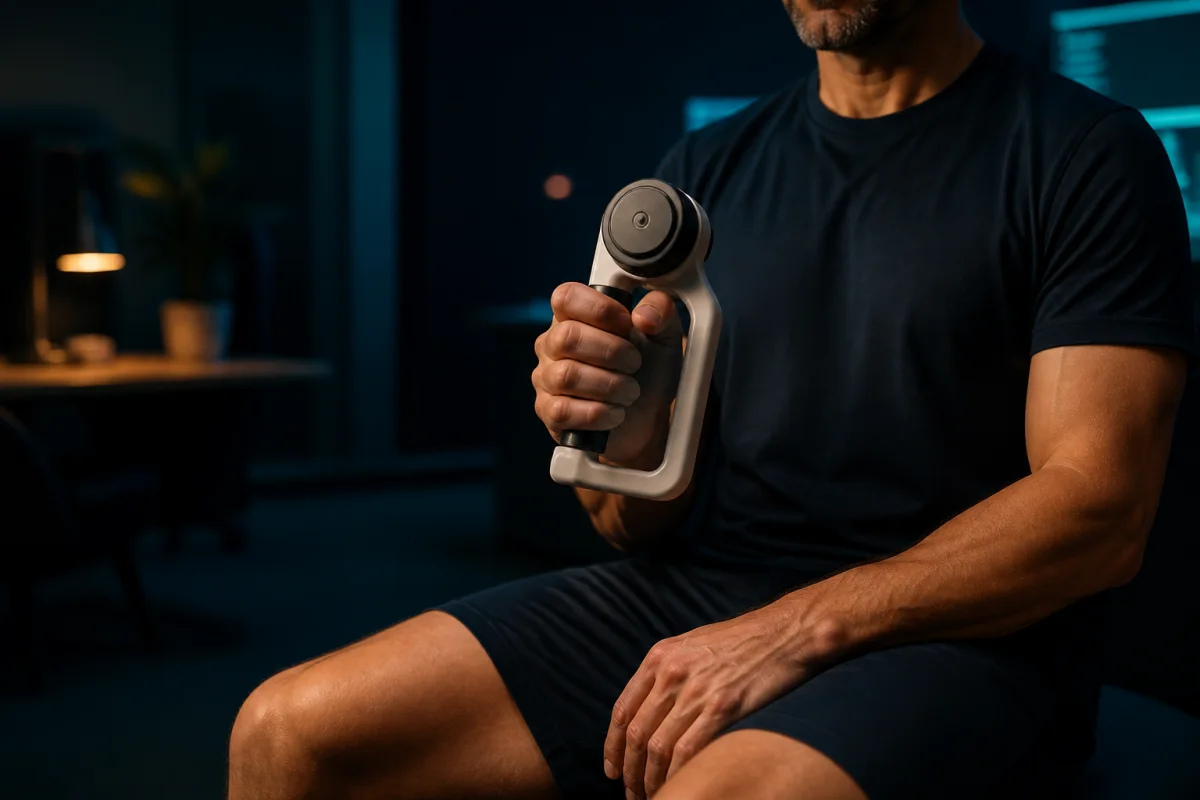
The 10 rules to remember
- Standardize device, handle and body position.See reference 1
- Test both hands.See reference 2
- Use multiple trials with rest.See reference 3
- Record pain and recent injury.See reference 4
- Compare with the same protocol over time.See reference 5
- Age and sex influence reference values.See reference 6
- Body size can influence absolute strength.See reference 7
- Association with mortality is not proof of causation.See reference 8
- Train the whole body, not only the hands.See reference 9
- Rapid unexplained decline needs evaluation.See reference 10
First principles: what this tool can actually change
A maximal grip recruits hand and forearm muscles but also reflects neural drive, pain, joint health and general muscle function.See reference 1,See reference 2
Because grip is simple to measure, large cohorts use it as a proxy for physical capability. Lower values predict adverse outcomes, but illness can reduce grip and create reverse causation.See reference 2,See reference 3
Improving grip alone does not necessarily reproduce the health association; whole-body strength, activity and underlying health remain the priority.See reference 3,See reference 4
A practical protocol
- Stage
- Setup
- What to do
- Same device and handle setting
- Why it matters
- Document postureSee reference 2
- Stage
- Trials
- What to do
- 2-3 per hand, 3-5 sec
- Why it matters
- 30-60 sec restSee reference 3
- Stage
- Score
- What to do
- Best value or protocol mean
- Why it matters
- Do not mix methodsSee reference 4
- Stage
- Retest
- What to do
- Every 1-3 months
- Why it matters
- Similar time and recoverySee reference 5
Timing and frequency
- When
- Before test
- Action
- Avoid exhaustive pulling or grip workSee reference 5
- When
- Warm-up
- Action
- One submaximal familiarization squeezeSee reference 6
- When
- Between trials
- Action
- Rest 30-60 secondsSee reference 7
- When
- Training block
- Action
- Retest after 6-12 weeksSee reference 8
What to measure
- Signal
- Absolute kg
- How
- Raw force
- Interpretation
- Common clinical measureSee reference 8
- Signal
- Dominant vs non-dominant
- How
- Side comparison
- Interpretation
- Large asymmetry needs contextSee reference 9
- Signal
- Age/sex percentile
- How
- Reference comparison
- Interpretation
- Population-specificSee reference 10
- Signal
- Trend
- How
- Change with same protocol
- Interpretation
- Most actionable personal signalSee reference 1
What the evidence supports
Grip testing is cheap, fast and reproducible when standardized, making it useful for tracking function and identifying possible weakness.See reference 1,See reference 4
Meta-analyses consistently associate lower grip strength with higher mortality and cardiovascular risk, but most evidence is observational.See reference 2,See reference 5
A low or falling score can prompt useful action: assess whole-body strength, protein and energy intake, pain, neurological symptoms and medical illness.See reference 3,See reference 6
Evidence strength by claim
- Claim
- The protocol changes its immediate target
- Confidence
- Moderate to strong
- Important boundary
- Depends on correct technique and populationSee reference 1,See reference 2
- Claim
- It improves a clinical or functional outcome
- Confidence
- Variable
- Important boundary
- Effect size and relevance differSee reference 3,See reference 4
- Claim
- It prevents major disease
- Confidence
- Usually limited
- Important boundary
- Surrogate outcomes are not clinical eventsSee reference 5,See reference 6
- Claim
- It extends human lifespan
- Confidence
- Not established
- Important boundary
- Association is not proof of causationSee reference 7,See reference 8,See reference 9,See reference 10
Limitations and common overclaims
Different dynamometers and postures produce different values, so internet norm tables may not match your method.See reference 5,See reference 7
Hand arthritis, tendon pain, nerve compression and recent training can lower the score without representing whole-body decline.See reference 6,See reference 8
There is no single grip target that guarantees longevity, and aggressive gripper training can irritate tendons.See reference 7,See reference 9
How to make it stick
Choose the smallest version you can repeat under normal conditions. Consistency creates a useful signal; a heroic one-off session does not.See reference 1,See reference 2
Change one variable at a time and write down the protocol. Otherwise an apparent improvement may simply reflect different timing, equipment or conditions.See reference 3,See reference 4
Review the result after a pre-defined period. Continue only when the benefit is meaningful, the burden is acceptable and no safety signal has appeared.See reference 5,See reference 6
Troubleshooting
- Problem
- Results vary widely
- Likely issue
- Technique or conditions changed
- Better next step
- Standardize and average repeated observationsSee reference 2,See reference 3
- Problem
- No meaningful benefit
- Likely issue
- Dose, adherence or target may be wrong
- Better next step
- Verify the protocol before escalatingSee reference 4,See reference 5
- Problem
- Symptoms appear
- Likely issue
- The intervention may be unsuitable
- Better next step
- Stop and use appropriate clinical adviceSee reference 6,See reference 7
- Problem
- Tracking creates anxiety
- Likely issue
- Measurement has replaced the goal
- Better next step
- Reduce frequency and focus on functionSee reference 8,See reference 9,See reference 10
Safety and when to stop
Do not perform maximal squeezing through acute hand, wrist, elbow or shoulder pain, recent surgery or an unstable injury. Seek assessment for sudden weakness, numbness, loss of dexterity, major side-to-side change or rapidly declining strength. Exhale during effort rather than prolonged breath-holding, especially with uncontrolled blood pressure.See reference 1,See reference 5,See reference 9
Who is most likely to benefit
This tool is most useful when it solves a defined problem, is feasible to repeat and changes a decision. It is less useful when collected or performed only because a score or influencer made it seem mandatory.See reference 2,See reference 4
People with symptoms, diagnosed disease, pregnancy, recent surgery or complex medicines should adapt the protocol with an appropriate health professional.See reference 5,See reference 7
The foundation remains sleep, physical activity, nutrition, tobacco avoidance and evidence-based medical care. Add this tool only where it improves that foundation.See reference 8,See reference 10
Track five things
- The exact protocol, equipment and timing.See reference 1
- The outcome the tool is meant to change.See reference 2
- Symptoms and adverse effects.See reference 3
- Adherence and practical burden.See reference 4
- Whether the result changes a real decision.See reference 5
Frequently asked questions
What is normal grip strength?
It varies by age, sex, body size, device and protocol; use matched reference data.See reference 3
Which hand should I test?
Both, using the same order and method each time.See reference 4
How many attempts?
Two or three maximal trials per hand with adequate rest.See reference 5
Does grip predict lifespan?
It is associated with outcomes in cohorts but cannot predict an individual's lifespan.See reference 6
How often should I retest?
Every one to three months is usually enough for trend tracking.See reference 7
How do I improve grip?
Use progressive carries, pulling, holds and hand work while training the whole body.See reference 8
Are cheap dynamometers accurate?
Quality varies; consistency matters, but clinical comparison needs a validated device.See reference 9
What does a sudden drop mean?
Fatigue or pain can cause it, but persistent or neurological change needs evaluation.See reference 10
Connect the protocol to your wider health picture
LongevityMate helps organize measurements, habits, symptoms and trends so one tool stays in context instead of becoming the whole plan.
See how LongevityMate worksGet the weekly longevity brief
The week's best longevity research in plain English. Free, every Tuesday.
References
- 1. Thresholds of handgrip strength for mortality
Ageing Research ReviewsMeta-analysis
- 2. Grip strength and mortality, cardiovascular disease and cancer
Journal of the American Medical Directors AssociationMeta-analysis
- 3. Muscular strength and all-cause mortality
Archives of Physical Medicine and RehabilitationMeta-analysis
- 4. Objective physical capability and mortality
BMJMeta-analysis
- 5. EWGSOP2 sarcopenia consensus
Age and AgeingGuideline
- 6. Handgrip strength measurement protocols
BMC GeriatricsSystematic review
- 7. Normative data for hand grip strength
PLOS ONEObservational study
- 8. Resistance exercise for health
American College of Sports MedicineGuideline
- 9. Muscle-strengthening activity and mortality
British Journal of Sports MedicineMeta-analysis
- 10. WHO guidelines on physical activity and sedentary behaviour
World Health OrganizationGuideline
Editorial transparency
- Published by
- LongevityMate Editorial Team
- Published
- Updated
Medical disclaimer
This guide provides general health education. It does not diagnose a condition, prescribe treatment, replace individualized medical or dental care, or guarantee a health or longevity outcome.